 Add to Chrome
 Add to Firefox
 Add to Edge
Spoken Language Identification with Pre-trained Models and Margin Loss
May 03, 2026
For the speaker-controlled spoken language identification task proposed in the TidyLang Challenge 2026, this paper proposes a language identification method based on pre-trained models and margin-based losses. The proposed method adopts a pre-trained ECAPA-TDNN as the feature encoder and incorporates margin-based losses to enhance the discriminative ability of language representations, thereby improving inter-class separability and reducing the interference of non-linguistic factors such as speaker characteristics. Experimental results on the Tidy-X dataset show that the proposed method achieves 85.95% macro accuracy and 90.96% micro accuracy on the language identification task and 17.08% equal error rate (EER) on the verification task. Compared with the official baseline, the macro accuracy improves by 45.7%, the micro accuracy improves by 15.2%, and the EER is reduced by approximately 50.8%, demonstrating the effectiveness of the proposed method. The code will be released at https://github.com/PunkMale/TidyLang2026.

Hyperbolic Additive Margin Softmax with Hierarchical Information for Speaker Verification
Jan 27, 2026Speaker embedding learning based on Euclidean space has achieved significant progress, but it is still insufficient in modeling hierarchical information within speaker features. Hyperbolic space, with its negative curvature geometric properties, can efficiently represent hierarchical information within a finite volume, making it more suitable for the feature distribution of speaker embeddings. In this paper, we propose Hyperbolic Softmax (H-Softmax) and Hyperbolic Additive Margin Softmax (HAM-Softmax) based on hyperbolic space. H-Softmax incorporates hierarchical information into speaker embeddings by projecting embeddings and speaker centers into hyperbolic space and computing hyperbolic distances. HAM-Softmax further enhances inter-class separability by introducing margin constraint on this basis. Experimental results show that H-Softmax and HAM-Softmax achieve average relative EER reductions of 27.84% and 14.23% compared with standard Softmax and AM-Softmax, respectively, demonstrating that the proposed methods effectively improve speaker verification performance and at the same time preserve the capability of hierarchical structure modeling. The code will be released at https://github.com/PunkMale/HAM-Softmax.
Noise Supervised Contrastive Learning and Feature-Perturbed for Anomalous Sound Detection
Sep 18, 2025Unsupervised anomalous sound detection aims to detect unknown anomalous sounds by training a model using only normal audio data. Despite advancements in self-supervised methods, the issue of frequent false alarms when handling samples of the same type from different machines remains unresolved. This paper introduces a novel training technique called one-stage supervised contrastive learning (OS-SCL), which significantly addresses this problem by perturbing features in the embedding space and employing a one-stage noisy supervised contrastive learning approach. On the DCASE 2020 Challenge Task 2, it achieved 94.64\% AUC, 88.42\% pAUC, and 89.24\% mAUC using only Log-Mel features. Additionally, a time-frequency feature named TFgram is proposed, which is extracted from raw audio. This feature effectively captures critical information for anomalous sound detection, ultimately achieving 95.71\% AUC, 90.23\% pAUC, and 91.23\% mAUC. The source code is available at: \underline{www.github.com/huangswt/OS-SCL}.
OR-Gate: A Noisy Label Filtering Method for Speaker Verification
Nov 22, 2022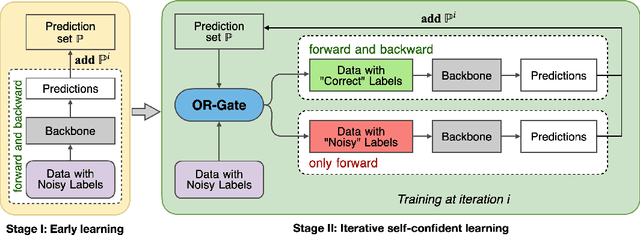
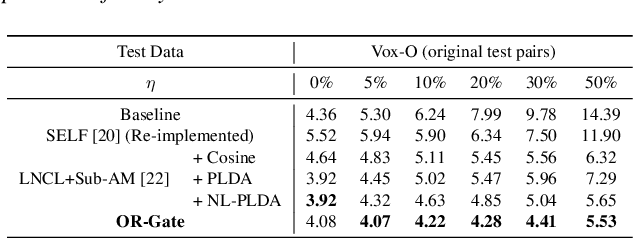
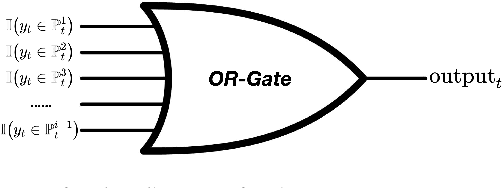

The deep learning models used for speaker verification are heavily dependent on large-scale data and correct labels. However, noisy (wrong) labels often occur, which deteriorates the system's performance. Unfortunately, there are relatively few studies in this area. In this paper, we propose a method to gradually filter noisy labels out at the training stage. We compare the network predictions at different training epochs with ground-truth labels, and select reliable (considered correct) labels by using the OR gate mechanism like that in logic circuits. Therefore, our proposed method is named as OR-Gate. We experimentally demonstrated that the OR-Gate can effectively filter noisy labels out and has excellent performance.