 Add to Chrome
 Add to Firefox
 Add to Edge
ActiveScope: Actively Seeking and Correcting Perception for MLLMs
Jun 23, 2026
Multimodal Large Language Models (MLLMs) have demonstrated impressive vision-language understanding, yet still struggle with fine-grained perception in high-resolution images. While existing training-free methods typically rely on attention-based localization or coarse-to-fine search, they are often misled by distractors and fail to locate multiple targets. Our investigation attributes these failures to Contextual Dominance, where salient distractors overwhelm target attention and cause inaccurate localization, and Semantic Bias, where global semantics cause the model to fixate on the most salient concept, resulting in incomplete localization in multi-object scenarios. Built on these insights, we propose ActiveScope, a training-free framework that enhances MLLMs by actively seeking and correcting perception. ActiveScope features two modules. The Semantic Anchor Localization (SAL) utilizes fine-grained semantic anchors to independently localize key targets, thereby mitigating semantic bias. The Interference-Suppressed Refinement (ISR) refines localization by suppressing attention on salient distractions to overcome contextual dominance. Extensive experiments on high-resolution image understanding benchmarks demonstrate that ActiveScope outperforms existing training-free methods (e.g., 96.34 percent accuracy on $V^{*}$ Bench), validating the superiority of the active search and self-correction paradigm. Our code is available at https://github.com/jasmine-ww/ActiveScope.

Adaptive Recurrent Message Passing for Test Time Computing on Graphs
Jun 21, 2026Pre-trained foundation models have demonstrated remarkable success in many domains, enabling a unified backbone to generalize across diverse downstream tasks. However, extending this paradigm to graph learning remains challenging due to the intrinsic mismatch between graph data and fixed architectural designs. In this work, we show that this limitation can be overcome via recurrent graph models. To achieve this, we conduct a systematic theoretical analysis, rigorously deriving step dependence as a necessary and sufficient condition for an adaptively convergent recurrent process. Building on this foundation, we propose AdaR, an Adaptive Recurrent graph model, empowering flexible test-time computing on various downstream tasks without changing model parameters. To enable adaptive inference, AdaR explicitly encodes normalized step information and representation-target relations into the recurrent updates. To ensure convergence of the recurrent process, AdaR employs gradient-based supervision signals that guide representation updates throughout the recurrence. Empirical results demonstrate that AdaR consistently outperforms strong baselines in both inductive and transductive settings.
Enhancing LLMs for Graph Tasks via Graph-aware LoRA Generation
Jun 21, 2026Graph neural networks (GNNs) tightly couple their input-output parameters to dataset-specific feature spaces and target sets, exhibiting limited transferability across different datasets. In contrast, language models (LMs) generalize flexibly via a unified input-output interface, motivating recent attempts to adapt LMs to graph tasks. However, existing methods struggle to encode whole-graph information, leading to potential information loss and suboptimal graph understanding. In this work, we propose a novel weight-level information injection paradigm for adapting LMs to graph tasks. This paradigm injects whole-graph information by generating task-specific weight updates that interact directly with hidden representations. Instantiating this paradigm following low-rank adaptation (LoRA), we introduce GaRA, a Graph-aware LoRA generation model. GaRA constructs low-rank weight updates conditioned on the original graph structures and constrains the norm of the generated updates, thus injecting whole-graph information and avoiding the optimization bias in the weight generation. Empirical studies demonstrate that GaRA consistently outperforms baselines on zero-shot graph learning tasks.
Expanding Sparse Tuning for Low Memory Usage
Nov 04, 2024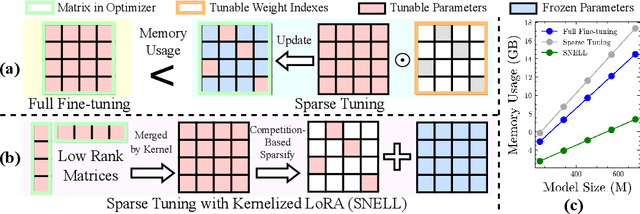

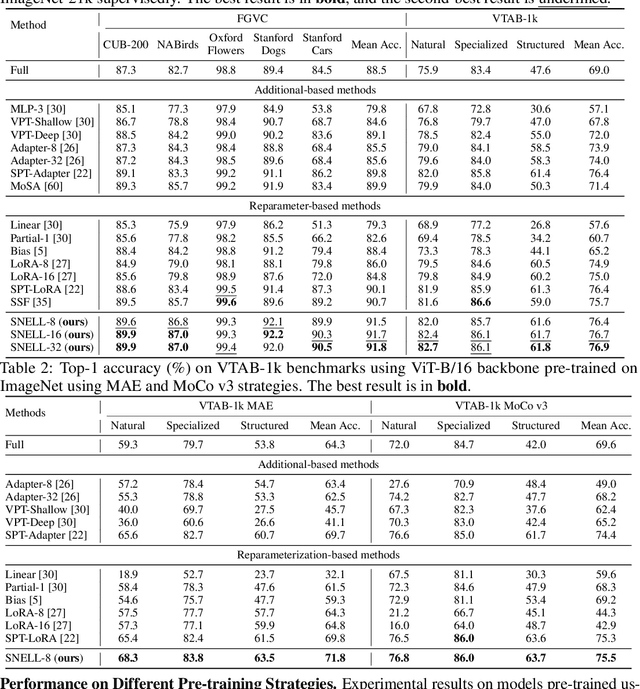
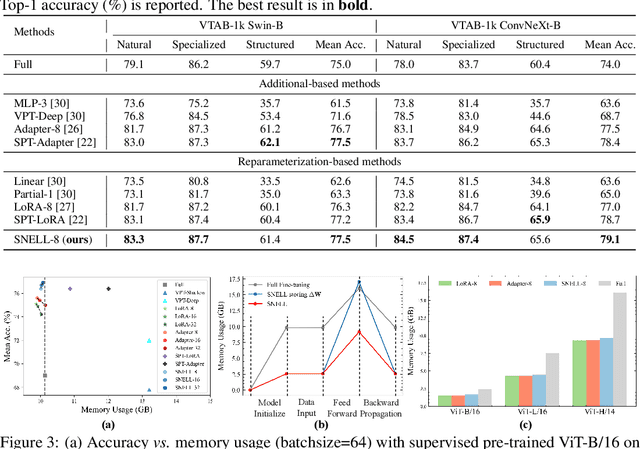
Parameter-efficient fine-tuning (PEFT) is an effective method for adapting pre-trained vision models to downstream tasks by tuning a small subset of parameters. Among PEFT methods, sparse tuning achieves superior performance by only adjusting the weights most relevant to downstream tasks, rather than densely tuning the whole weight matrix. However, this performance improvement has been accompanied by increases in memory usage, which stems from two factors, i.e., the storage of the whole weight matrix as learnable parameters in the optimizer and the additional storage of tunable weight indexes. In this paper, we propose a method named SNELL (Sparse tuning with kerNELized LoRA) for sparse tuning with low memory usage. To achieve low memory usage, SNELL decomposes the tunable matrix for sparsification into two learnable low-rank matrices, saving from the costly storage of the whole original matrix. A competition-based sparsification mechanism is further proposed to avoid the storage of tunable weight indexes. To maintain the effectiveness of sparse tuning with low-rank matrices, we extend the low-rank decomposition by applying nonlinear kernel functions to the whole-matrix merging. Consequently, we gain an increase in the rank of the merged matrix, enhancing the ability of SNELL in adapting the pre-trained models to downstream tasks. Extensive experiments on multiple downstream tasks show that SNELL achieves state-of-the-art performance with low memory usage, endowing PEFT with sparse tuning to large-scale models. Codes are available at https://github.com/ssfgunner/SNELL.
Towards Dynamic Message Passing on Graphs
Oct 31, 2024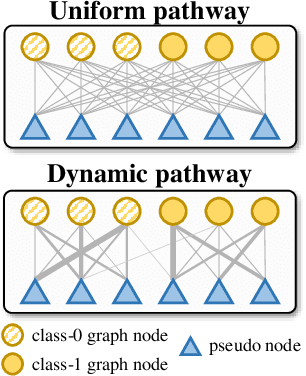
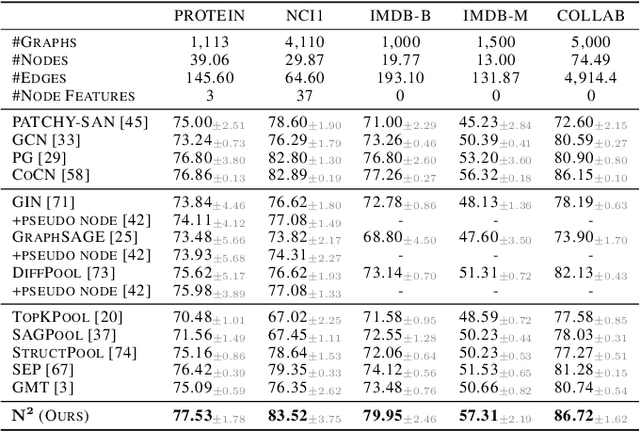
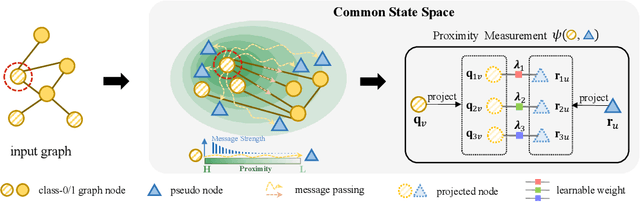
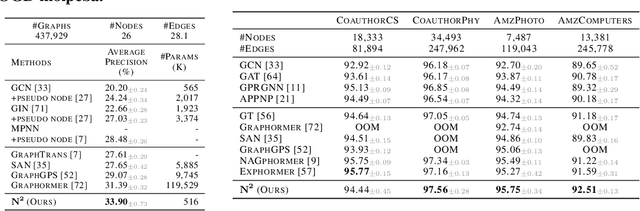
Message passing plays a vital role in graph neural networks (GNNs) for effective feature learning. However, the over-reliance on input topology diminishes the efficacy of message passing and restricts the ability of GNNs. Despite efforts to mitigate the reliance, existing study encounters message-passing bottlenecks or high computational expense problems, which invokes the demands for flexible message passing with low complexity. In this paper, we propose a novel dynamic message-passing mechanism for GNNs. It projects graph nodes and learnable pseudo nodes into a common space with measurable spatial relations between them. With nodes moving in the space, their evolving relations facilitate flexible pathway construction for a dynamic message-passing process. Associating pseudo nodes to input graphs with their measured relations, graph nodes can communicate with each other intermediately through pseudo nodes under linear complexity. We further develop a GNN model named $\mathtt{\mathbf{N^2}}$ based on our dynamic message-passing mechanism. $\mathtt{\mathbf{N^2}}$ employs a single recurrent layer to recursively generate the displacements of nodes and construct optimal dynamic pathways. Evaluation on eighteen benchmarks demonstrates the superior performance of $\mathtt{\mathbf{N^2}}$ over popular GNNs. $\mathtt{\mathbf{N^2}}$ successfully scales to large-scale benchmarks and requires significantly fewer parameters for graph classification with the shared recurrent layer.
Scalable Graph Compressed Convolutions
Jul 26, 2024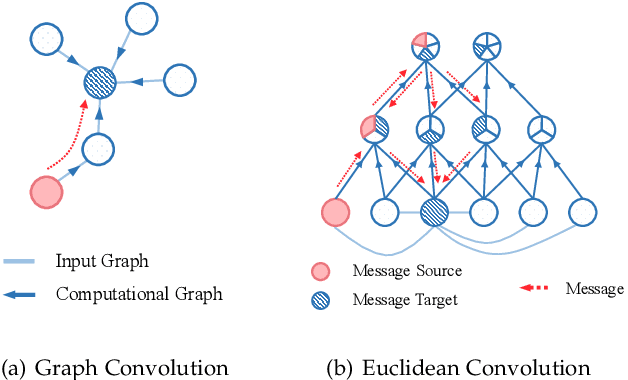

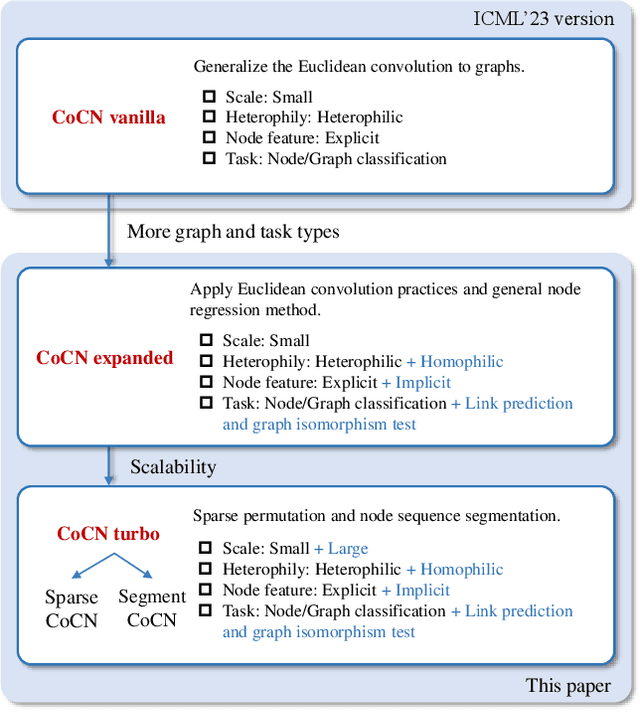
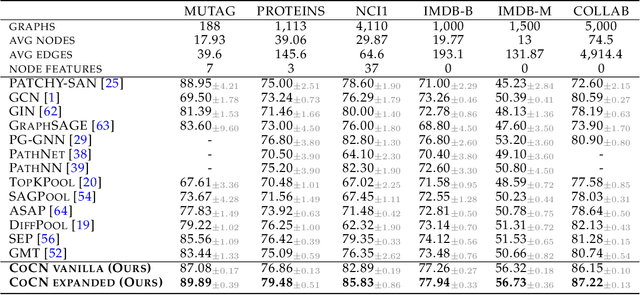
Designing effective graph neural networks (GNNs) with message passing has two fundamental challenges, i.e., determining optimal message-passing pathways and designing local aggregators. Previous methods of designing optimal pathways are limited with information loss on the input features. On the other hand, existing local aggregators generally fail to extract multi-scale features and approximate diverse operators under limited parameter scales. In contrast to these methods, Euclidean convolution has been proven as an expressive aggregator, making it a perfect candidate for GNN construction. However, the challenges of generalizing Euclidean convolution to graphs arise from the irregular structure of graphs. To bridge the gap between Euclidean space and graph topology, we propose a differentiable method that applies permutations to calibrate input graphs for Euclidean convolution. The permutations constrain all nodes in a row regardless of their input order and therefore enable the flexible generalization of Euclidean convolution to graphs. Based on the graph calibration, we propose the Compressed Convolution Network (CoCN) for hierarchical graph representation learning. CoCN follows local feature-learning and global parameter-sharing mechanisms of convolution neural networks. The whole model can be trained end-to-end, with compressed convolution applied to learn individual node features and their corresponding structure features. CoCN can further borrow successful practices from Euclidean convolution, including residual connection and inception mechanism. We validate CoCN on both node-level and graph-level benchmarks. CoCN achieves superior performance over competitive GNN baselines. Codes are available at https://github.com/sunjss/CoCN.