 Add to Chrome
 Add to Firefox
 Add to Edge
Theoretical Analysis of Diffusion Models for Radio Map Estimation with Ultra-low Sampling Rates
Jun 24, 2026
Radio maps, which characterize the spatial distribution of radio frequency metrics such as received signal strength, are essential for a wide range of wireless applications. The problem of radio map estimation involves constructing a radio map from sparse sensor measurements at multiple locations. This problem is particularly challenging due to ultra-low sampling rates, where available sensor measurements are far fewer than the high resolution requirement of radio maps to be estimated. Recently, diffusion models have been increasingly adopted for this problem, yet its theoretical performance remains unexamined. This paper bridges this gap by formulating radio map estimation as a non-linear matrix completion problem. Based on this formulation, we first derive a theoretical lower bound on the minimum estimation error achievable by diffusion models, which is fundamentally governed by the discrepancy between the deployment distribution and the true underlying radio propagation law. We then extend this bound to incorporate the effect of sampling sparsity, capturing the additional error introduced by ultra-low sampling rates. Furthermore, we establish a critical sampling rate threshold necessary for diffusion models to achieve performance convergence. Finally, considering that the derived error bounds depend on certain information that is difficult to obtain in practice, we propose empirical approximations that are readily computable from observable data. Extensive simulations based on real-world traces demonstrate that these empirical formulas tightly approximate the theoretical error bounds, validating their effectiveness for practical deployment.

Bridging the Sampling Distribution Shift in Radio Map Estimation: A Trajectory-Aware Paradigm
May 27, 2026Learning-based radio map estimation (RME) plays a critical role in UAV-assisted wireless sensing, enabling tasks such as coverage prediction and network optimization. Most current methods assume an independently and identically distributed (i.i.d.) training and testing setting based on random sampling. However, practical UAV measurements are collected sequentially along feasible trajectories, resulting in highly structured and spatially correlated patterns. This mismatch introduces a sampling distribution shift that increases the intrinsic difficulty of spatial field recovery and compromises the generalization of models trained under i.i.d. assumptions. To mitigate this issue, we propose a trajectory-aware training paradigm based on Stochastic-Triggered Trajectory-Based Sampling (ST-TBS), which preserves trajectory continuity while introducing sampling variability. Moreover, from a statistical perspective, we show that trajectory-based sampling reduces spatial diversity and increases information redundancy compared to random sampling. Extensive experiments on the RadioMapSeer and SpectrumNet datasets demonstrate that models trained with random sampling suffer significant performance degradation under trajectory-based observations, with RMSE increasing from 0.0391 to 0.2632 on SpectrumNet. Conversely, our proposed ST-TBS method effectively reduces the RMSE to 0.0571. These results highlight the necessity of aligning training and deployment sampling distributions for reliable RME.
WiFi-Diffusion: Achieving Fine-Grained WiFi Radio Map Estimation With Ultra-Low Sampling Rate by Diffusion Models
Mar 15, 2025Fine-grained radio map presents communication parameters of interest, e.g., received signal strength, at every point across a large geographical region. It can be leveraged to improve the efficiency of spectrum utilization for a large area, particularly critical for the unlicensed WiFi spectrum. The problem of fine-grained radio map estimation is to utilize radio samples collected by sparsely distributed sensors to infer the map. This problem is challenging due to the ultra-low sampling rate, where the number of available samples is far less than the fine-grained resolution required for radio map estimation. We propose WiFi-Diffusion -- a novel generative framework for achieving fine-grained WiFi radio map estimation using diffusion models. WiFi-Diffusion employs the creative power of generative AI to address the ultra-low sampling rate challenge and consists of three blocks: 1) a boost block, using prior information such as the layout of obstacles to optimize the diffusion model; 2) a generation block, leveraging the diffusion model to generate a candidate set of radio maps; and 3) an election block, utilizing the radio propagation model as a guide to find the best radio map from the candidate set. Extensive simulations demonstrate that 1) the fine-grained radio map generated by WiFi-Diffusion is ten times better than those produced by state-of-the-art (SOTA) when they use the same ultra-low sampling rate; and 2) WiFi-Diffusion achieves comparable fine-grained radio map quality with only one-fifth of the sampling rate required by SOTA.
RoCoSDF: Row-Column Scanned Neural Signed Distance Fields for Freehand 3D Ultrasound Imaging Shape Reconstruction
Aug 14, 2024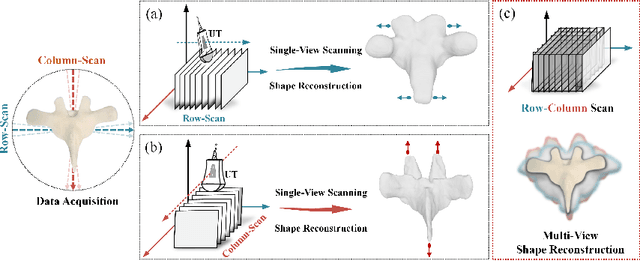
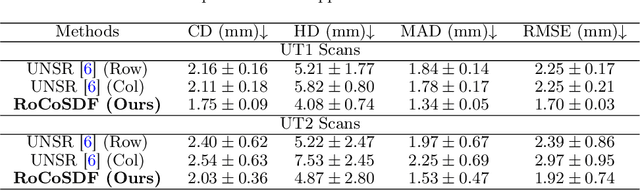
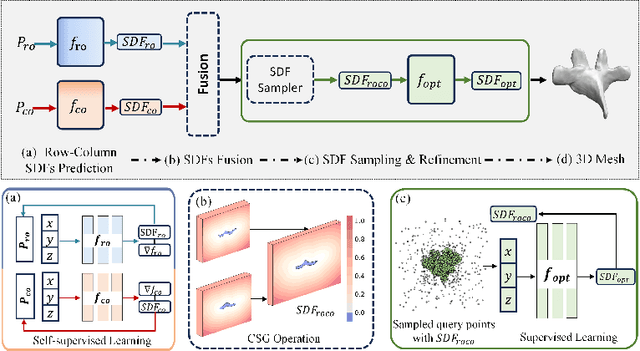
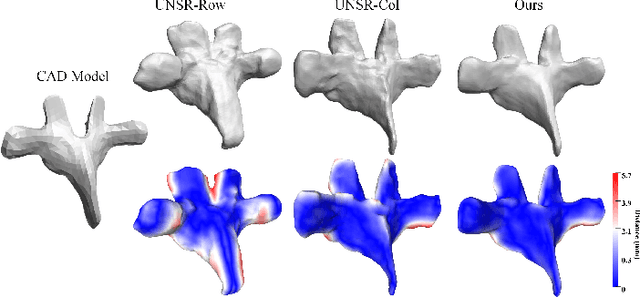
The reconstruction of high-quality shape geometry is crucial for developing freehand 3D ultrasound imaging. However, the shape reconstruction of multi-view ultrasound data remains challenging due to the elevation distortion caused by thick transducer probes. In this paper, we present a novel learning-based framework RoCoSDF, which can effectively generate an implicit surface through continuous shape representations derived from row-column scanned datasets. In RoCoSDF, we encode the datasets from different views into the corresponding neural signed distance function (SDF) and then operate all SDFs in a normalized 3D space to restore the actual surface contour. Without requiring pre-training on large-scale ground truth shapes, our approach can synthesize a smooth and continuous signed distance field from multi-view SDFs to implicitly represent the actual geometry. Furthermore, two regularizers are introduced to facilitate shape refinement by constraining the SDF near the surface. The experiments on twelve shapes data acquired by two ultrasound transducer probes validate that RoCoSDF can effectively reconstruct accurate geometric shapes from multi-view ultrasound data, which outperforms current reconstruction methods. Code is available at https://github.com/chenhbo/RoCoSDF.
Large Models for Aerial Edges: An Edge-Cloud Model Evolution and Communication Paradigm
Aug 09, 2024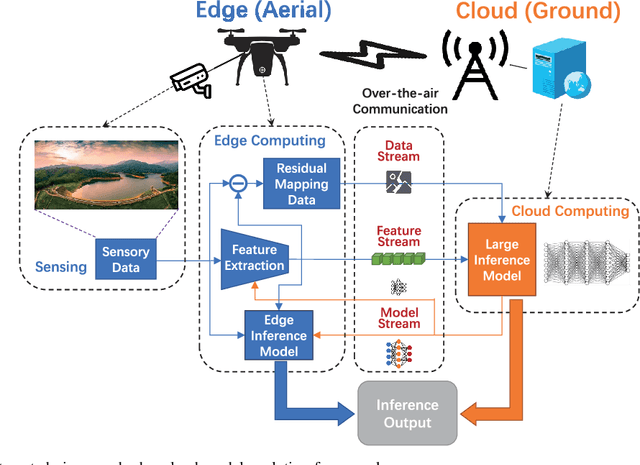
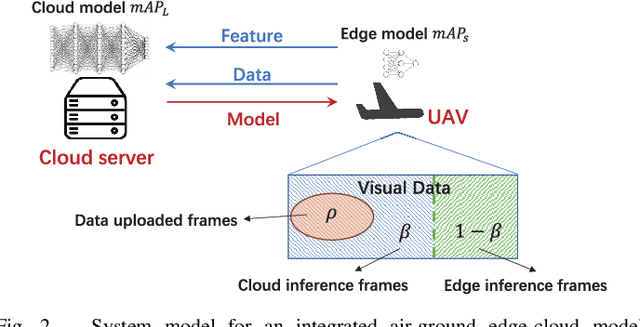
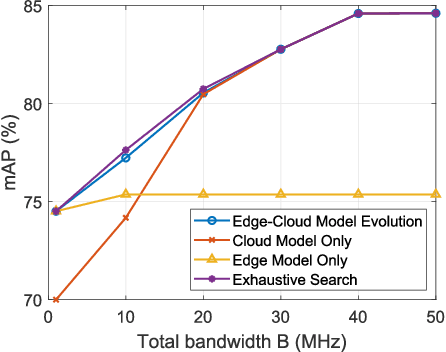
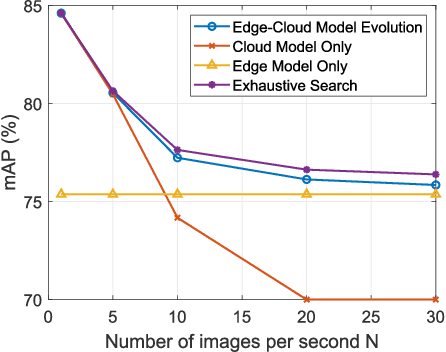
The future sixth-generation (6G) of wireless networks is expected to surpass its predecessors by offering ubiquitous coverage through integrated air-ground facility deployments in both communication and computing domains. In this network, aerial facilities, such as unmanned aerial vehicles (UAVs), conduct artificial intelligence (AI) computations based on multi-modal data to support diverse applications including surveillance and environment construction. However, these multi-domain inference and content generation tasks require large AI models, demanding powerful computing capabilities, thus posing significant challenges for UAVs. To tackle this problem, we propose an integrated edge-cloud model evolution framework, where UAVs serve as edge nodes for data collection and edge model computation. Through wireless channels, UAVs collaborate with ground cloud servers, providing cloud model computation and model updating for edge UAVs. With limited wireless communication bandwidth, the proposed framework faces the challenge of information exchange scheduling between the edge UAVs and the cloud server. To tackle this, we present joint task allocation, transmission resource allocation, transmission data quantization design, and edge model update design to enhance the inference accuracy of the integrated air-ground edge-cloud model evolution framework by mean average precision (mAP) maximization. A closed-form lower bound on the mAP of the proposed framework is derived, and the solution to the mAP maximization problem is optimized accordingly. Simulations, based on results from vision-based classification experiments, consistently demonstrate that the mAP of the proposed framework outperforms both a centralized cloud model framework and a distributed edge model framework across various communication bandwidths and data sizes.
Design and manufacture of edible microfluidic logic gates
Apr 05, 2023
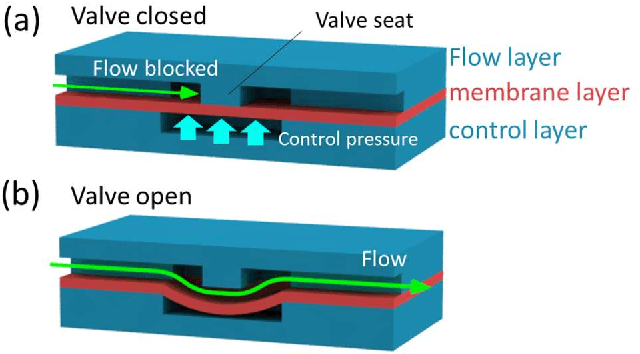
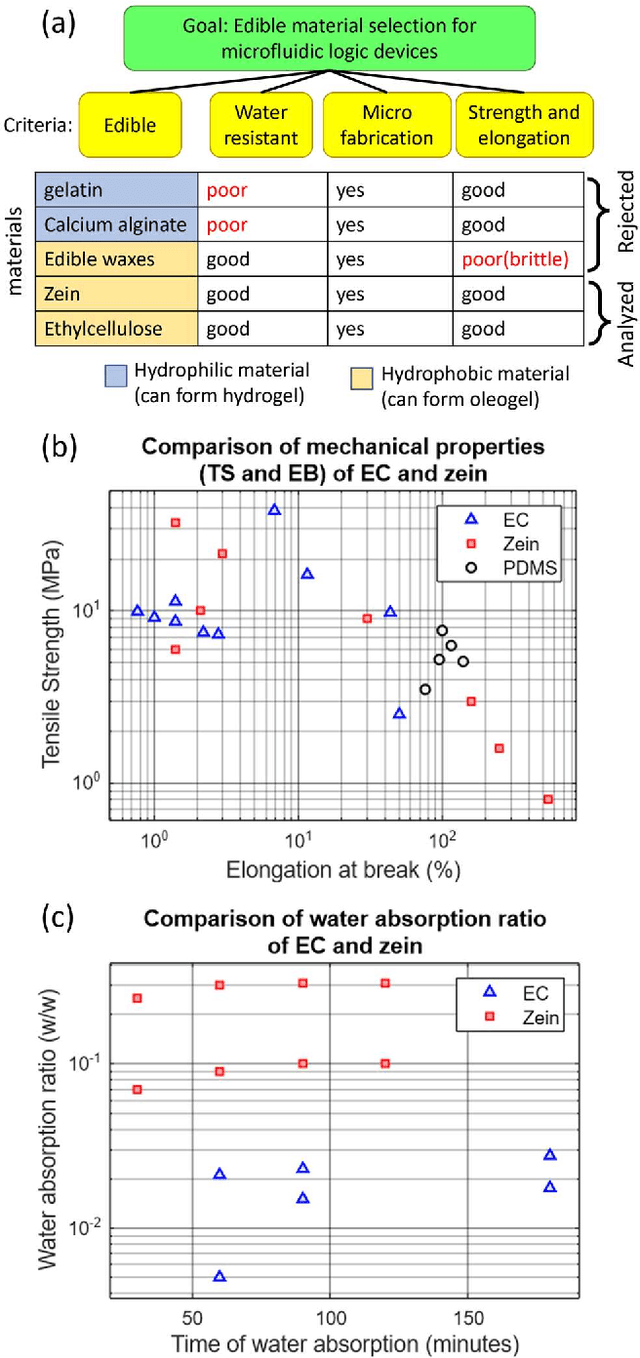
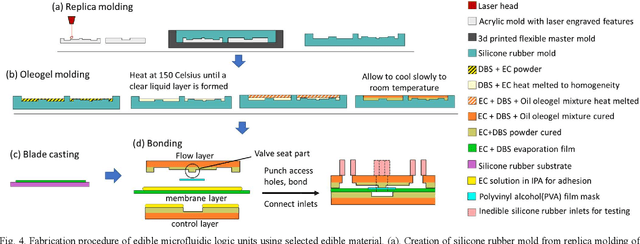
Edible robotics is an emerging research field with potential use in environmental, food, and medical scenarios. In this context, the design of edible control circuits could increase the behavioral complexity of edible robots and reduce their dependence on inedible components. Here we describe a method to design and manufacture edible control circuits based on microfluidic logic gates. We focus on the choice of materials and fabrication procedure to produce edible logic gates based on recently available soft microfluidic logic. We validate the proposed design with the production of a functional NOT gate and suggest further research avenues for scaling up the method to more complex circuits.