 Add to Chrome
 Add to Firefox
 Add to Edge
ProtoFlow: Mitigating Forgetting in Class-Incremental Remote Sensing Segmentation via Low-Curvature Prototype Flow
Apr 03, 2026
Remote sensing segmentation in real deployment is inherently continual: new semantic categories emerge, and acquisition conditions shift across seasons, cities, and sensors. Despite recent progress, many incremental approaches still treat training steps as isolated updates, which leaves representation drift and forgetting insufficiently controlled. We present ProtoFlow, a time-aware prototype dynamics framework that models class prototypes as trajectories and learns their evolution with an explicit temporal vector field. By jointly enforcing low-curvature motion and inter-class separation, ProtoFlow stabilizes prototype geometry throughout incremental learning. Experiments on standard class- and domain-incremental remote sensing benchmarks show consistent gains over strong baselines, including up to 1.5-2.0 points improvement in mIoUall, together with reduced forgetting. These results suggest that explicitly modeling temporal prototype evolution is a practical and interpretable strategy for robust continual remote sensing segmentation.

SwiftGS: Episodic Priors for Immediate Satellite Surface Recovery
Mar 19, 2026Rapid, large-scale 3D reconstruction from multi-date satellite imagery is vital for environmental monitoring, urban planning, and disaster response, yet remains difficult due to illumination changes, sensor heterogeneity, and the cost of per-scene optimization. We introduce SwiftGS, a meta-learned system that reconstructs 3D surfaces in a single forward pass by predicting geometry-radiation-decoupled Gaussian primitives together with a lightweight SDF, replacing expensive per-scene fitting with episodic training that captures transferable priors. The model couples a differentiable physics graph for projection, illumination, and sensor response with spatial gating that blends sparse Gaussian detail and global SDF structure, and incorporates semantic-geometric fusion, conditional lightweight task heads, and multi-view supervision from a frozen geometric teacher under an uncertainty-aware multi-task loss. At inference, SwiftGS operates zero-shot with optional compact calibration and achieves accurate DSM reconstruction and view-consistent rendering at significantly reduced computational cost, with ablations highlighting the benefits of the hybrid representation, physics-aware rendering, and episodic meta-training.
Hybrid Fuzzing with LLM-Guided Input Mutation and Semantic Feedback
Nov 06, 2025Software fuzzing has become a cornerstone in automated vulnerability discovery, yet existing mutation strategies often lack semantic awareness, leading to redundant test cases and slow exploration of deep program states. In this work, I present a hybrid fuzzing framework that integrates static and dynamic analysis with Large Language Model (LLM)-guided input mutation and semantic feedback. Static analysis extracts control-flow and data-flow information, which is transformed into structured prompts for the LLM to generate syntactically valid and semantically diverse inputs. During execution, I augment traditional coverage-based feedback with semantic feedback signals-derived from program state changes, exception types, and output semantics-allowing the fuzzer to prioritize inputs that trigger novel program behaviors beyond mere code coverage. I implement our approach atop AFL++, combining program instrumentation with embedding-based semantic similarity metrics to guide seed selection. Evaluation on real-world open-source targets, including libpng, tcpdump, and sqlite, demonstrates that our method achieves faster time-to-first-bug, higher semantic diversity, and a competitive number of unique bugs compared to state-of-the-art fuzzers. This work highlights the potential of combining LLM reasoning with semantic-aware feedback to accelerate and deepen vulnerability discovery.
Abductive Inference in Retrieval-Augmented Language Models: Generating and Validating Missing Premises
Nov 06, 2025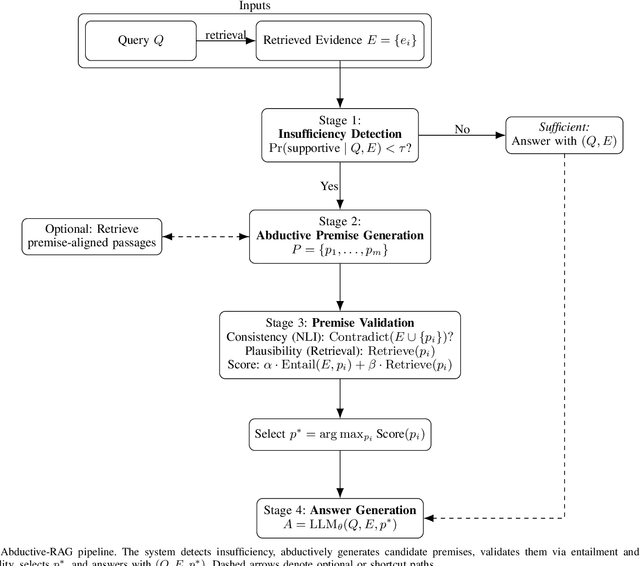
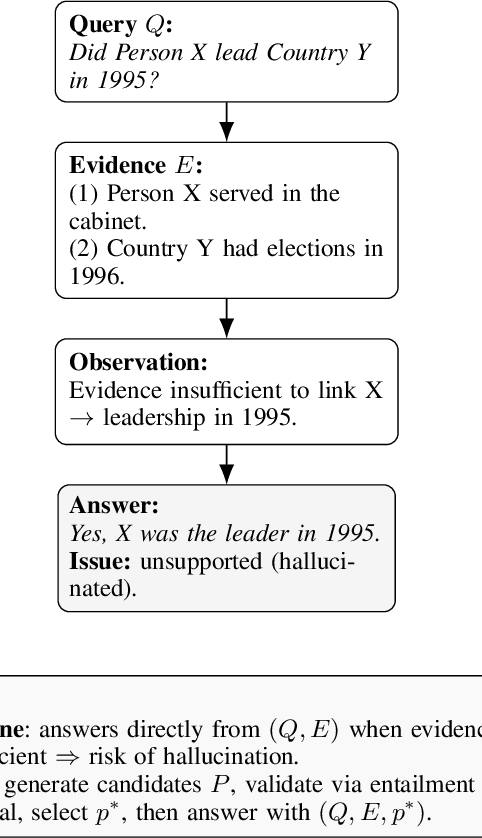
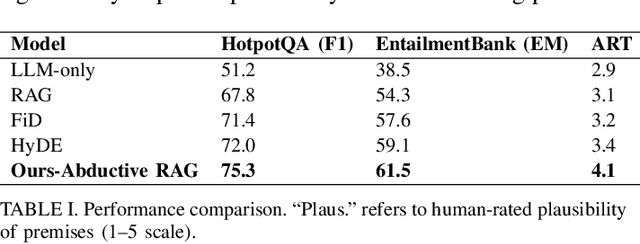
Large Language Models (LLMs) enhanced with retrieval -- commonly referred to as Retrieval-Augmented Generation (RAG) -- have demonstrated strong performance in knowledge-intensive tasks. However, RAG pipelines often fail when retrieved evidence is incomplete, leaving gaps in the reasoning process. In such cases, \emph{abductive inference} -- the process of generating plausible missing premises to explain observations -- offers a principled approach to bridge these gaps. In this paper, we propose a framework that integrates abductive inference into retrieval-augmented LLMs. Our method detects insufficient evidence, generates candidate missing premises, and validates them through consistency and plausibility checks. Experimental results on abductive reasoning and multi-hop QA benchmarks show that our approach improves both answer accuracy and reasoning faithfulness. This work highlights abductive inference as a promising direction for enhancing the robustness and explainability of RAG systems.