 Add to Chrome
 Add to Firefox
 Add to Edge
Part-Level 3D Gaussian Vehicle Generation with Joint and Hinge Axis Estimation
Apr 06, 2026
Simulation is essential for autonomous driving, yet current frameworks often model vehicles as rigid assets and fail to capture part-level articulation. With perception algorithms increasingly leveraging dynamics such as wheel steering or door opening, realistic simulation requires animatable vehicle representations. Existing CAD-based pipelines are limited by library coverage and fixed templates, preventing faithful reconstruction of in-the-wild instances. We propose a generative framework that, from a single image or sparse multi-view input, synthesizes an animatable 3D Gaussian vehicle. Our method addresses two challenges: (i) large 3D asset generators are optimized for static quality but not articulation, leading to distortions at part boundaries when animated; and (ii) segmentation alone cannot provide the kinematic parameters required for motion. To overcome this, we introduce a part-edge refinement module that enforces exclusive Gaussian ownership and a kinematic reasoning head that predicts joint positions and hinge axes of movable parts. Together, these components enable faithful part-aware simulation, bridging the gap between static generation and animatable vehicle models.

SCORE: Story Coherence and Retrieval Enhancement for AI Narratives
Mar 30, 2025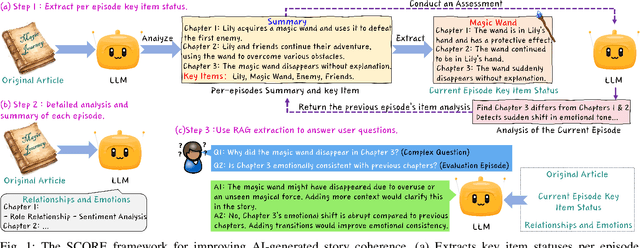



Large Language Models (LLMs) excel at generating creative narratives but struggle with long-term coherence and emotional consistency in complex stories. To address this, we propose SCORE (Story Coherence and Retrieval Enhancement), a framework integrating three components: 1) Dynamic State Tracking (monitoring objects/characters via symbolic logic), 2) Context-Aware Summarization (hierarchical episode summaries for temporal progression), and 3) Hybrid Retrieval (combining TF-IDF keyword relevance with cosine similarity-based semantic embeddings). The system employs a temporally-aligned Retrieval-Augmented Generation (RAG) pipeline to validate contextual consistency. Evaluations show SCORE achieves 23.6% higher coherence (NCI-2.0 benchmark), 89.7% emotional consistency (EASM metric), and 41.8% fewer hallucinations versus baseline GPT models. Its modular design supports incremental knowledge graph construction for persistent story memory and multi-LLM backend compatibility, offering an explainable solution for industrial-scale narrative systems requiring long-term consistency.