 Add to Chrome
 Add to Firefox
 Add to Edge
Workflow-GYM: Towards Long-Horizon Evaluation of Computer-use Agentic tasks in Real-World Professional Fields
Jun 09, 2026
Recent years have witnessed the rapid evolution of AI agents toward handling increasingly complex, real-world tasks. However, existing benchmarks rarely evaluate whether agents can operate graphical user interfaces to complete long-horizon, high-value professional workflows across diverse domains. Current GUI benchmarks still predominantly focus on general-purpose software, relatively simple applications, and short-horizon tasks, leaving it largely unknown whether modern agents can follow user instructions to autonomously operate domain-specific professional software and accomplish economically valuable work in an end-to-end manner. To bridge this gap, we introduce Workflow-GYM, a benchmark for long-horizon GUI tasks centered on professional domains and specialized software environments. Through extensive experiments on state-of-the-art models, we find that even the strongest models achieve only slightly above 30% success rates, highlighting that professional long-horizon GUI workflows remain highly challenging for current GUI agents. Further analysis reveals that current agents struggle to maintain long-horizon workflow consistency, frequently exhibiting workflow stage omission, error propagation, objective drift, and insufficient understanding of professional software environments. Our findings provide important insights into the limitations of current agent systems and suggest key directions for the next generation of GUI-agent research.

Training Long-Context Vision-Language Models Effectively with Generalization Beyond 128K Context
May 13, 2026Long-context modeling is becoming a core capability of modern large vision-language models (LVLMs), enabling sustained context management across long-document understanding, video analysis, and multi-turn tool use in agentic workflows. Yet practical training recipes remain insufficiently explored, particularly for designing and balancing long-context data mixtures. In this work, we present a systematic study of long-context continued pre-training for LVLMs, extending a 7B model from 32K to 128K context with extensive ablations on long-document data. We first show that long-document VQA is substantially more effective than OCR transcription. Building on this observation, our ablations further yield three key findings: i) for sequence-length distribution, balanced data outperforms target-length-focused data (e.g., 128K), suggesting that long-context ability requires generalizable key-information retrieval across various lengths and positions; ii) retrieval remains the primary bottleneck, favoring retrieval-heavy mixtures with modest reasoning data for task diversity; and iii) pure long-document VQA largely preserves short-context capabilities, suggesting that instruction-formatted long data reduces the need for short-data mixing. Based on these findings, we introduce MMProLong, obtained by long-context continued pre-training from Qwen2.5-VL-7B with only a 5B-token budget. MMProLong improves long-document VQA scores by 7.1% and maintains strong performance at 256K and 512K contexts beyond its 128K training window, without additional training. It further generalizes to webpage-based multimodal needle retrieval, long-context vision-text compression, and long-video understanding without task-specific supervision. Overall, our study establishes a practical LongPT recipe and an empirical foundation for advancing long-context vision-language models.
Seed1.5-VL Technical Report
May 11, 2025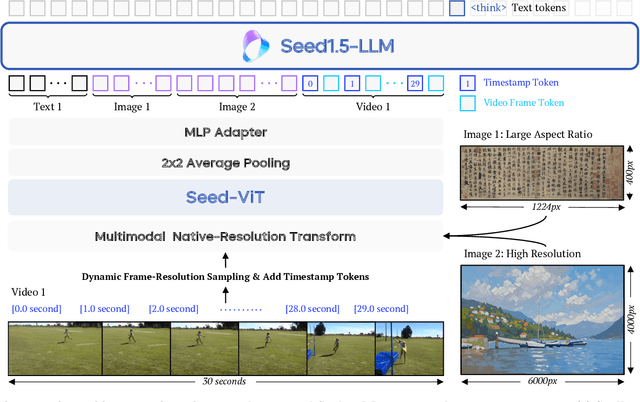

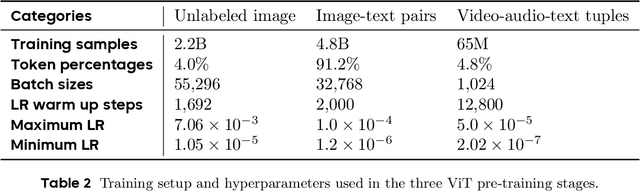
We present Seed1.5-VL, a vision-language foundation model designed to advance general-purpose multimodal understanding and reasoning. Seed1.5-VL is composed with a 532M-parameter vision encoder and a Mixture-of-Experts (MoE) LLM of 20B active parameters. Despite its relatively compact architecture, it delivers strong performance across a wide spectrum of public VLM benchmarks and internal evaluation suites, achieving the state-of-the-art performance on 38 out of 60 public benchmarks. Moreover, in agent-centric tasks such as GUI control and gameplay, Seed1.5-VL outperforms leading multimodal systems, including OpenAI CUA and Claude 3.7. Beyond visual and video understanding, it also demonstrates strong reasoning abilities, making it particularly effective for multimodal reasoning challenges such as visual puzzles. We believe these capabilities will empower broader applications across diverse tasks. In this report, we mainly provide a comprehensive review of our experiences in building Seed1.5-VL across model design, data construction, and training at various stages, hoping that this report can inspire further research. Seed1.5-VL is now accessible at https://www.volcengine.com/ (Volcano Engine Model ID: doubao-1-5-thinking-vision-pro-250428)
DocPrompt: Large-scale continue pretrain for zero-shot and few-shot document question answering
Aug 31, 2023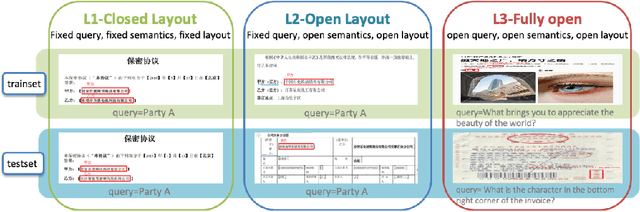
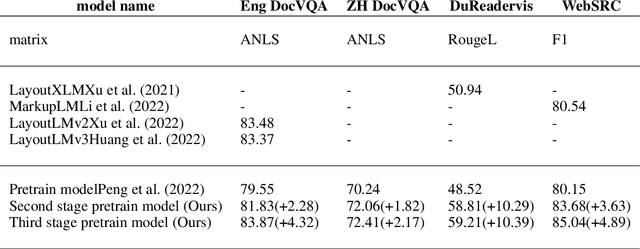
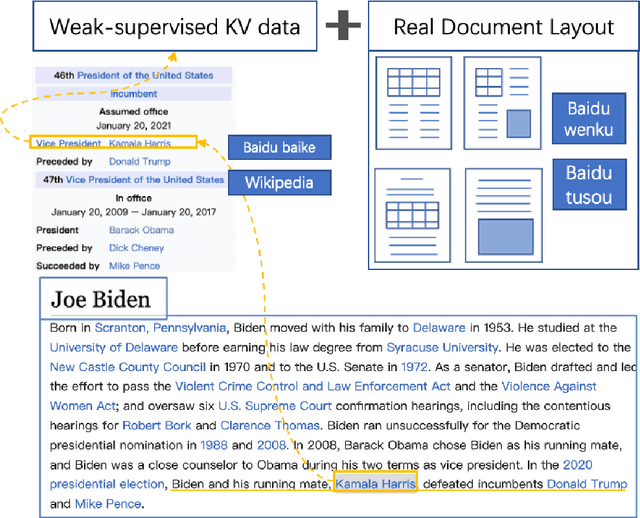
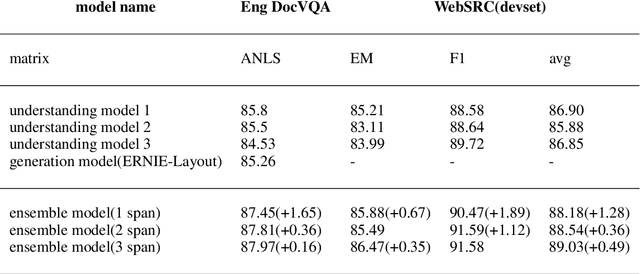
In this paper, we propose Docprompt for document question answering tasks with powerful zero-shot and few-shot performance. We proposed a novel weakly supervised data generation method, a novel multl-stage training method and a novel understanding model \& generation model ensemble method. We achieved state-of-the-art performance on 4 document question answering tasks. This method greatly improves the delivery efficiency and model performance of document question answering customer projects, reducing annotation costs and labor costs. Our demo can be found at https://huggingface.co/spaces/PaddlePaddle/ERNIE-Layout.