 Add to Chrome
 Add to Firefox
 Add to Edge
VideoSEAL: Mitigating Evidence Misalignment in Agentic Long Video Understanding by Decoupling Answer Authority
May 12, 2026
Long video question answering requires locating sparse, time-scattered visual evidence within highly redundant content. Although current MLLMs perform well on short videos, long videos introduce long-horizon search and verification, which often necessitates multi-turn, agentic interaction. We show that existing LVU agents can exhibit "evidence misalignment": they produce correct answers that are not supported by the retrieved or inspected evidence. To characterize this failure, we introduce two diagnostics (temporal groundedness and semantic groundedness) and use them to reveal two pressures that amplify misalignment: prompt pressure from shared-context saturation at inference time and reward pressure from outcome-only optimization during training. These findings point to a structural root cause: the coupled agent paradigm conflates long-horizon planning with answer authority. We therefore propose the decoupled planner-inspector framework, which separates planning from answer authority and gates final answering on pixel-level verification. Across four long-video benchmarks, our framework improves both answer accuracy and evidence alignment, achieving 55.1% on LVBench and 62.0% on LongVideoBench while producing interpretable search trajectories. Moreover, the decoupled architecture scales consistently with increased search budgets and supports plug-and-play upgrades of the MLLM backbone without retraining the planner. Code and models are available at https://github.com/Echochef/VideoSEAL.

MARS2 2025 Challenge on Multimodal Reasoning: Datasets, Methods, Results, Discussion, and Outlook
Sep 17, 2025
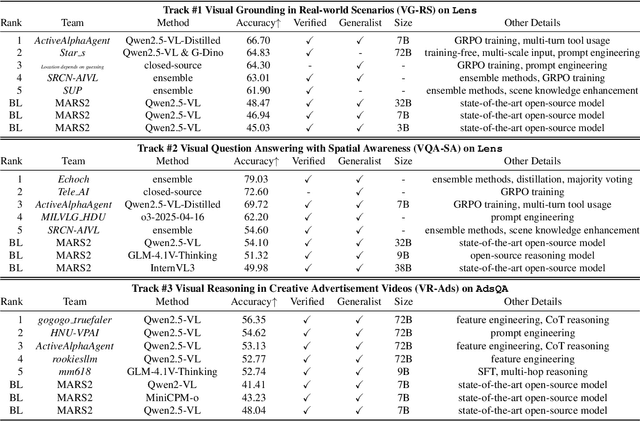

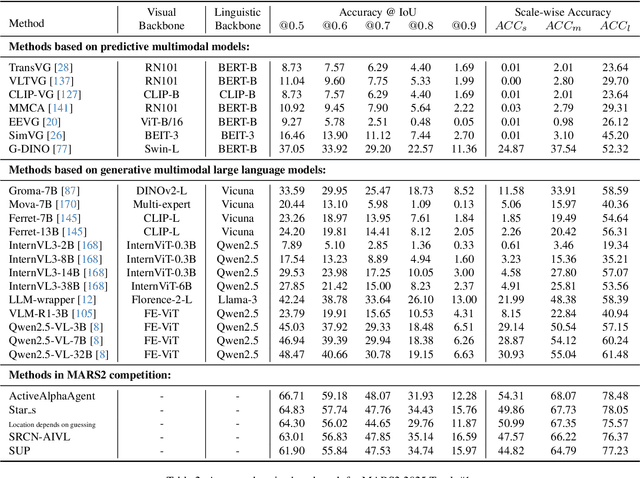
This paper reviews the MARS2 2025 Challenge on Multimodal Reasoning. We aim to bring together different approaches in multimodal machine learning and LLMs via a large benchmark. We hope it better allows researchers to follow the state-of-the-art in this very dynamic area. Meanwhile, a growing number of testbeds have boosted the evolution of general-purpose large language models. Thus, this year's MARS2 focuses on real-world and specialized scenarios to broaden the multimodal reasoning applications of MLLMs. Our organizing team released two tailored datasets Lens and AdsQA as test sets, which support general reasoning in 12 daily scenarios and domain-specific reasoning in advertisement videos, respectively. We evaluated 40+ baselines that include both generalist MLLMs and task-specific models, and opened up three competition tracks, i.e., Visual Grounding in Real-world Scenarios (VG-RS), Visual Question Answering with Spatial Awareness (VQA-SA), and Visual Reasoning in Creative Advertisement Videos (VR-Ads). Finally, 76 teams from the renowned academic and industrial institutions have registered and 40+ valid submissions (out of 1200+) have been included in our ranking lists. Our datasets, code sets (40+ baselines and 15+ participants' methods), and rankings are publicly available on the MARS2 workshop website and our GitHub organization page https://github.com/mars2workshop/, where our updates and announcements of upcoming events will be continuously provided.