 Add to Chrome
 Add to Firefox
 Add to Edge
Causal Machine Learning Is Not a Panacea: A Roadmap for Observational Causal Inference in Health
May 20, 2026
Objective: The growing availability of large-scale observational clinical datasets and challenges in conducting randomized controlled trials have spurred enthusiasm in using causal machine learning (ML) for causal inference in observational data. We present a roadmap for applying causal ML to observational data. Materials and methods: We outline the importance of assessing validity assumptions within available data and applying causal ML responsibly for clinical experts using causal ML and ML practitioners with limited clinical expertise. Observations: Despite advances in causal ML, its limitations remain largely under-appreciated across disciplines. This gap in shared knowledge may impact the validity of findings. Discussion: Causal assumptions must be satisfied and modeling choices justified. Otherwise, these approaches risk producing biased or misleading results, with consequences for clinical research and patient care. Conclusion: Causal ML can be a powerful tool for generating causal hypotheses. We provide a template to strengthen the rigor and interpretability of causal analyses.

Quantifying Potential Observation Missingness in Inverse Reinforcement Learning
May 12, 2026Inverse reinforcement learning (IRL), which infers reward functions from demonstrations, is a valuable tool for modeling and understanding decision-making behavior. Many variants of IRL have been developed to capture complexities of human decision-making, such as subjective beliefs, imperfect planning, and dynamic goals. However, an often-overlooked issue in real-world behavioral datasets is that the recorded data may be missing observations that were available to the original decision-maker. In use-inspired settings such as healthcare, this can make expert actions appear suboptimal, even when they were near-optimal given the information available at the time. As a result, the rewards learned by standard IRL may be misleading. In this paper, we identify the minimal perturbations to the recorded observations needed for the expert's actions to appear optimal. We develop a practical algorithm for this problem and demonstrate its utility for quantifying the possible extent of missing observations in behavioral datasets through extensive experiments on synthetic navigation tasks, a cancer treatment simulator, and ICU treatment data.
Personalized and Context-Aware Transformer Models for Predicting Post-Intervention Physiological Responses from Wearable Sensor Data
Apr 16, 2026Consumer wearables enable continuous measurement of physiological data related to stress and recovery, but turning these streams into actionable, personalized stress-management recommendations remains a challenge. In practice, users often do not know how a given intervention, defined as an activity intended to reduce stress, will affect heart rate (HR), heart rate variability (HRV), or inter-beat intervals (BBI) over the next 15 to 120 minutes. We present a framework that predicts post-intervention trajectories and the direction of change for these physiological indicators across time windows. Our methodology combines a Transformer model for multi-horizon trajectories of percent change relative to a pre-intervention baseline, direction-of-change calls (positive, negative, or neutral) at each horizon, and an empirical study using wearable sensor data overlaid with user-tagged events and interventions. This proof of concept shows that personalized post-intervention prediction is feasible. We encourage future integration into stress-management tools for personalized intervention recommendations tailored to each person's day following further validation in larger studies and, where applicable, appropriate regulatory review.
A Benchmark for Multi-Party Negotiation Games from Real Negotiation Data
Mar 14, 2026Many real-world multi-party negotiations unfold as sequences of binding, action-level commitments rather than a single final outcome. We introduce a benchmark for this under-studied regime featuring a configurable game generator that sweeps key structural properties such as incentive alignment, goal complexity, and payoff distribution. To evaluate decision-making, we test three value-function approximations - myopic reward, an optimistic upper bound, and a pessimistic lower bound - that act as biased lenses on deal evaluation. Through exact evaluation on small games and comparative evaluation on large, document-grounded instances derived from the Harvard Negotiation Challenge, we map the strategic regimes where each approximation succeeds or fails. We observe that different game structures demand different valuation strategies, motivating agents that learn robust state values and plan effectively over long horizons under binding commitments and terminal only rewards.
Federated ADMM from Bayesian Duality
Jun 16, 2025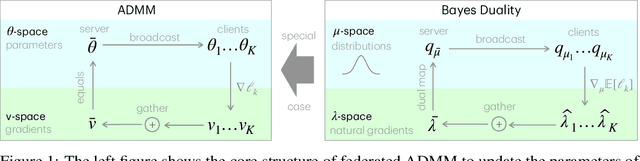
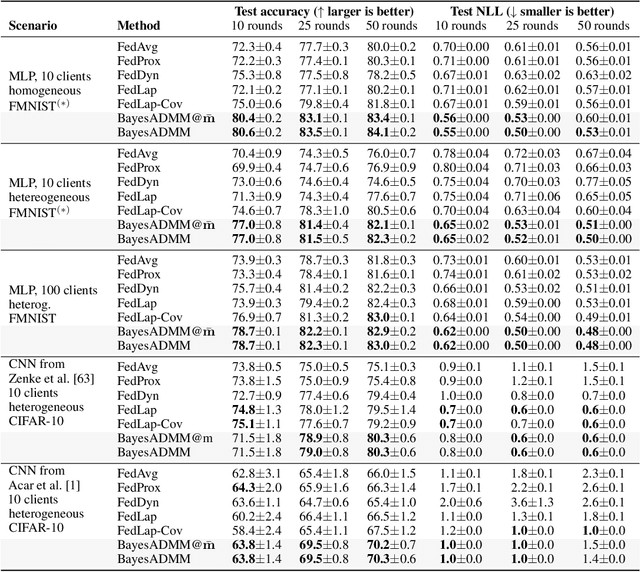

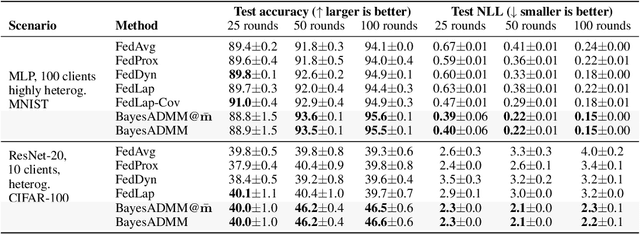
ADMM is a popular method for federated deep learning which originated in the 1970s and, even though many new variants of it have been proposed since then, its core algorithmic structure has remained unchanged. Here, we take a major departure from the old structure and present a fundamentally new way to derive and extend federated ADMM. We propose to use a structure called Bayesian Duality which exploits a duality of the posterior distributions obtained by solving a variational-Bayesian reformulation of the original problem. We show that this naturally recovers the original ADMM when isotropic Gaussian posteriors are used, and yields non-trivial extensions for other posterior forms. For instance, full-covariance Gaussians lead to Newton-like variants of ADMM, while diagonal covariances result in a cheap Adam-like variant. This is especially useful to handle heterogeneity in federated deep learning, giving up to 7% accuracy improvements over recent baselines. Our work opens a new Bayesian path to improve primal-dual methods.
Strategically Linked Decisions in Long-Term Planning and Reinforcement Learning
May 22, 2025Long-term planning, as in reinforcement learning (RL), involves finding strategies: actions that collectively work toward a goal rather than individually optimizing their immediate outcomes. As part of a strategy, some actions are taken at the expense of short-term benefit to enable future actions with even greater returns. These actions are only advantageous if followed up by the actions they facilitate, consequently, they would not have been taken if those follow-ups were not available. In this paper, we quantify such dependencies between planned actions with strategic link scores: the drop in the likelihood of one decision under the constraint that a follow-up decision is no longer available. We demonstrate the utility of strategic link scores through three practical applications: (i) explaining black-box RL agents by identifying strategically linked pairs among decisions they make, (ii) improving the worst-case performance of decision support systems by distinguishing whether recommended actions can be adopted as standalone improvements or whether they are strategically linked hence requiring a commitment to a broader strategy to be effective, and (iii) characterizing the planning processes of non-RL agents purely through interventions aimed at measuring strategic link scores - as an example, we consider a realistic traffic simulator and analyze through road closures the effective planning horizon of the emergent routing behavior of many drivers.
Connecting Federated ADMM to Bayes
Jan 28, 2025We provide new connections between two distinct federated learning approaches based on (i) ADMM and (ii) Variational Bayes (VB), and propose new variants by combining their complementary strengths. Specifically, we show that the dual variables in ADMM naturally emerge through the 'site' parameters used in VB with isotropic Gaussian covariances. Using this, we derive two versions of ADMM from VB that use flexible covariances and functional regularisation, respectively. Through numerical experiments, we validate the improvements obtained in performance. The work shows connection between two fields that are believed to be fundamentally different and combines them to improve federated learning.
Diverse Concept Proposals for Concept Bottleneck Models
Dec 24, 2024
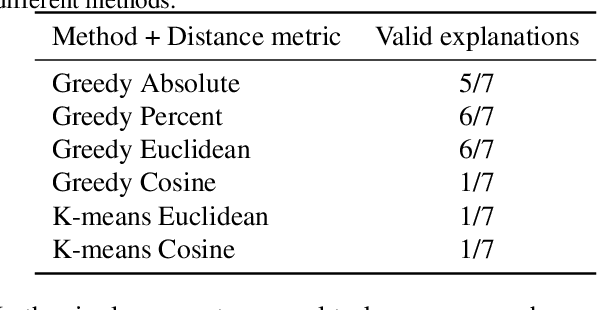
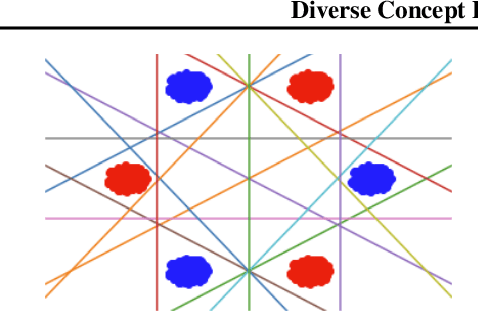
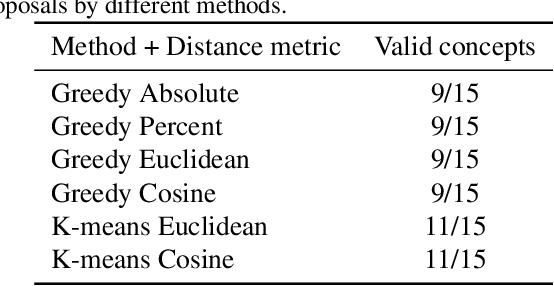
Concept bottleneck models are interpretable predictive models that are often used in domains where model trust is a key priority, such as healthcare. They identify a small number of human-interpretable concepts in the data, which they then use to make predictions. Learning relevant concepts from data proves to be a challenging task. The most predictive concepts may not align with expert intuition, thus, failing interpretability with no recourse. Our proposed approach identifies a number of predictive concepts that explain the data. By offering multiple alternative explanations, we allow the human expert to choose the one that best aligns with their expectation. To demonstrate our method, we show that it is able discover all possible concept representations on a synthetic dataset. On EHR data, our model was able to identify 4 out of the 5 pre-defined concepts without supervision.
Shaping AI's Impact on Billions of Lives
Dec 03, 2024


Artificial Intelligence (AI), like any transformative technology, has the potential to be a double-edged sword, leading either toward significant advancements or detrimental outcomes for society as a whole. As is often the case when it comes to widely-used technologies in market economies (e.g., cars and semiconductor chips), commercial interest tends to be the predominant guiding factor. The AI community is at risk of becoming polarized to either take a laissez-faire attitude toward AI development, or to call for government overregulation. Between these two poles we argue for the community of AI practitioners to consciously and proactively work for the common good. This paper offers a blueprint for a new type of innovation infrastructure including 18 concrete milestones to guide AI research in that direction. Our view is that we are still in the early days of practical AI, and focused efforts by practitioners, policymakers, and other stakeholders can still maximize the upsides of AI and minimize its downsides. We talked to luminaries such as recent Nobelist John Jumper on science, President Barack Obama on governance, former UN Ambassador and former National Security Advisor Susan Rice on security, philanthropist Eric Schmidt on several topics, and science fiction novelist Neal Stephenson on entertainment. This ongoing dialogue and collaborative effort has produced a comprehensive, realistic view of what the actual impact of AI could be, from a diverse assembly of thinkers with deep understanding of this technology and these domains. From these exchanges, five recurring guidelines emerged, which form the cornerstone of a framework for beginning to harness AI in service of the public good. They not only guide our efforts in discovery but also shape our approach to deploying this transformative technology responsibly and ethically.
Inverse Transition Learning: Learning Dynamics from Demonstrations
Nov 07, 2024


We consider the problem of estimating the transition dynamics $T^*$ from near-optimal expert trajectories in the context of offline model-based reinforcement learning. We develop a novel constraint-based method, Inverse Transition Learning, that treats the limited coverage of the expert trajectories as a \emph{feature}: we use the fact that the expert is near-optimal to inform our estimate of $T^*$. We integrate our constraints into a Bayesian approach. Across both synthetic environments and real healthcare scenarios like Intensive Care Unit (ICU) patient management in hypotension, we demonstrate not only significant improvements in decision-making, but that our posterior can inform when transfer will be successful.