 Add to Chrome
 Add to Firefox
 Add to Edge
Align-RAG: Alignment Is All You Need for TSFM In-Context Learning
Aug 06, 2026
Retrieval-augmented forecasting promises to adapt frozen Time Series Foundation Models (TSFMs) to new domains without fine-tuning, but recent methods typically rely on learned fusion modules, i.e., trained adapters that merge retrieved examples into the backbone's forecast, based on the assumption that frozen backbones cannot dynamically incorporate retrieved context on their own. We show this assumption is unnecessary. We introduce Align-RAG, a training-free method that applies a closed-form per-pair amplitude rescaling and integer-lag phase shift to retrieved past-future windows before they enter a frozen backbone's context. With no learned parameters, Align-RAG outperforms the state-of-the-art trained retrieval adapter on a frozen Chronos-Bolt on all seven datasets of the standard benchmark (avg -3.75% MSE), showing that the gains previously attributed to learned fusion are recoverable without any training. Align-RAG further improves zero-shot MSE on four additional frozen TSFMs with various architectures by 2.5% to 13.7% per backbone with no per-backbone tuning. To probe why alignment helps, we compare the frozen backbone's prediction shift under aligned demonstrations to the closed-form ridge prediction shift on the same pairs. We find that aligned demonstrations induce prediction shifts that track a closed-form ridge predictor on the same pairs, with a future-shuffle control ruling out a futures-averaging account. Together, these results indicate that frozen TSFMs already support dynamic in-context use of retrievals, and that closed-form alignment should be the default baseline for retrieval-augmented forecasting before any fusion module is trained. Code available at: https://github.com/masadi-99/align-rag

NeuroQA: A Large-Scale Image-Grounded Benchmark for 3D Brain MRI Understanding
May 19, 2026We present NeuroQA, a large-scale benchmark for visual question answering in 3D brain magnetic resonance imaging (MRI), with 56,953 QA pairs from 12,977 subjects across 12 datasets. It spans ages 5-104 and five clinical domains: Alzheimer's, Parkinson's, tumors, white matter disease, and neurodevelopment. Unlike prior medical Visual Question Answering (VQA) efforts that operate on 2D slices or rely on narrow diagnostic labels, NeuroQA pairs every item with a full 3D volume. It evaluates 11 clinically grounded reasoning skills across Yes/No, multiple-choice, and open-ended formats. Of the 203 templates, 131 are image-grounded (answerable from a 3-plane viewer) and 72 are image-informed (ground truth from quantitative volumetry or clinical instruments). To remove text-only shortcuts, we apply answer-distribution refinement, reducing closed-format text-only accuracy from $>$80% to 44.6%; image necessity is assessed separately through an image-grounding protocol released with the benchmark. A 38-rule deterministic pipeline and two rounds of expert review verify every QA pair against FreeSurfer measurements, metadata, or radiology report fields, with zero same-subject contradictions across templates. We conduct a clinician evaluation in which two clinicians independently assess 100 frozen test items on a three-plane viewer. On closed-format (Yes/No + multiple-choice) test-public items, the best zero-shot vision-language model and a supervised 3D CNN baseline reach 47.5% and 43.7% accuracy respectively, both below the 49.4% text-only majority-template floor. NeuroQA adopts a two-tier release with public QA pairs for open-access datasets and reproducible generation scripts for datasets restricted by data use agreements (DUAs), plus subject-level splits, a held-out private test set, and an online leaderboard.
MARCUS: An agentic, multimodal vision-language model for cardiac diagnosis and management
Mar 23, 2026Cardiovascular disease remains the leading cause of global mortality, with progress hindered by human interpretation of complex cardiac tests. Current AI vision-language models are limited to single-modality inputs and are non-interactive. We present MARCUS (Multimodal Autonomous Reasoning and Chat for Ultrasound and Signals), an agentic vision-language system for end-to-end interpretation of electrocardiograms (ECGs), echocardiograms, and cardiac magnetic resonance imaging (CMR) independently and as multimodal input. MARCUS employs a hierarchical agentic architecture comprising modality-specific vision-language expert models, each integrating domain-trained visual encoders with multi-stage language model optimization, coordinated by a multimodal orchestrator. Trained on 13.5 million images (0.25M ECGs, 1.3M echocardiogram images, 12M CMR images) and our novel expert-curated dataset spanning 1.6 million questions, MARCUS achieves state-of-the-art performance surpassing frontier models (GPT-5 Thinking, Gemini 2.5 Pro Deep Think). Across internal (Stanford) and external (UCSF) test cohorts, MARCUS achieves accuracies of 87-91% for ECG, 67-86% for echocardiography, and 85-88% for CMR, outperforming frontier models by 34-45% (P<0.001). On multimodal cases, MARCUS achieved 70% accuracy, nearly triple that of frontier models (22-28%), with 1.7-3.0x higher free-text quality scores. Our agentic architecture also confers resistance to mirage reasoning, whereby vision-language models derive reasoning from unintended textual signals or hallucinated visual content. MARCUS demonstrates that domain-specific visual encoders with an agentic orchestrator enable multimodal cardiac interpretation. We release our models, code, and benchmark open-source.
Deterministic Hallucination Detection in Medical VQA via Confidence-Evidence Bayesian Gain
Mar 23, 2026Multimodal large language models (MLLMs) have shown strong potential for medical Visual Question Answering (VQA), yet they remain prone to hallucinations, defined as generating responses that contradict the input image, posing serious risks in clinical settings. Current hallucination detection methods, such as Semantic Entropy (SE) and Vision-Amplified Semantic Entropy (VASE), require 10 to 20 stochastic generations per sample together with an external natural language inference model for semantic clustering, making them computationally expensive and difficult to deploy in practice. We observe that hallucinated responses exhibit a distinctive signature directly in the model's own log-probabilities: inconsistent token-level confidence and weak sensitivity to visual evidence. Based on this observation, we propose Confidence-Evidence Bayesian Gain (CEBaG), a deterministic hallucination detection method that requires no stochastic sampling, no external models, and no task-specific hyperparameters. CEBaG combines two complementary signals: token-level predictive variance, which captures inconsistent confidence across response tokens, and evidence magnitude, which measures how much the image shifts per-token predictions relative to text-only inference. Evaluated across four medical MLLMs and three VQA benchmarks (16 experimental settings), CEBaG achieves the highest AUC in 13 of 16 settings and improves over VASE by 8 AUC points on average, while being fully deterministic and self-contained. The code will be made available upon acceptance.
Mirage The Illusion of Visual Understanding
Mar 23, 2026Multimodal AI systems have achieved remarkable performance across a broad range of real-world tasks, yet the mechanisms underlying visual-language reasoning remain surprisingly poorly understood. We report three findings that challenge prevailing assumptions about how these systems process and integrate visual information. First, Frontier models readily generate detailed image descriptions and elaborate reasoning traces, including pathology-biased clinical findings, for images never provided; we term this phenomenon mirage reasoning. Second, without any image input, models also attain strikingly high scores across general and medical multimodal benchmarks, bringing into question their utility and design. In the most extreme case, our model achieved the top rank on a standard chest X-ray question-answering benchmark without access to any images. Third, when models were explicitly instructed to guess answers without image access, rather than being implicitly prompted to assume images were present, performance declined markedly. Explicit guessing appears to engage a more conservative response regime, in contrast to the mirage regime in which models behave as though images have been provided. These findings expose fundamental vulnerabilities in how visual-language models reason and are evaluated, pointing to an urgent need for private benchmarks that eliminate textual cues enabling non-visual inference, particularly in medical contexts where miscalibrated AI carries the greatest consequence. We introduce B-Clean as a principled solution for fair, vision-grounded evaluation of multimodal AI systems.
Ripple: Concept-Based Interpretation for Raw Time Series Models in Education
Dec 13, 2022
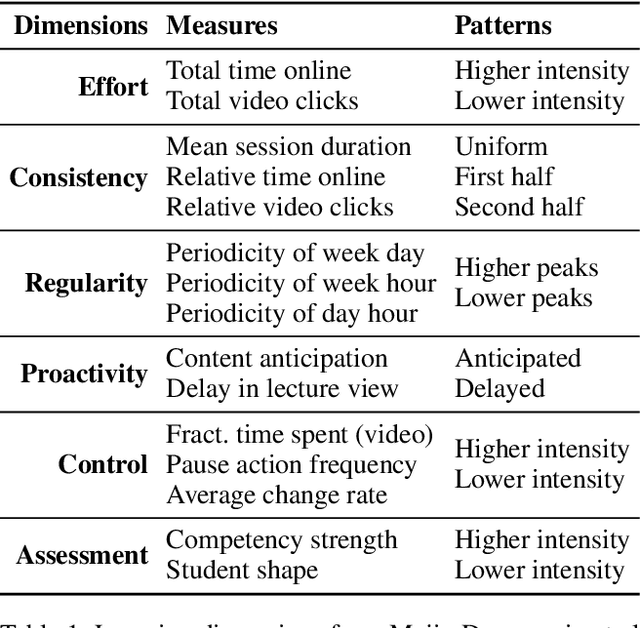
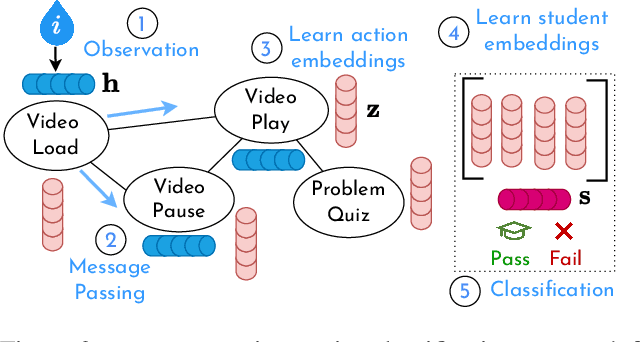
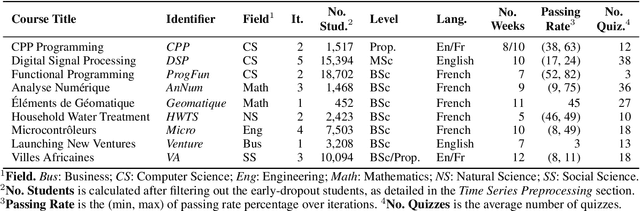
Time series is the most prevalent form of input data for educational prediction tasks. The vast majority of research using time series data focuses on hand-crafted features, designed by experts for predictive performance and interpretability. However, extracting these features is labor-intensive for humans and computers. In this paper, we propose an approach that utilizes irregular multivariate time series modeling with graph neural networks to achieve comparable or better accuracy with raw time series clickstreams in comparison to hand-crafted features. Furthermore, we extend concept activation vectors for interpretability in raw time series models. We analyze these advances in the education domain, addressing the task of early student performance prediction for downstream targeted interventions and instructional support. Our experimental analysis on 23 MOOCs with millions of combined interactions over six behavioral dimensions show that models designed with our approach can (i) beat state-of-the-art educational time series baselines with no feature extraction and (ii) provide interpretable insights for personalized interventions. Source code: https://github.com/epfl-ml4ed/ripple/.