 Add to Chrome
 Add to Firefox
 Add to Edge
Critical Interval MSE: Toward Reliable Offline Validation for Robot Manipulation Policies
Jun 29, 2026
Real-world evaluation is the gold standard for robot policies because it tests them against the physical conditions and deployment challenges they are ultimately designed to handle. However, real-world evaluation is also the bottleneck for iterating on robot policies: it is costly, difficult to reproduce, and often too sparse to reliably compare nearby model variants. A straightforward proxy for performance is validation loss on expert demonstrations, but this proxy is often poorly correlated with real-world performance. In this paper, we introduce Critical Interval MSE (CI-MSE), an intuitively simple yet effective offline validation metric. CI-MSE restricts error computation to task-critical segments and pairs it with simple action-alignment procedures that better match rollout-time behavior. Across simulation and real-world experiments, CI-MSE yields a stronger correlation between validation error and rollout performance than raw MSE. Across a wide range of policy checkpoints, CI-MSE achieves a Spearman's rank correlation of $-0.87$, much closer to the ideal value of $-1$ than raw MSE's $-0.61$, demonstrating a significant improvement. We show through sensitivity analysis that our metric is robust to a wide range of hyperparameters. We further study the effectiveness of CI-MSE under evaluation distribution shifts and suggest design boundaries when using this metric. In summary, this paper provides a simple and reliable offline validation tool for accelerating policy iteration. Project webpage: https://ci-mse.github.io/

Learning Sparse Latent Predictive Foundation Model for Multimodal Neuroimaging
Jun 18, 2026Brain MRIs are routinely acquired as multiple complementary sequences with unique contrast weighting, including T1-weighed imaging (T1w) anatomic and fluid-sensitive T2-weighted (T2w) contrasts. However, methods for learning unified representations across the multitude of MRI contrast mechanisms at health-system scale are lacking. In this study, we introduce Neuro-JEPA, a sparse multimodal neuroimaging foundation model that combines a latent predictive objective with a Mixture-of-Experts architecture to encode brain MRI across core T1w, T2w, and fluid-suppressed FLAIR imaging (FLAIR). We further provide a systematic methodological study of architectural, masking, objective, and sparsity design choices beneficial for robust neuroimaging multimodal representation learning. Neuro-JEPA was pretrained on 1,551,862 scans from 428,647 studies after modality-specific preprocessing with data curation across three core structural brain MRI sequences. We evaluated the learned representations across clinical and research settings, including 25 tasks from three health systems: NYU Langone, NYU Long Island, and Massachusetts General Hospital, and 22 tasks from 12 public datasets, covering unimodal, multimodal and cross-domain evaluation configurations. Across these benchmarks, existing neuroimaging foundation models showed inconsistent gains over a simple convolutional neural network (CNN) baseline, whereas Neuro-JEPA achieved stronger and more consistent performance across all evaluated settings. These results establish a scalable methodological framework for multimodal neuroimaging representation learning and highlight the need for foundation model evaluation protocols that include simple baselines, clinically heterogeneous cohorts and controlled multimodal comparisons.
3D Foundation AI Model for Generalizable Disease Detection in Head Computed Tomography
Feb 04, 2025
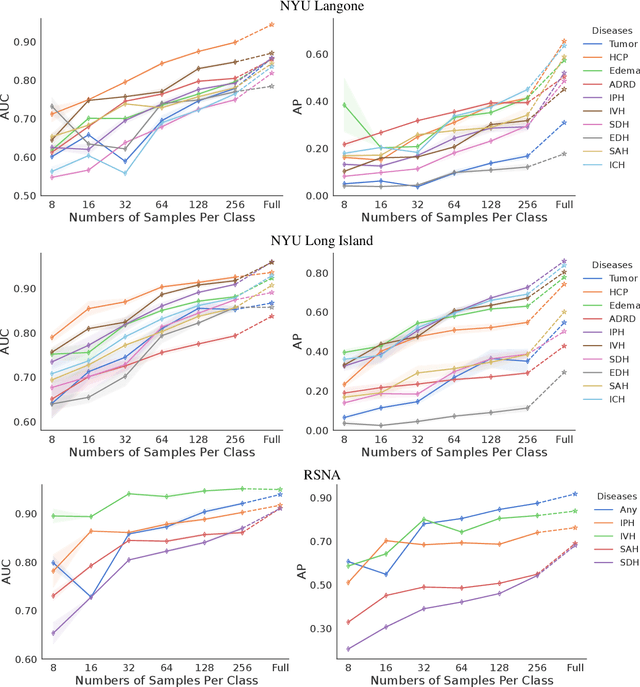


Head computed tomography (CT) imaging is a widely-used imaging modality with multitudes of medical indications, particularly in assessing pathology of the brain, skull, and cerebrovascular system. It is commonly the first-line imaging in neurologic emergencies given its rapidity of image acquisition, safety, cost, and ubiquity. Deep learning models may facilitate detection of a wide range of diseases. However, the scarcity of high-quality labels and annotations, particularly among less common conditions, significantly hinders the development of powerful models. To address this challenge, we introduce FM-CT: a Foundation Model for Head CT for generalizable disease detection, trained using self-supervised learning. Our approach pre-trains a deep learning model on a large, diverse dataset of 361,663 non-contrast 3D head CT scans without the need for manual annotations, enabling the model to learn robust, generalizable features. To investigate the potential of self-supervised learning in head CT, we employed both discrimination with self-distillation and masked image modeling, and we construct our model in 3D rather than at the slice level (2D) to exploit the structure of head CT scans more comprehensively and efficiently. The model's downstream classification performance is evaluated using internal and three external datasets, encompassing both in-distribution (ID) and out-of-distribution (OOD) data. Our results demonstrate that the self-supervised foundation model significantly improves performance on downstream diagnostic tasks compared to models trained from scratch and previous 3D CT foundation models on scarce annotated datasets. This work highlights the effectiveness of self-supervised learning in medical imaging and sets a new benchmark for head CT image analysis in 3D, enabling broader use of artificial intelligence for head CT-based diagnosis.
HIST-AID: Leveraging Historical Patient Reports for Enhanced Multi-Modal Automatic Diagnosis
Nov 16, 2024Chest X-ray imaging is a widely accessible and non-invasive diagnostic tool for detecting thoracic abnormalities. While numerous AI models assist radiologists in interpreting these images, most overlook patients' historical data. To bridge this gap, we introduce Temporal MIMIC dataset, which integrates five years of patient history, including radiographic scans and reports from MIMIC-CXR and MIMIC-IV, encompassing 12,221 patients and thirteen pathologies. Building on this, we present HIST-AID, a framework that enhances automatic diagnostic accuracy using historical reports. HIST-AID emulates the radiologist's comprehensive approach, leveraging historical data to improve diagnostic accuracy. Our experiments demonstrate significant improvements, with AUROC increasing by 6.56% and AUPRC by 9.51% compared to models that rely solely on radiographic scans. These gains were consistently observed across diverse demographic groups, including variations in gender, age, and racial categories. We show that while recent data boost performance, older data may reduce accuracy due to changes in patient conditions. Our work paves the potential of incorporating historical data for more reliable automatic diagnosis, providing critical support for clinical decision-making.
CoPa: General Robotic Manipulation through Spatial Constraints of Parts with Foundation Models
Mar 13, 2024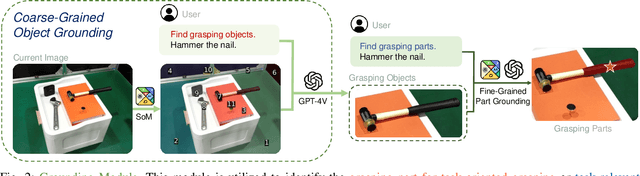
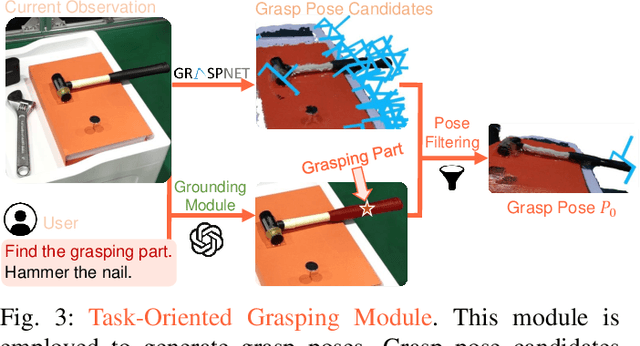
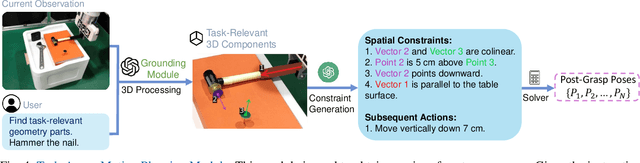
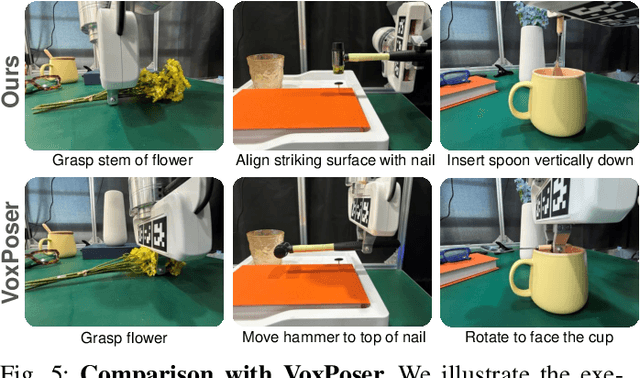
Foundation models pre-trained on web-scale data are shown to encapsulate extensive world knowledge beneficial for robotic manipulation in the form of task planning. However, the actual physical implementation of these plans often relies on task-specific learning methods, which require significant data collection and struggle with generalizability. In this work, we introduce Robotic Manipulation through Spatial Constraints of Parts (CoPa), a novel framework that leverages the common sense knowledge embedded within foundation models to generate a sequence of 6-DoF end-effector poses for open-world robotic manipulation. Specifically, we decompose the manipulation process into two phases: task-oriented grasping and task-aware motion planning. In the task-oriented grasping phase, we employ foundation vision-language models (VLMs) to select the object's grasping part through a novel coarse-to-fine grounding mechanism. During the task-aware motion planning phase, VLMs are utilized again to identify the spatial geometry constraints of task-relevant object parts, which are then used to derive post-grasp poses. We also demonstrate how CoPa can be seamlessly integrated with existing robotic planning algorithms to accomplish complex, long-horizon tasks. Our comprehensive real-world experiments show that CoPa possesses a fine-grained physical understanding of scenes, capable of handling open-set instructions and objects with minimal prompt engineering and without additional training. Project page: https://copa-2024.github.io/
CcHarmony: Color-checker based Image Harmonization Dataset
Jun 01, 2022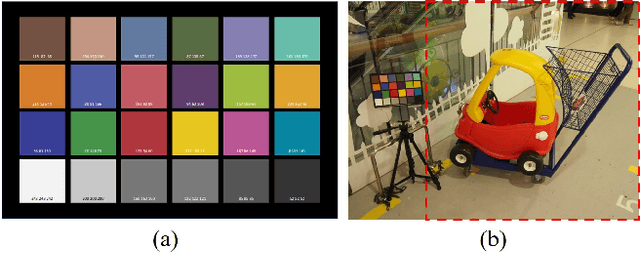
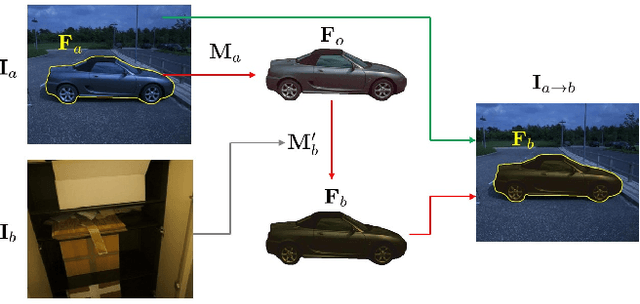
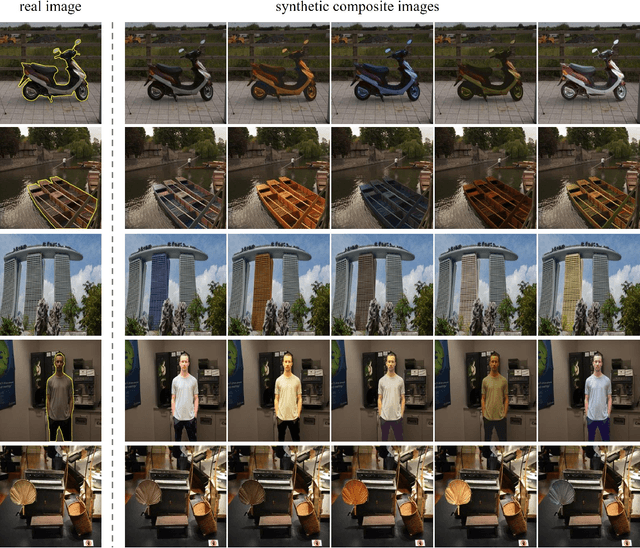
Image harmonization targets at adjusting the foreground in a composite image to make it compatible with the background, producing a more realistic and harmonious image. Training deep image harmonization network requires abundant training data, but it is extremely difficult to acquire training pairs of composite images and ground-truth harmonious images. Therefore, existing works turn to adjust the foreground appearance in a real image to create a synthetic composite image. However, such adjustment may not faithfully reflect the natural illumination change of foreground. In this work, we explore a novel transitive way to construct image harmonization dataset. Specifically, based on the existing datasets with recorded illumination information, we first convert the foreground in a real image to the standard illumination condition, and then convert it to another illumination condition, which is combined with the original background to form a synthetic composite image. In this manner, we construct an image harmonization dataset called ccHarmony, which is named after color checker (cc). The dataset is available at https://github.com/bcmi/Image-Harmonization-Dataset-ccHarmony.