 Add to Chrome
 Add to Firefox
 Add to Edge
An Efficient Memory-Augmented Transformer for Knowledge-Intensive NLP Tasks
Oct 30, 2022
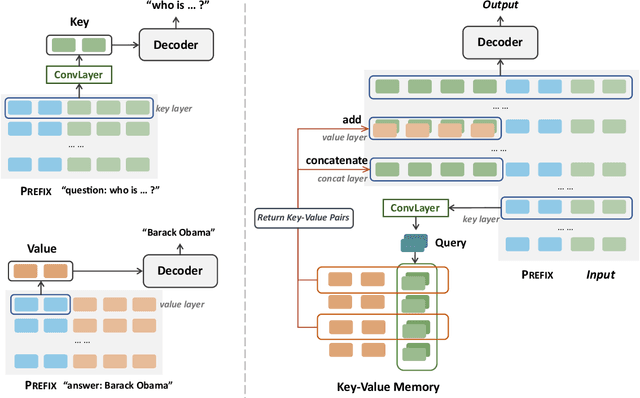
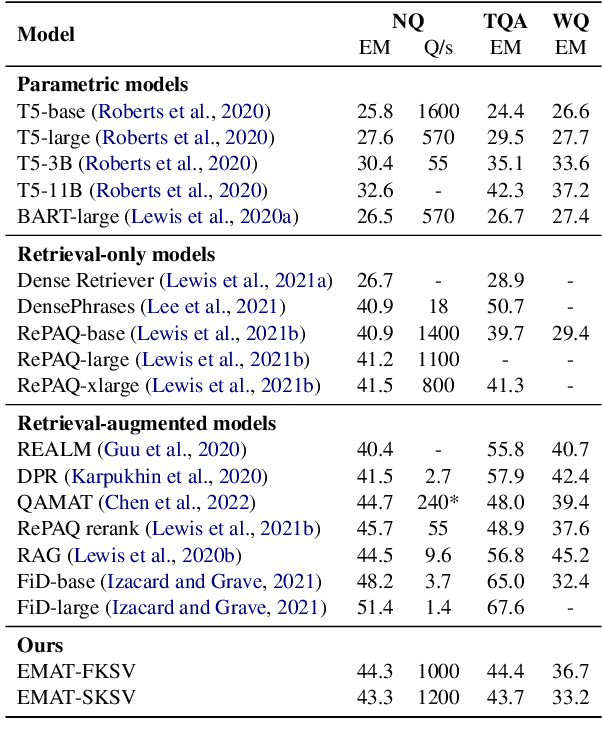

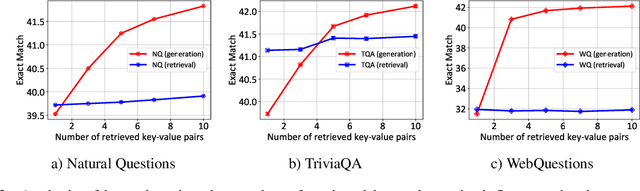
Access to external knowledge is essential for many natural language processing tasks, such as question answering and dialogue. Existing methods often rely on a parametric model that stores knowledge in its parameters, or use a retrieval-augmented model that has access to an external knowledge source. Parametric and retrieval-augmented models have complementary strengths in terms of computational efficiency and predictive accuracy. To combine the strength of both approaches, we propose the Efficient Memory-Augmented Transformer (EMAT) -- it encodes external knowledge into a key-value memory and exploits the fast maximum inner product search for memory querying. We also introduce pre-training tasks that allow EMAT to encode informative key-value representations, and to learn an implicit strategy to integrate multiple memory slots into the transformer. Experiments on various knowledge-intensive tasks such as question answering and dialogue datasets show that, simply augmenting parametric models (T5-base) using our method produces more accurate results (e.g., 25.8 -> 44.3 EM on NQ) while retaining a high throughput (e.g., 1000 queries/s on NQ). Compared to retrieval-augmented models, EMAT runs substantially faster across the board and produces more accurate results on WoW and ELI5. Our code and datasets are available at https://github. com/uclnlp/EMAT.

Query Expansion Using Contextual Clue Sampling with Language Models
Oct 13, 2022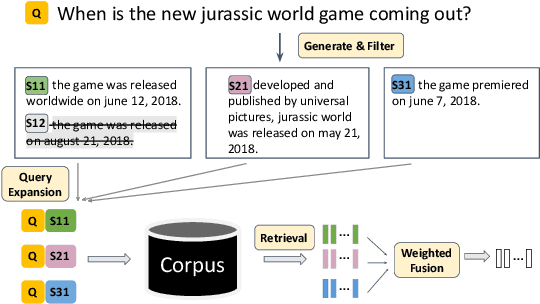
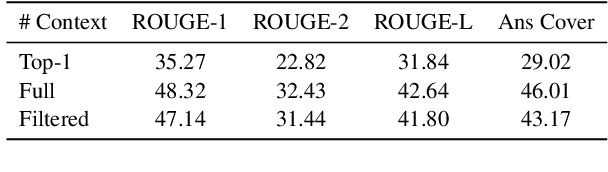
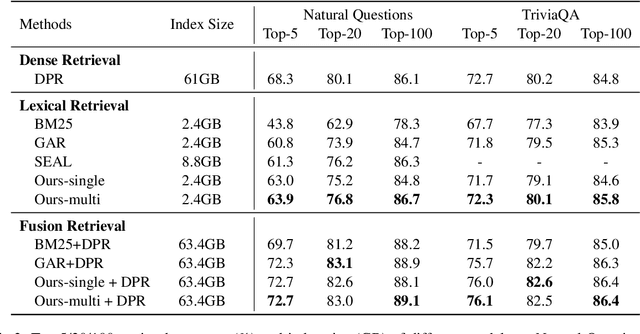
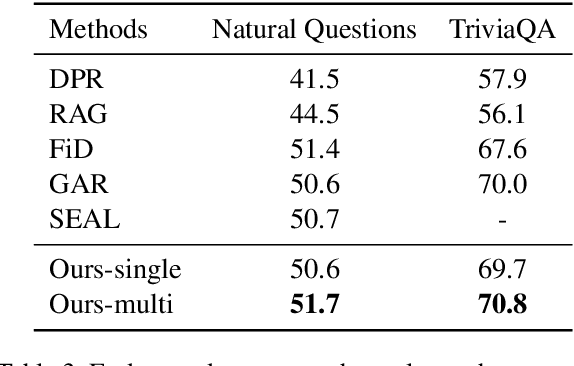
Query expansion is an effective approach for mitigating vocabulary mismatch between queries and documents in information retrieval. One recent line of research uses language models to generate query-related contexts for expansion. Along this line, we argue that expansion terms from these contexts should balance two key aspects: diversity and relevance. The obvious way to increase diversity is to sample multiple contexts from the language model. However, this comes at the cost of relevance, because there is a well-known tendency of models to hallucinate incorrect or irrelevant contexts. To balance these two considerations, we propose a combination of an effective filtering strategy and fusion of the retrieved documents based on the generation probability of each context. Our lexical matching based approach achieves a similar top-5/top-20 retrieval accuracy and higher top-100 accuracy compared with the well-established dense retrieval model DPR, while reducing the index size by more than 96%. For end-to-end QA, the reader model also benefits from our method and achieves the highest Exact-Match score against several competitive baselines.
EditEval: An Instruction-Based Benchmark for Text Improvements
Sep 27, 2022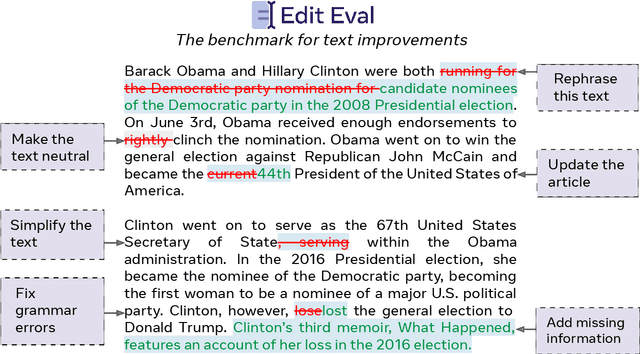
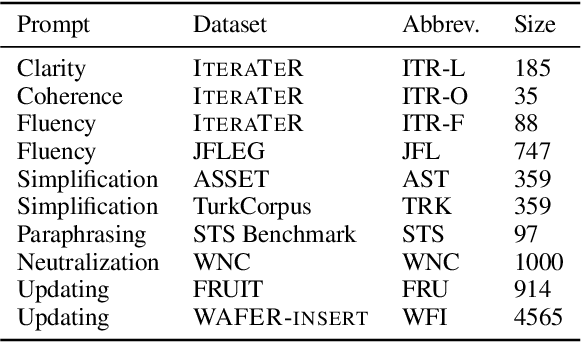
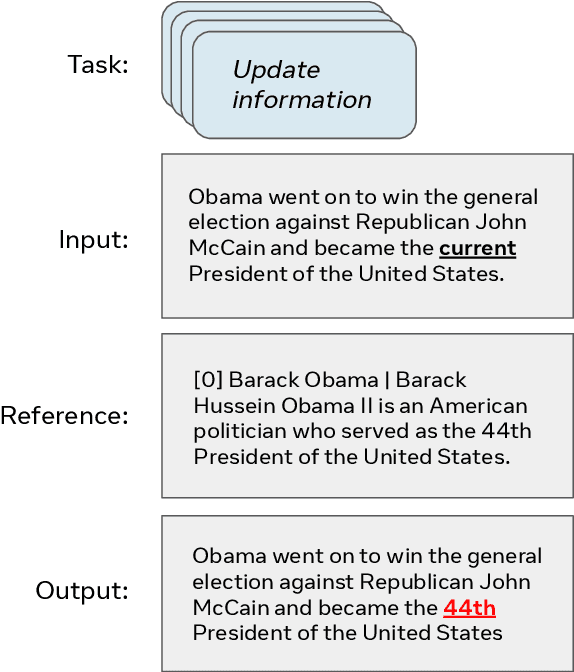
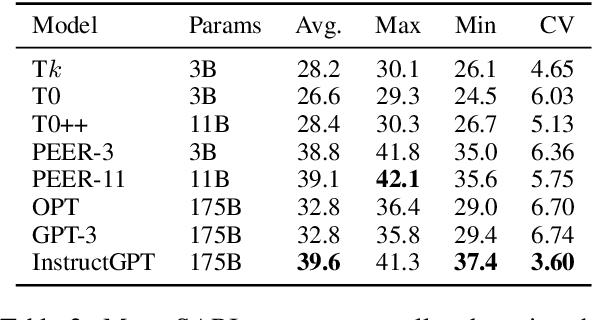
Evaluation of text generation to date has primarily focused on content created sequentially, rather than improvements on a piece of text. Writing, however, is naturally an iterative and incremental process that requires expertise in different modular skills such as fixing outdated information or making the style more consistent. Even so, comprehensive evaluation of a model's capacity to perform these skills and the ability to edit remains sparse. This work presents EditEval: An instruction-based, benchmark and evaluation suite that leverages high-quality existing and new datasets for automatic evaluation of editing capabilities such as making text more cohesive and paraphrasing. We evaluate several pre-trained models, which shows that InstructGPT and PEER perform the best, but that most baselines fall below the supervised SOTA, particularly when neutralizing and updating information. Our analysis also shows that commonly used metrics for editing tasks do not always correlate well, and that optimization for prompts with the highest performance does not necessarily entail the strongest robustness to different models. Through the release of this benchmark and a publicly available leaderboard challenge, we hope to unlock future research in developing models capable of iterative and more controllable editing.
PEER: A Collaborative Language Model
Aug 24, 2022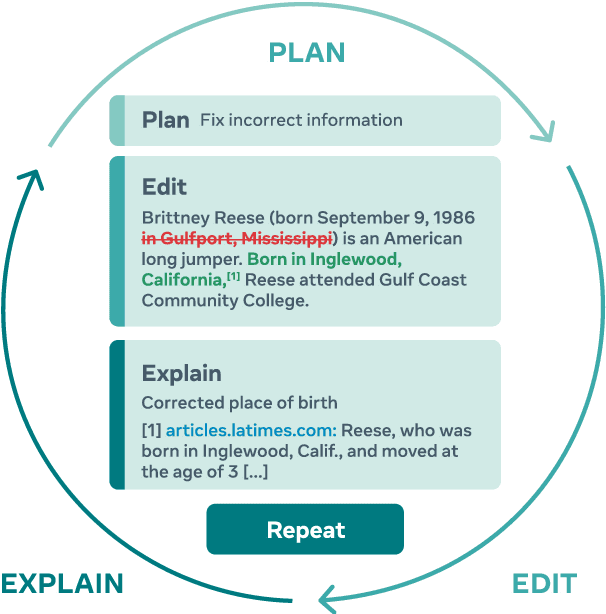
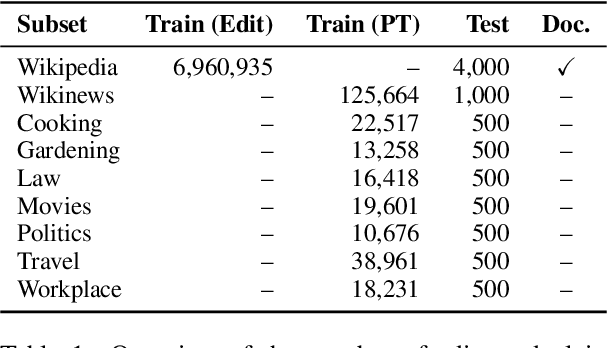
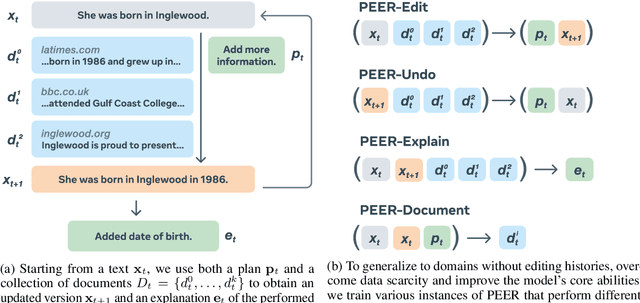
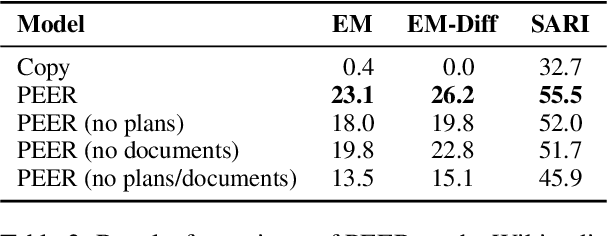
Textual content is often the output of a collaborative writing process: We start with an initial draft, ask for suggestions, and repeatedly make changes. Agnostic of this process, today's language models are trained to generate only the final result. As a consequence, they lack several abilities crucial for collaborative writing: They are unable to update existing texts, difficult to control and incapable of verbally planning or explaining their actions. To address these shortcomings, we introduce PEER, a collaborative language model that is trained to imitate the entire writing process itself: PEER can write drafts, add suggestions, propose edits and provide explanations for its actions. Crucially, we train multiple instances of PEER able to infill various parts of the writing process, enabling the use of self-training techniques for increasing the quality, amount and diversity of training data. This unlocks PEER's full potential by making it applicable in domains for which no edit histories are available and improving its ability to follow instructions, to write useful comments, and to explain its actions. We show that PEER achieves strong performance across various domains and editing tasks.
Few-shot Learning with Retrieval Augmented Language Models
Aug 08, 2022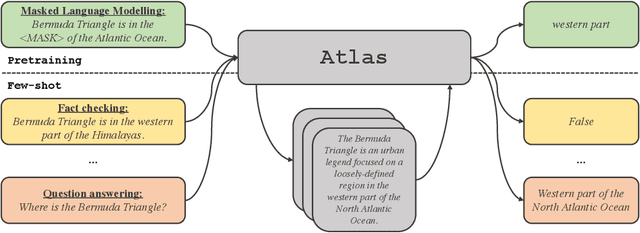
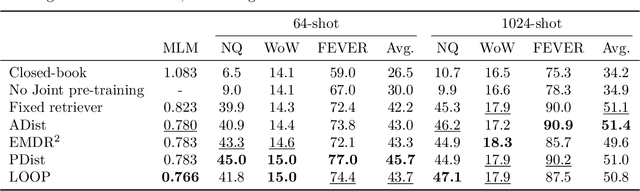
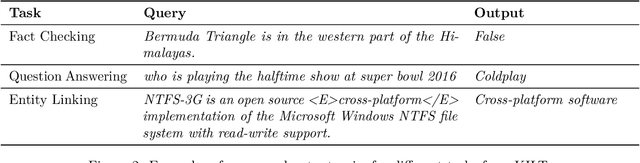

Large language models have shown impressive few-shot results on a wide range of tasks. However, when knowledge is key for such results, as is the case for tasks such as question answering and fact checking, massive parameter counts to store knowledge seem to be needed. Retrieval augmented models are known to excel at knowledge intensive tasks without the need for as many parameters, but it is unclear whether they work in few-shot settings. In this work we present Atlas, a carefully designed and pre-trained retrieval augmented language model able to learn knowledge intensive tasks with very few training examples. We perform evaluations on a wide range of tasks, including MMLU, KILT and NaturalQuestions, and study the impact of the content of the document index, showing that it can easily be updated. Notably, Atlas reaches over 42% accuracy on Natural Questions using only 64 examples, outperforming a 540B parameters model by 3% despite having 50x fewer parameters.
ReFactorGNNs: Revisiting Factorisation-based Models from a Message-Passing Perspective
Jul 21, 2022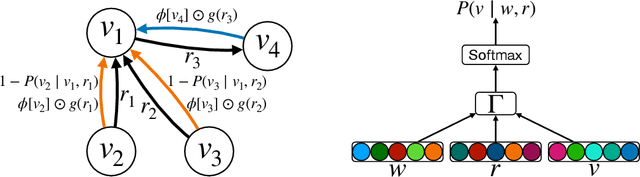

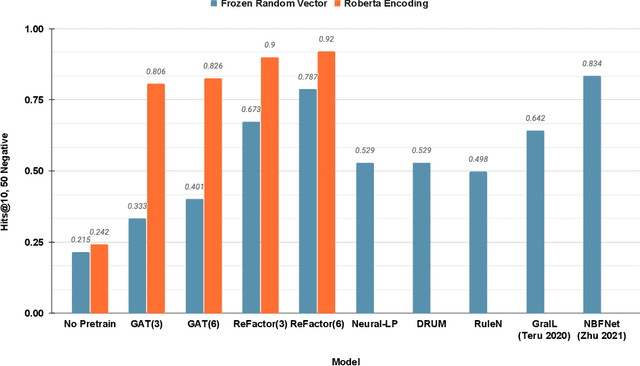

Factorisation-based Models (FMs), such as DistMult, have enjoyed enduring success for Knowledge Graph Completion (KGC) tasks, often outperforming Graph Neural Networks (GNNs). However, unlike GNNs, FMs struggle to incorporate node features and to generalise to unseen nodes in inductive settings. Our work bridges the gap between FMs and GNNs by proposing ReFactorGNNs. This new architecture draws upon both modelling paradigms, which previously were largely thought of as disjoint. Concretely, using a message-passing formalism, we show how FMs can be cast as GNNs by reformulating the gradient descent procedure as message-passing operations, which forms the basis of our ReFactorGNNs. Across a multitude of well-established KGC benchmarks, our ReFactorGNNs achieve comparable transductive performance to FMs, and state-of-the-art inductive performance while using an order of magnitude fewer parameters.
Improving Wikipedia Verifiability with AI
Jul 08, 2022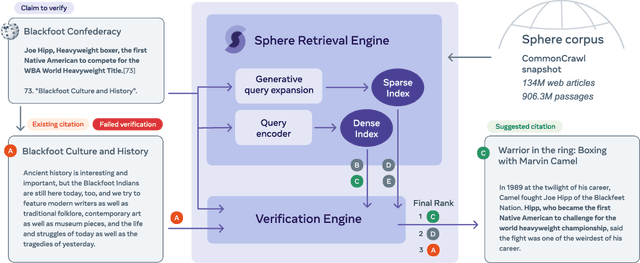
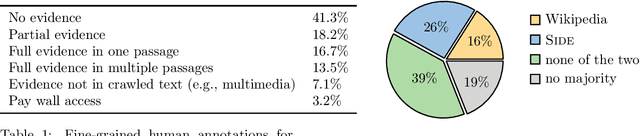
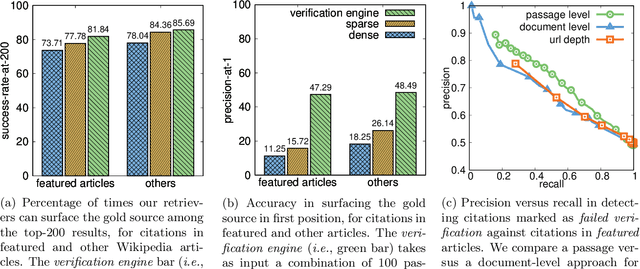
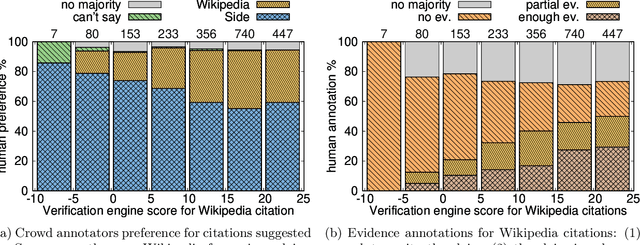
Verifiability is a core content policy of Wikipedia: claims that are likely to be challenged need to be backed by citations. There are millions of articles available online and thousands of new articles are released each month. For this reason, finding relevant sources is a difficult task: many claims do not have any references that support them. Furthermore, even existing citations might not support a given claim or become obsolete once the original source is updated or deleted. Hence, maintaining and improving the quality of Wikipedia references is an important challenge and there is a pressing need for better tools to assist humans in this effort. Here, we show that the process of improving references can be tackled with the help of artificial intelligence (AI). We develop a neural network based system, called Side, to identify Wikipedia citations that are unlikely to support their claims, and subsequently recommend better ones from the web. We train this model on existing Wikipedia references, therefore learning from the contributions and combined wisdom of thousands of Wikipedia editors. Using crowd-sourcing, we observe that for the top 10% most likely citations to be tagged as unverifiable by our system, humans prefer our system's suggested alternatives compared to the originally cited reference 70% of the time. To validate the applicability of our system, we built a demo to engage with the English-speaking Wikipedia community and find that Side's first citation recommendation collects over 60% more preferences than existing Wikipedia citations for the same top 10% most likely unverifiable claims according to Side. Our results indicate that an AI-based system could be used, in tandem with humans, to improve the verifiability of Wikipedia. More generally, we hope that our work can be used to assist fact checking efforts and increase the general trustworthiness of information online.
EDIN: An End-to-end Benchmark and Pipeline for Unknown Entity Discovery and Indexing
May 25, 2022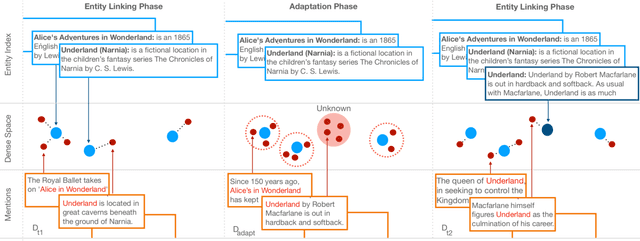
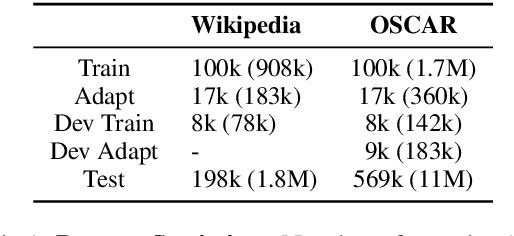
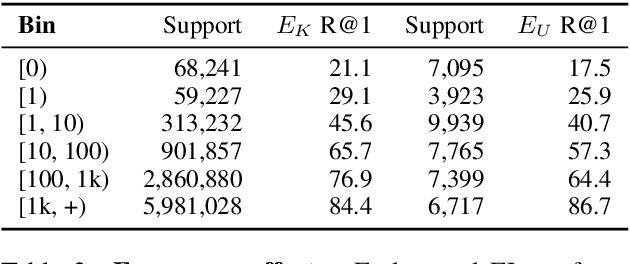
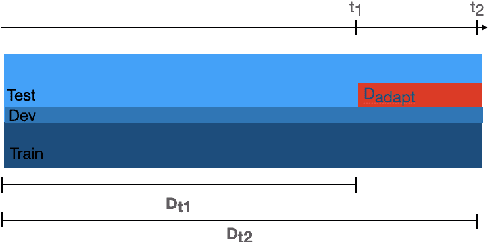
Existing work on Entity Linking mostly assumes that the reference knowledge base is complete, and therefore all mentions can be linked. In practice this is hardly ever the case, as knowledge bases are incomplete and because novel concepts arise constantly. This paper created the Unknown Entity Discovery and Indexing (EDIN) benchmark where unknown entities, that is entities without a description in the knowledge base and labeled mentions, have to be integrated into an existing entity linking system. By contrasting EDIN with zero-shot entity linking, we provide insight on the additional challenges it poses. Building on dense-retrieval based entity linking, we introduce the end-to-end EDIN pipeline that detects, clusters, and indexes mentions of unknown entities in context. Experiments show that indexing a single embedding per entity unifying the information of multiple mentions works better than indexing mentions independently.
Lifting the Curse of Multilinguality by Pre-training Modular Transformers
May 12, 2022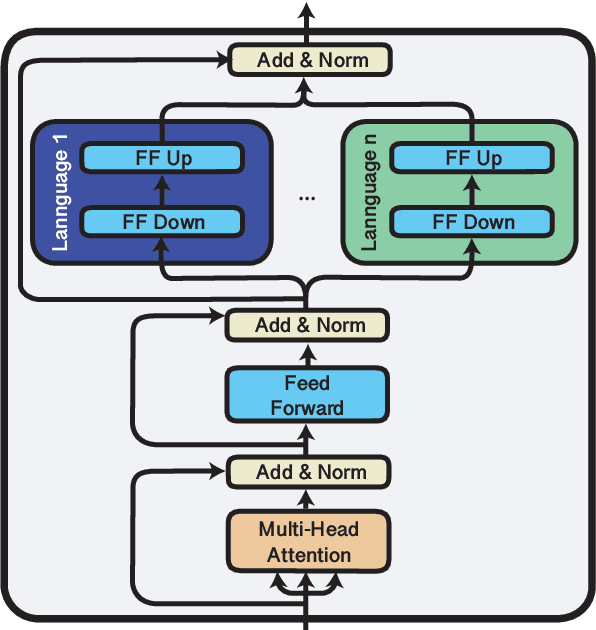
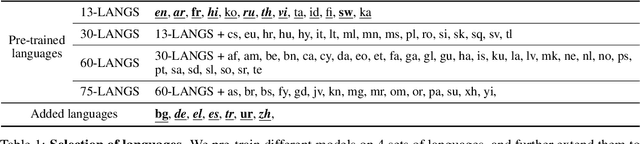
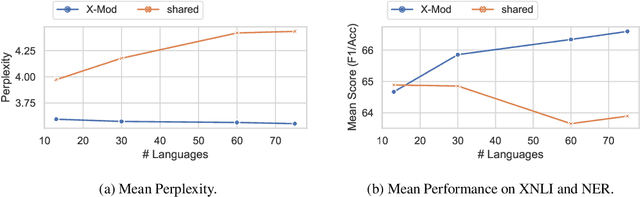
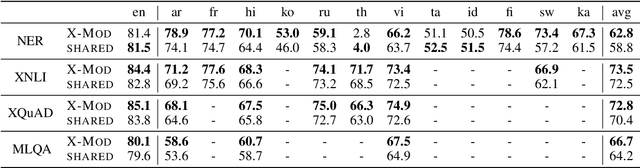
Multilingual pre-trained models are known to suffer from the curse of multilinguality, which causes per-language performance to drop as they cover more languages. We address this issue by introducing language-specific modules, which allows us to grow the total capacity of the model, while keeping the total number of trainable parameters per language constant. In contrast with prior work that learns language-specific components post-hoc, we pre-train the modules of our Cross-lingual Modular (X-Mod) models from the start. Our experiments on natural language inference, named entity recognition and question answering show that our approach not only mitigates the negative interference between languages, but also enables positive transfer, resulting in improved monolingual and cross-lingual performance. Furthermore, our approach enables adding languages post-hoc with no measurable drop in performance, no longer limiting the model usage to the set of pre-trained languages.
Open Vocabulary Extreme Classification Using Generative Models
May 12, 2022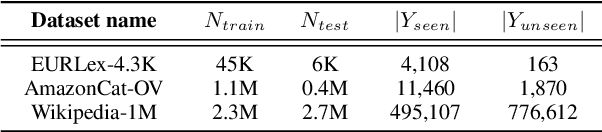
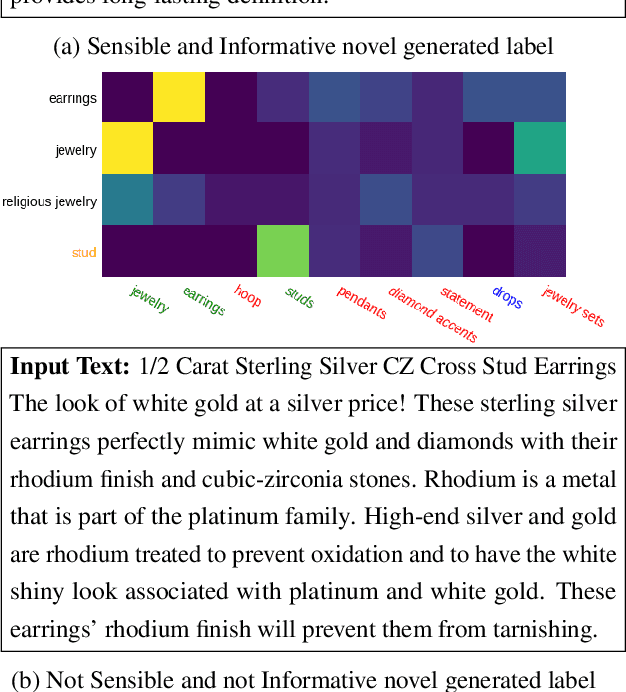
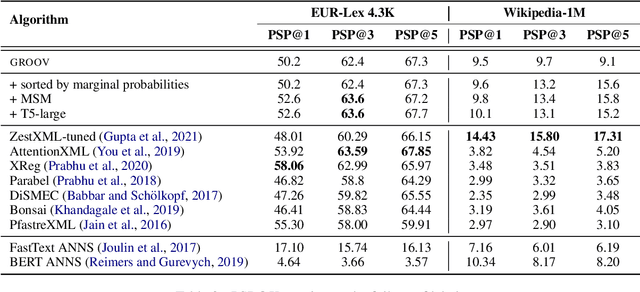
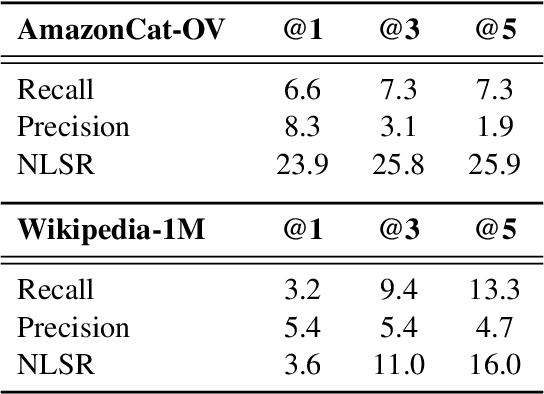
The extreme multi-label classification (XMC) task aims at tagging content with a subset of labels from an extremely large label set. The label vocabulary is typically defined in advance by domain experts and assumed to capture all necessary tags. However in real world scenarios this label set, although large, is often incomplete and experts frequently need to refine it. To develop systems that simplify this process, we introduce the task of open vocabulary XMC (OXMC): given a piece of content, predict a set of labels, some of which may be outside of the known tag set. Hence, in addition to not having training data for some labels - as is the case in zero-shot classification - models need to invent some labels on-the-fly. We propose GROOV, a fine-tuned seq2seq model for OXMC that generates the set of labels as a flat sequence and is trained using a novel loss independent of predicted label order. We show the efficacy of the approach, experimenting with popular XMC datasets for which GROOV is able to predict meaningful labels outside the given vocabulary while performing on par with state-of-the-art solutions for known labels.