 Add to Chrome
 Add to Firefox
 Add to Edge
Hierarchical Experimentalist Agents
Jun 28, 2026
Large language models (LLMs) are increasingly used to take actions in the real world and support human decision-making, yet most agents rely on parametric knowledge, fixed post-training data, retrieval, or search. This paradigm breaks down in novel domains and for sophisticated queries that cannot be answered from prior knowledge alone. Knowing the laws of physics, for instance, does not by itself enable LLMs to answer queries or complete long-horizon tasks in a complex physical system. To address this, we introduce Hierarchical Experimentalist Agents (HExA), an in-context self-improvement framework to learn from active experimentation. HExA iteratively designs and refines query-relevant experiments, learns a reusable library of composable skills from experience, and integrates experimental evidence to answer queries or take actions. HExA is training-free, compatible with any black-box model, and does not require external supervision, oracles, or offline data. To evaluate active experimentation, we introduce Interphyre, a tool-calling benchmark built on the PHYRE 2D procedural physics environment, where agents propose interventions and test hypotheses through simulation APIs. Experiments show that current LLM agents struggle in these settings, especially on the hardest levels of Interphyre. Claude Sonnet 4.6 achieves only 2% success, while HExA improves the same model to up to 77% success. HExA also improves open-weight models and outperforms agentic baselines such as ReAct and Reflexion. Moreover, using only skills learned from easier levels and transferred without active experimentation, HExA achieves 44% success, demonstrating the reusability and generalization of its learned skills. Overall, HExA shows that learning through active experimentation can help agents discover useful knowledge, acquire reusable skills, and make efficient progress on novel long-horizon tasks.

The Curse of Multiple Mediators: Hidden Interaction Effects in Activation Patching
Jun 25, 2026Activation patching is the primary tool in mechanistic interpretability. It attributes causal responsibility for a model behavior to each of its individual components by estimating its natural indirect effect (NIE). Re-deriving the activation patching estimand from causal mediation analysis, we find that the NIE does not solely capture the causal effect through the specific component. It also contains interaction effects (INT) that measure how much the component's causal effect itself depends on the state of other components in the model. A natural response may be to try to eliminate INT by adjusting the estimator or unit of analysis, but each of these potential remedies has predictable failure modes. We demonstrate these failure modes in the GPT-2 IOI circuit; components whose causal importance is conditional on the state of other components are either invisible or artificially inflated, and INT variance explains the previously documented instability of faithfulness scores. We prove that INT scales with the distance between clean and patched component activations, is negligible when the model is locally affine, and decomposes combinatorially into pairwise and higher-order group interactions. Despite its inevitability, INT is not a nuisance to be eliminated, but rather a diagnostic for interpretability studies. Its individual and group-level magnitude and sign signal when causal conclusions are prompt-dependent, and when greedy NIE-based component ranking will miss mechanisms only discoverable through combinatorial search.
Evaluation Awareness Is Not One Capability: Evidence from Open Language Models
Jun 22, 2026Safety benchmarks assume that test-condition behavior predicts deployment behavior, an assumption that fails if models detect evaluation cues and adapt. This opens a gap between benchmark performance and deployment behavior: compliance measured under test conditions becomes an optimistic upper bound that overstates how safely a model behaves once the evaluation harness is removed. We characterize this evaluation awareness through eight experiments across 37 open-weight models and seven families. (i)Detection is moderate and training-driven (24/37 models exceed chance, best AUROC 0.714 vs.0.819 human, with instruction tuning dominating over scale). (ii)Detection shifts safety behavior (hard refusal drops 5.8 percentage points under hypothetical framing, and 21/140 HarmBench framing effects are significant, with compliance rising up to +30 percentage points. (iii)Representations survive behavioral collapse (probes retain AUROC 0.98 under rewrites that drive behavior below chance, and multi-layer steering causally moves three downstream tasks while random controls do not). (iv)These axes are weakly coupled (only 1/15 correlations are significant, the sole robust link being behavioral detection versus framing resistance, $ρ=-0.79$, $p<0.001$). We call this gap the benchmark illusion: because detectability, behavioral manifestation, and controllability vary independently, it is multivariate rather than a single number, so no single awareness score is a reliable proxy for deployment safety.
Detecting and Characterizing Planning in Language Models
Aug 25, 2025Modern large language models (LLMs) have demonstrated impressive performance across a wide range of multi-step reasoning tasks. Recent work suggests that LLMs may perform planning - selecting a future target token in advance and generating intermediate tokens that lead towards it - rather than merely improvising one token at a time. However, existing studies assume fixed planning horizons and often focus on single prompts or narrow domains. To distinguish planning from improvisation across models and tasks, we present formal and causally grounded criteria for detecting planning and operationalize them as a semi-automated annotation pipeline. We apply this pipeline to both base and instruction-tuned Gemma-2-2B models on the MBPP code generation benchmark and a poem generation task where Claude 3.5 Haiku was previously shown to plan. Our findings show that planning is not universal: unlike Haiku, Gemma-2-2B solves the same poem generation task through improvisation, and on MBPP it switches between planning and improvisation across similar tasks and even successive token predictions. We further show that instruction tuning refines existing planning behaviors in the base model rather than creating them from scratch. Together, these studies provide a reproducible and scalable foundation for mechanistic studies of planning in LLMs.
Adaptive Circuit Behavior and Generalization in Mechanistic Interpretability
Nov 25, 2024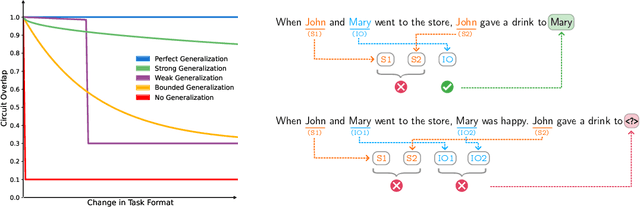

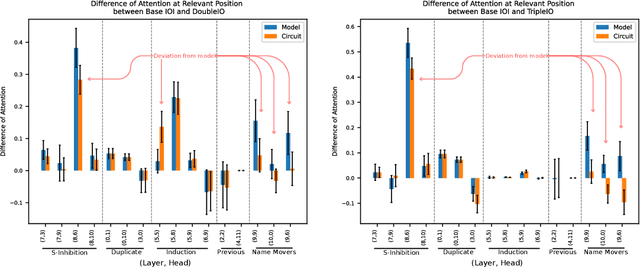
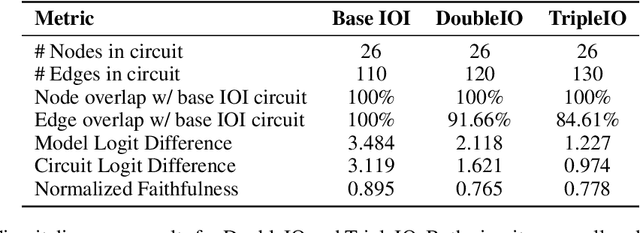
Mechanistic interpretability aims to understand the inner workings of large neural networks by identifying circuits, or minimal subgraphs within the model that implement algorithms responsible for performing specific tasks. These circuits are typically discovered and analyzed using a narrowly defined prompt format. However, given the abilities of large language models (LLMs) to generalize across various prompt formats for the same task, it remains unclear how well these circuits generalize. For instance, it is unclear whether the models generalization results from reusing the same circuit components, the components behaving differently, or the use of entirely different components. In this paper, we investigate the generality of the indirect object identification (IOI) circuit in GPT-2 small, which is well-studied and believed to implement a simple, interpretable algorithm. We evaluate its performance on prompt variants that challenge the assumptions of this algorithm. Our findings reveal that the circuit generalizes surprisingly well, reusing all of its components and mechanisms while only adding additional input edges. Notably, the circuit generalizes even to prompt variants where the original algorithm should fail; we discover a mechanism that explains this which we term S2 Hacking. Our findings indicate that circuits within LLMs may be more flexible and general than previously recognized, underscoring the importance of studying circuit generalization to better understand the broader capabilities of these models.
Judging the Judges: Evaluating Alignment and Vulnerabilities in LLMs-as-Judges
Jun 18, 2024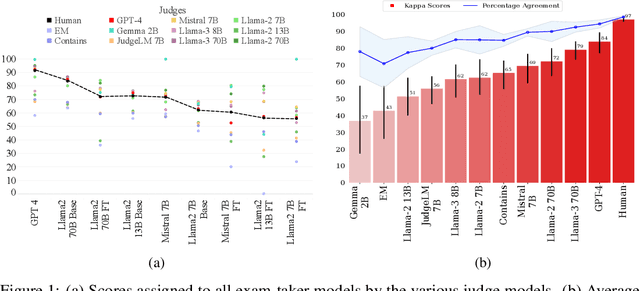

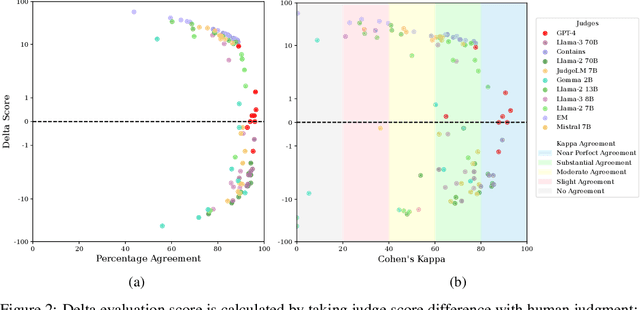

Offering a promising solution to the scalability challenges associated with human evaluation, the LLM-as-a-judge paradigm is rapidly gaining traction as an approach to evaluating large language models (LLMs). However, there are still many open questions about the strengths and weaknesses of this paradigm, and what potential biases it may hold. In this paper, we present a comprehensive study of the performance of various LLMs acting as judges. We leverage TriviaQA as a benchmark for assessing objective knowledge reasoning of LLMs and evaluate them alongside human annotations which we found to have a high inter-annotator agreement. Our study includes 9 judge models and 9 exam taker models -- both base and instruction-tuned. We assess the judge model's alignment across different model sizes, families, and judge prompts. Among other results, our research rediscovers the importance of using Cohen's kappa as a metric of alignment as opposed to simple percent agreement, showing that judges with high percent agreement can still assign vastly different scores. We find that both Llama-3 70B and GPT-4 Turbo have an excellent alignment with humans, but in terms of ranking exam taker models, they are outperformed by both JudgeLM-7B and the lexical judge Contains, which have up to 34 points lower human alignment. Through error analysis and various other studies, including the effects of instruction length and leniency bias, we hope to provide valuable lessons for using LLMs as judges in the future.
Automated Discovery of Functional Actual Causes in Complex Environments
Apr 16, 2024

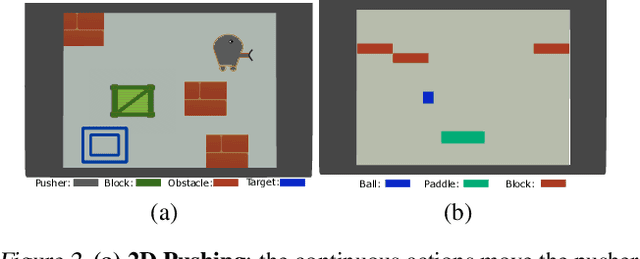

Reinforcement learning (RL) algorithms often struggle to learn policies that generalize to novel situations due to issues such as causal confusion, overfitting to irrelevant factors, and failure to isolate control of state factors. These issues stem from a common source: a failure to accurately identify and exploit state-specific causal relationships in the environment. While some prior works in RL aim to identify these relationships explicitly, they rely on informal domain-specific heuristics such as spatial and temporal proximity. Actual causality offers a principled and general framework for determining the causes of particular events. However, existing definitions of actual cause often attribute causality to a large number of events, even if many of them rarely influence the outcome. Prior work on actual causality proposes normality as a solution to this problem, but its existing implementations are challenging to scale to complex and continuous-valued RL environments. This paper introduces functional actual cause (FAC), a framework that uses context-specific independencies in the environment to restrict the set of actual causes. We additionally introduce Joint Optimization for Actual Cause Inference (JACI), an algorithm that learns from observational data to infer functional actual causes. We demonstrate empirically that FAC agrees with known results on a suite of examples from the actual causality literature, and JACI identifies actual causes with significantly higher accuracy than existing heuristic methods in a set of complex, continuous-valued environments.
Hypergraph Clustering: A Modularity Maximization Approach
Dec 28, 2018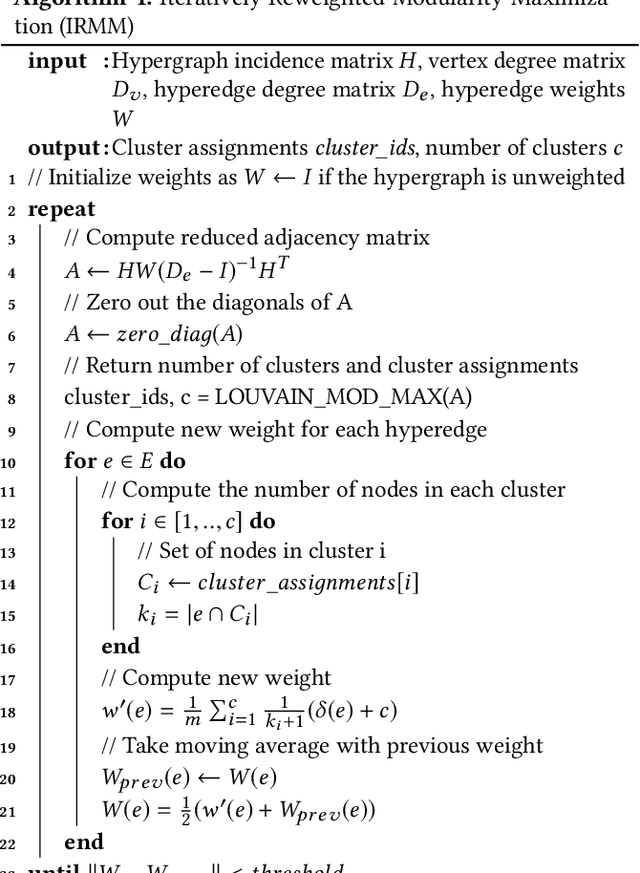

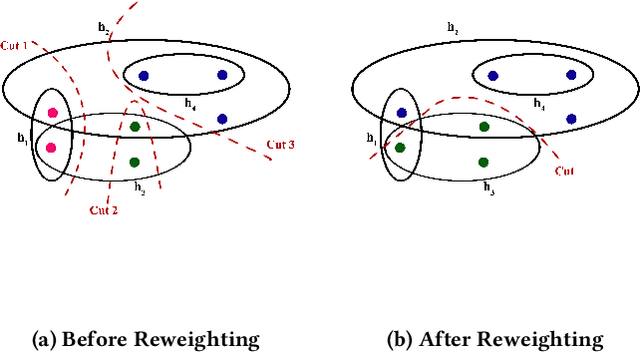
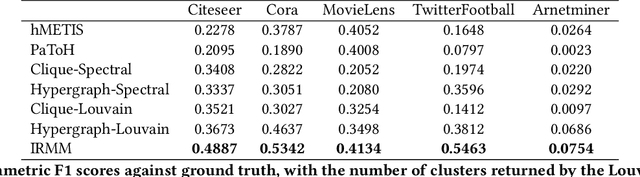
Clustering on hypergraphs has been garnering increased attention with potential applications in network analysis, VLSI design and computer vision, among others. In this work, we generalize the framework of modularity maximization for clustering on hypergraphs. To this end, we introduce a hypergraph null model, analogous to the configuration model on undirected graphs, and a node-degree preserving reduction to work with this model. This is used to define a modularity function that can be maximized using the popular and fast Louvain algorithm. We additionally propose a refinement over this clustering, by reweighting cut hyperedges in an iterative fashion. The efficacy and efficiency of our methods are demonstrated on several real-world datasets.