 Add to Chrome
 Add to Firefox
 Add to Edge
SciSchema.org: A Multidisciplinary Collection of Schemas for Structured Scientific Process Descriptions
Jul 30, 2026
Scientific processes are often described in heterogeneous article discourse, with details needed for comparison, reproducibility, reuse, and automation dispersed across prose, tables, figures, protocols, and supplementary files. We present the first release of SciSchema.org, a multidisciplinary collection of 16 expert-annotated schemas spanning Biology & Biotechnology, Materials & Chemistry, Imaging & Measurement, Physics, and Psychology. Each schema defines reusable fields for describing process instances, including inputs, outputs, materials, instruments or software, parameters, conditions, procedural steps, measurements, and provenance-related information. The schemas were created through a human-in-the-loop schema-mining workflow in which large language models generated candidate structures from process specifications, scientific articles, and expert feedback, followed by domain-expert construction of final master schemas. The dataset contains final schemas in JSON Schema and SHACL formats, intermediate model-generated schemas, expert-feedback records, source-paper metadata, community-development materials, and analysis scripts. Technical validation assessed schema structure, development provenance, expert review, and syntactic conformance. The collection supports structured annotation, metadata enrichment, scientific knowledge graphs, information extraction, semantic publishing, and cross-study comparison.

MPSelectTune: Prompt-type Selection for Fine-tuning improves Concept Unlearning in LLMs
Jul 04, 2026LLMs can be conveniently adapted to a diverse set of tasks, e.g, prediction, question-answering tasks, etc, using appropriate prompts with few-shot examples. Biased or harmful concepts, e.g. gender or bio-weapons, present in pre-trained LLMs can lead to unsafe or unethical responses for many such prompts. Removing such undesirable concepts robustly across different prompt types remains a challenging problem, since existing unlearning methods typically ignore the impact of prompt variation. In this paper, we explore a novel adversarial approach to use a joint prompt for the main task and concept task prediction. We show that fine-tuning using the ``worst prompt type'' for concept prediction (with the highest concept accuracy) improves the average unlearning performance over a fine-tuning method that uses a combination of all prompt types. Our proposed method, MPSelectTune, is a two-stage approach that minimizes the concept accuracy of the highest accuracy-prompt type, after fine-tuning using a novel multi-task loss using multiple prompt types. Experimental results on four benchmarks show $2 - 15\%$ main task accuracy improvements over recent baselines and while reducing the worst-case concept accuracy by up to $17\%$ compared to recent baselines.
Erasing CLIP Memories: Non-Destructive, Data-Free Zero-Shot class Unlearning in CLIP Models
Dec 16, 2025We introduce a novel, closed-form approach for selective unlearning in multimodal models, specifically targeting pretrained models such as CLIP. Our method leverages nullspace projection to erase the target class information embedded in the final projection layer, without requiring any retraining or the use of images from the forget set. By computing an orthonormal basis for the subspace spanned by target text embeddings and projecting these directions, we dramatically reduce the alignment between image features and undesired classes. Unlike traditional unlearning techniques that rely on iterative fine-tuning and extensive data curation, our approach is both computationally efficient and surgically precise. This leads to a pronounced drop in zero-shot performance for the target classes while preserving the overall multimodal knowledge of the model. Our experiments demonstrate that even a partial projection can balance between complete unlearning and retaining useful information, addressing key challenges in model decontamination and privacy preservation.
Selective, Controlled and Domain-Agnostic Unlearning in Pretrained CLIP: A Training- and Data-Free Approach
Dec 16, 2025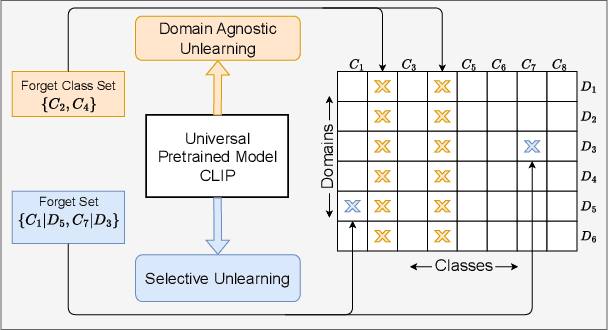
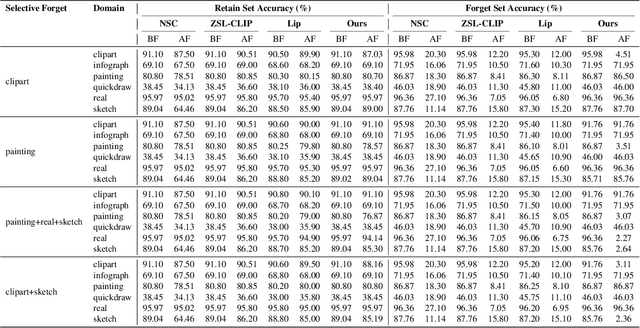
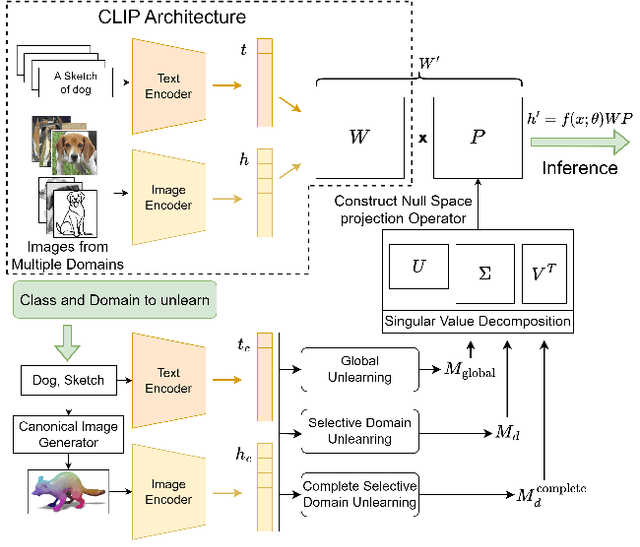
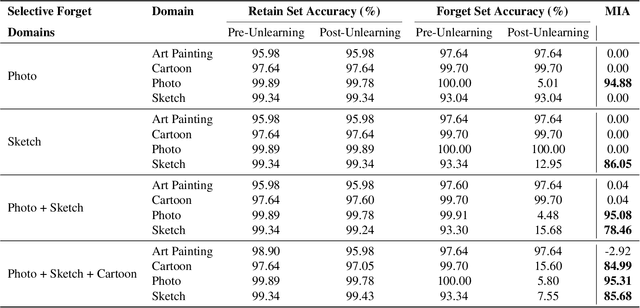
Pretrained models like CLIP have demonstrated impressive zero-shot classification capabilities across diverse visual domains, spanning natural images, artistic renderings, and abstract representations. However, real-world applications often demand the removal (or "unlearning") of specific object classes without requiring additional data or retraining, or affecting the model's performance on unrelated tasks. In this paper, we propose a novel training- and data-free unlearning framework that enables three distinct forgetting paradigms: (1) global unlearning of selected objects across all domains, (2) domain-specific knowledge removal (e.g., eliminating sketch representations while preserving photo recognition), and (3) complete unlearning in selective domains. By leveraging a multimodal nullspace through synergistic integration of text prompts and synthesized visual prototypes derived from CLIP's joint embedding space, our method efficiently removes undesired class information while preserving the remaining knowledge. This approach overcomes the limitations of existing retraining-based methods and offers a flexible and computationally efficient solution for controlled model forgetting.
Evaluating Table Structure Recognition: A New Perspective
Jul 31, 2022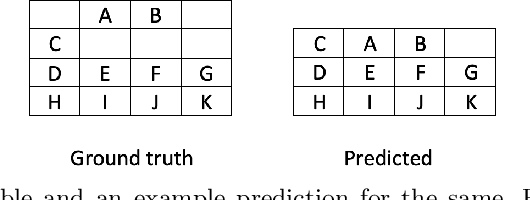
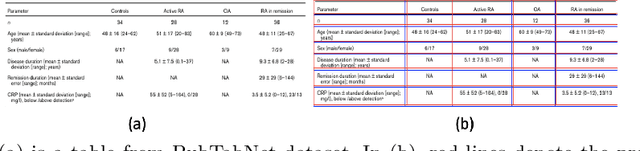
Existing metrics used to evaluate table structure recognition algorithms have shortcomings with regard to capturing text and empty cells alignment. In this paper, we build on prior work and propose a new metric - TEDS based IOU similarity (TEDS (IOU)) for table structure recognition which uses bounding boxes instead of text while simultaneously being robust against the above disadvantages. We demonstrate the effectiveness of our metric against previous metrics through various examples.
Hypergraph Clustering: A Modularity Maximization Approach
Dec 28, 2018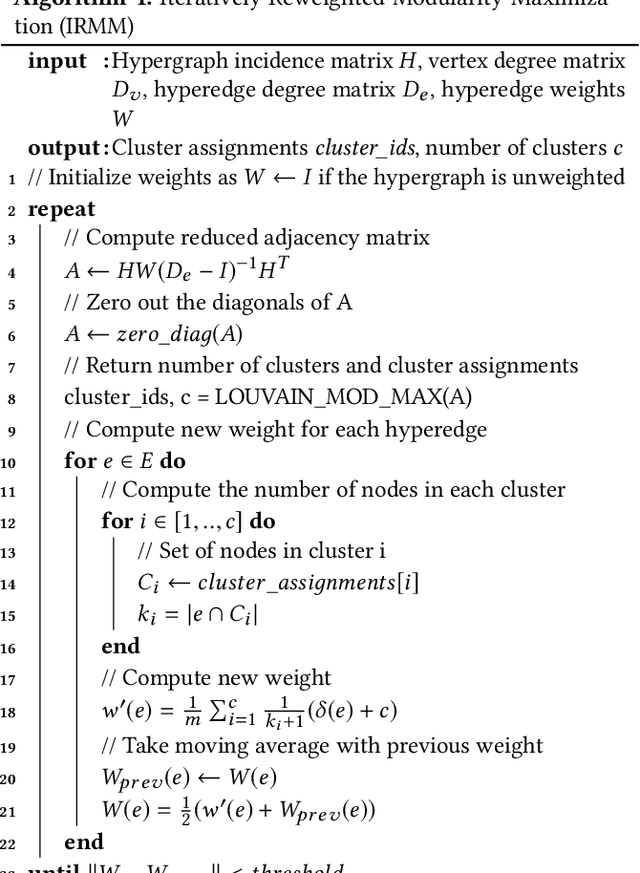

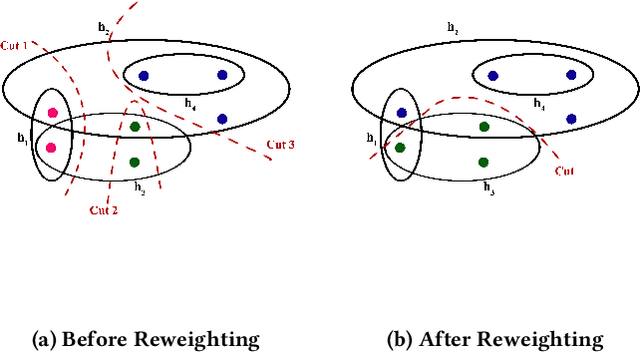
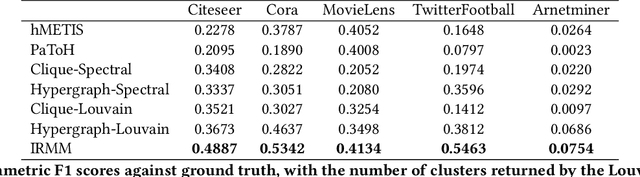
Clustering on hypergraphs has been garnering increased attention with potential applications in network analysis, VLSI design and computer vision, among others. In this work, we generalize the framework of modularity maximization for clustering on hypergraphs. To this end, we introduce a hypergraph null model, analogous to the configuration model on undirected graphs, and a node-degree preserving reduction to work with this model. This is used to define a modularity function that can be maximized using the popular and fast Louvain algorithm. We additionally propose a refinement over this clustering, by reweighting cut hyperedges in an iterative fashion. The efficacy and efficiency of our methods are demonstrated on several real-world datasets.