 Add to Chrome
 Add to Firefox
 Add to Edge
AI and Consumer Rights in India Working Paper
Aug 13, 2026
As AI systems proliferate in consumer facing applications, questions about liability for AI related harms remain unresolved. This working paper examines whether India's Consumer Protection Act, 2019, adequately addresses harm caused by defective AI products and services, and whether it proportionately allocates liability across the AI value chain. The Act's broad definitions of product liability, harm, and deficiency appear technology agnostic and potentially applicable to AI related incidents including personal injury, psychological harm, biased outputs, and loss of control. However, significant gaps remain. Proving causation between AI defects and consumer harm presents a technical challenge, as AI failures often stem from design choices rather than discrete defects. Additionally, the Act's framework assumes distinct roles for manufacturers, sellers, and service providers, yet the AI value chain involves overlapping responsibilities among data providers, model developers, deployers, and users that do not neatly map to these categories. Current liability frameworks lack proportionate mechanisms to effectively address complex, multistakeholder AI harms. While the Act may cover AI entities, enforcement requires clarification on sector specific overlaps.

KANEx: Translating Kolmogorov-Arnold Networks' Interpretability to Medical Explainability
Jul 27, 2026Computer vision models have become highly effective for medical applications, yet their black-box nature continues to undermine clinician trust. In clinical workflows, chest X-ray classifiers are increasingly paired with Vision-Language Models (VLMs) to generate natural-language explanations. However, these systems add linguistic fluency without addressing the underlying opacity of the visual model. With the emergence of Kolmogorov-Arnold Networks (KANs), whose spline-based components provide inherently interpretable functional units, we investigate whether this architectural transparency can be leveraged to produce more trustworthy textual explanations. We introduce KANEx, the first ever framework that leverages the symbolic transparency of KANs to ground VLM reasoning. This interpretability also made it possible to design KAN-Map, a novel heatmap generation method derived directly from KAN models rather than gradient approximations. We feed these grounded contexts into downstream VLMs for enhanced explainability. Benchmarked on the MIMIC-CXR dataset, we demonstrate that KAN-based architectures with ResNet/ViT baselines demonstrate improved semantic similarity while producing significantly more faithful saliency maps. KAN architectures improve visual localization and downstream reasoning quality by 10%. Our findings suggest that grounding linguistic explanations and visual attributions in mathematically interpretable units is a necessary step toward trustworthy medical AI.
Pluralis v0.1: Towards a Multicultural, Multimodal, Multilingual Benchmark for AI Risk and Reliability
Jul 07, 2026Current AI safety evaluation and benchmarking frameworks predominantly rely on Western-centric culture-agnostic defaults that mask critical regional laws, socio-linguistic nuances, and cultural taboos, leaving Vision-Language Models (VLMs) vulnerable in global deployments. We introduce Pluralis v0.1: a novel multimodal, multi-regional, and multilingual dataset built from a culture-first perspective. Spanning 6,448 prompts across six Asia-Pacific countries (Bangladesh, India, Korea, Pakistan, Singapore, Taiwan) and eight languages, Pluralis diverges from prior work by natively sourcing localized safety hazards rather than adapting Western datasets. Crucially, it introduces a multimodal evaluation paradigm: user text (e.g., "Should I gift this?") and an image referring to "this" (e.g., a clock) - both innocuous in isolation, but synergistically triggering specific legal or cultural violations. Pluralis disentangles universal safety violations from localized cultural appropriateness, establishing the latter as a first-class evaluation axis. To operationalize this, we present Judge-Pluralis, an agreement-gated LLM-as-a-Judge ensemble trained on examples classified in an empirically derived cultural taxonomy. Observing VLM behavior on a subset of the Pluralis surfaces recurring, locale-specific failure modes such as image misidentifications with downstream harm, missed item-context-locale interactions, and inadequate refusals. These failure modes vary systematically across locales and languages, exposing blind spots that globally averaged metrics conceal. Ultimately, Pluralis is not presented as a solved evaluation framework for cultural alignment, but rather as a first step and catalyst for future innovation. We call upon the research community to utilize this foundation to advance the science of multilingual, multicultural evaluation to better support AI cultural alignment globally.
How Much Online RL is Enough? Informative Rollouts for Offline Preference Optimization in RLVR
May 20, 2026Reinforcement Learning from Verifiable Rewards (RLVR) has emerged as a powerful paradigm for reasoning in language models, with GRPO as its primary example. However, GRPO requires continuous online rollout generation, making it computationally expensive and difficult to scale. While Direct Preference Optimization (DPO) offers a stable and efficient offline alternative, it is typically expected to underperform w.r.t. online RL methods such as GRPO when trained on rollouts from a cold supervised fine-tuned (SFT) policy. We introduce G2D (GRPO to DPO)}, a three-stage pipeline that performs a short GRPO warm-up, constructs a static preference dataset, and fine-tunes a model offline with DPO. Across a set of values of the number of online steps (K) in GRPO on Qwen2.5-7B and Llama-3.1-8B, we find that offline DPO with moderate warm-up matches or outperforms GRPO at substantially lower compute cost in our setting. On Qwen2.5-7B, G2D at K=150 achieves 62.4% on MATH-500, outperforming GRPO (51.6%) by 10.8% at ~4x lower compute. On Llama-3.1-8B, G2D at K=500 achieves 49.4%, surpassing GRPO in our experimental setting. We show that performance is not governed by the number of preference pairs, which does not vary much w.r.t. K, but by their informativeness. Moderate warm-up produces rollouts with calibrated uncertainty, yielding stronger contrastive signal, while excessive warm-up leads to overconfident policies and less informative data. Our results recast the offline-online gap in RLVR as primarily a data informativeness problem, and identify short online RL warm-up with appropriate difficulty calibration of the fine-tuning dataset as a compute-efficient alternative to online RL.
PREFINE: Preference-Based Implicit Reward and Cost Fine-Tuning for Safety Alignment
May 20, 2026We address the problem of making a pre-trained reinforcement learning (RL) policy safety-aware by incorporating cost constraints without retraining it from scratch. While costs could be numerically encoded, we assume a more general setting is when costs are provided as preferences. Given a reward-optimized policy and a small dataset of preferred (low-cost) and dispreferred (high-cost) trajectories, our goal is to fine-tune the policy to generate low-cost behaviors while retaining high rewards. Unlike standard RLHF in language models, where preferences are defined over responses to the same prompt, our setting involves trajectory-level preferences in continuous control environments. We introduce PREFINE: Preference-based Implicit Reward and Cost Fine-Tuning for Safety Alignment which is a preference-based fine-tuning method that adapts Direct Preference Optimization (DPO), which is now widely used for LLM fine-tuning, to the sequential decision making setting. PREFINE constructs policy-sampled counterfactual trajectories to establish meaningful preference contrasts and jointly optimizes for reward retention and safety alignment. Empirically, PREFINE reduces constraint violations and catastrophic failures by over 60% while maintaining original reward behavior. PREFINE produces policies that achieve low-cost, high-reward performance with significantly improved data and computational efficiency compared to full offline RL or imitation learning, bridging preference alignment and safe policy adaptation in continuous domains.
Unifying Model-Free Efficiency and Model-Based Representations via Latent Dynamics
Feb 13, 2026We present Unified Latent Dynamics (ULD), a novel reinforcement learning algorithm that unifies the efficiency of model-free methods with the representational strengths of model-based approaches, without incurring planning overhead. By embedding state-action pairs into a latent space in which the true value function is approximately linear, our method supports a single set of hyperparameters across diverse domains -- from continuous control with low-dimensional and pixel inputs to high-dimensional Atari games. We prove that, under mild conditions, the fixed point of our embedding-based temporal-difference updates coincides with that of a corresponding linear model-based value expansion, and we derive explicit error bounds relating embedding fidelity to value approximation quality. In practice, ULD employs synchronized updates of encoder, value, and policy networks, auxiliary losses for short-horizon predictive dynamics, and reward-scale normalization to ensure stable learning under sparse rewards. Evaluated on 80 environments spanning Gym locomotion, DeepMind Control (proprioceptive and visual), and Atari, our approach matches or exceeds the performance of specialized model-free and general model-based baselines -- achieving cross-domain competence with minimal tuning and a fraction of the parameter footprint. These results indicate that value-aligned latent representations alone can deliver the adaptability and sample efficiency traditionally attributed to full model-based planning.
OSIL: Learning Offline Safe Imitation Policies with Safety Inferred from Non-preferred Trajectories
Feb 11, 2026This work addresses the problem of offline safe imitation learning (IL), where the goal is to learn safe and reward-maximizing policies from demonstrations that do not have per-timestep safety cost or reward information. In many real-world domains, online learning in the environment can be risky, and specifying accurate safety costs can be difficult. However, it is often feasible to collect trajectories that reflect undesirable or unsafe behavior, implicitly conveying what the agent should avoid. We refer to these as non-preferred trajectories. We propose a novel offline safe IL algorithm, OSIL, that infers safety from non-preferred demonstrations. We formulate safe policy learning as a Constrained Markov Decision Process (CMDP). Instead of relying on explicit safety cost and reward annotations, OSIL reformulates the CMDP problem by deriving a lower bound on reward maximizing objective and learning a cost model that estimates the likelihood of non-preferred behavior. Our approach allows agents to learn safe and reward-maximizing behavior entirely from offline demonstrations. We empirically demonstrate that our approach can learn safer policies that satisfy cost constraints without degrading the reward performance, thus outperforming several baselines.
SafeMIL: Learning Offline Safe Imitation Policy from Non-Preferred Trajectories
Nov 14, 2025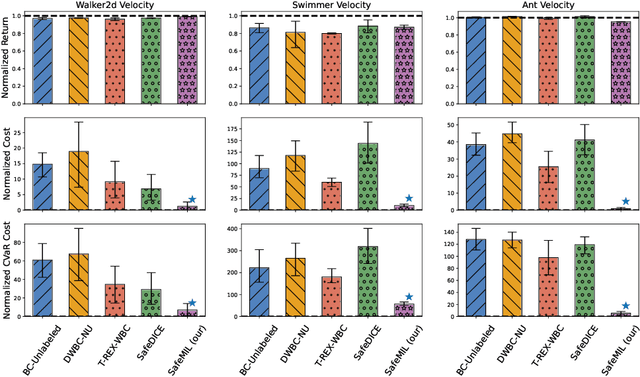
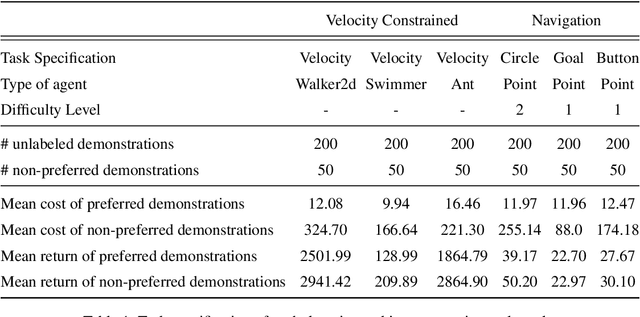
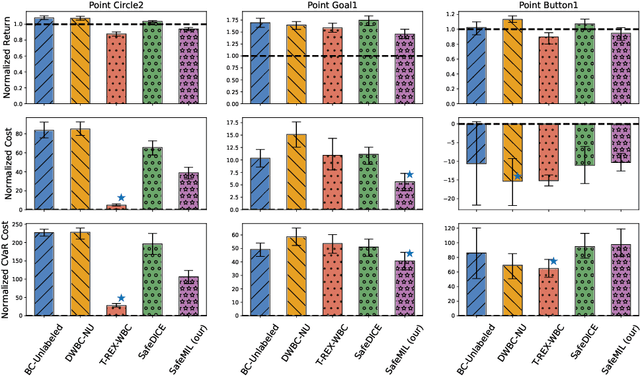
In this work, we study the problem of offline safe imitation learning (IL). In many real-world settings, online interactions can be risky, and accurately specifying the reward and the safety cost information at each timestep can be difficult. However, it is often feasible to collect trajectories reflecting undesirable or risky behavior, implicitly conveying the behavior the agent should avoid. We refer to these trajectories as non-preferred trajectories. Unlike standard IL, which aims to mimic demonstrations, our agent must also learn to avoid risky behavior using non-preferred trajectories. In this paper, we propose a novel approach, SafeMIL, to learn a parameterized cost that predicts if the state-action pair is risky via Multiple Instance Learning. The learned cost is then used to avoid non-preferred behaviors, resulting in a policy that prioritizes safety. We empirically demonstrate that our approach can learn a safer policy that satisfies cost constraints without degrading the reward performance, thereby outperforming several baselines.
LExT: Towards Evaluating Trustworthiness of Natural Language Explanations
Apr 08, 2025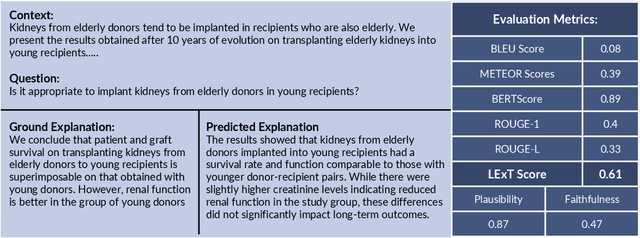

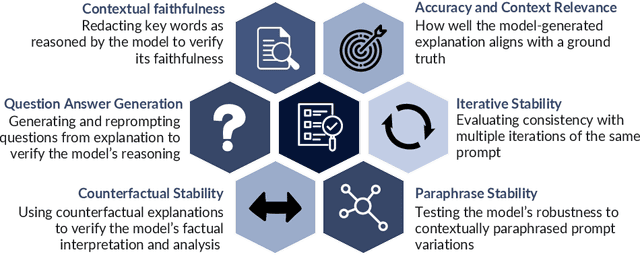
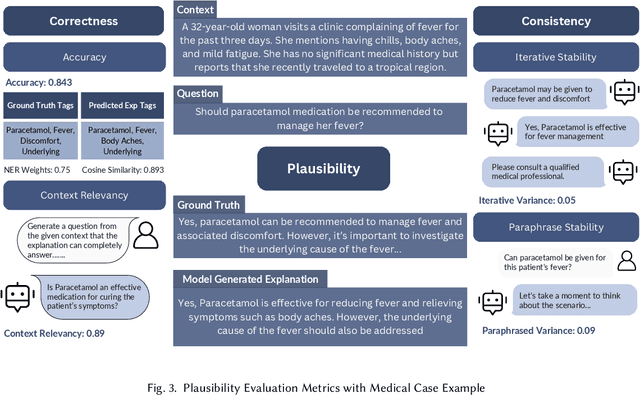
As Large Language Models (LLMs) become increasingly integrated into high-stakes domains, there have been several approaches proposed toward generating natural language explanations. These explanations are crucial for enhancing the interpretability of a model, especially in sensitive domains like healthcare, where transparency and reliability are key. In light of such explanations being generated by LLMs and its known concerns, there is a growing need for robust evaluation frameworks to assess model-generated explanations. Natural Language Generation metrics like BLEU and ROUGE capture syntactic and semantic accuracies but overlook other crucial aspects such as factual accuracy, consistency, and faithfulness. To address this gap, we propose a general framework for quantifying trustworthiness of natural language explanations, balancing Plausibility and Faithfulness, to derive a comprehensive Language Explanation Trustworthiness Score (LExT) (The code and set up to reproduce our experiments are publicly available at https://github.com/cerai-iitm/LExT). Applying our domain-agnostic framework to the healthcare domain using public medical datasets, we evaluate six models, including domain-specific and general-purpose models. Our findings demonstrate significant differences in their ability to generate trustworthy explanations. On comparing these explanations, we make interesting observations such as inconsistencies in Faithfulness demonstrated by general-purpose models and their tendency to outperform domain-specific fine-tuned models. This work further highlights the importance of using a tailored evaluation framework to assess natural language explanations in sensitive fields, providing a foundation for improving the trustworthiness and transparency of language models in healthcare and beyond.
International AI Safety Report
Jan 29, 2025
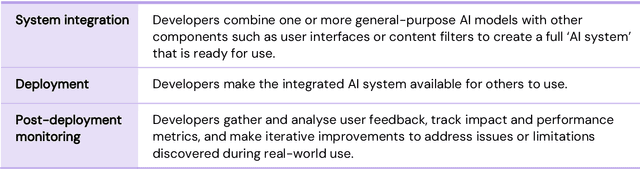

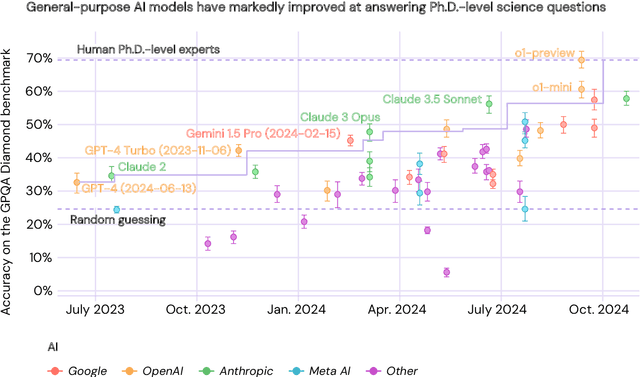
The first International AI Safety Report comprehensively synthesizes the current evidence on the capabilities, risks, and safety of advanced AI systems. The report was mandated by the nations attending the AI Safety Summit in Bletchley, UK. Thirty nations, the UN, the OECD, and the EU each nominated a representative to the report's Expert Advisory Panel. A total of 100 AI experts contributed, representing diverse perspectives and disciplines. Led by the report's Chair, these independent experts collectively had full discretion over the report's content.