 Add to Chrome
 Add to Firefox
 Add to Edge
DaWin: Training-free Dynamic Weight Interpolation for Robust Adaptation
Oct 03, 2024
Adapting a pre-trained foundation model on downstream tasks should ensure robustness against distribution shifts without the need to retrain the whole model. Although existing weight interpolation methods are simple yet effective, we argue their static nature limits downstream performance while achieving efficiency. In this work, we propose DaWin, a training-free dynamic weight interpolation method that leverages the entropy of individual models over each unlabeled test sample to assess model expertise, and compute per-sample interpolation coefficients dynamically. Unlike previous works that typically rely on additional training to learn such coefficients, our approach requires no training. Then, we propose a mixture modeling approach that greatly reduces inference overhead raised by dynamic interpolation. We validate DaWin on the large-scale visual recognition benchmarks, spanning 14 tasks across robust fine-tuning -- ImageNet and derived five distribution shift benchmarks -- and multi-task learning with eight classification tasks. Results demonstrate that DaWin achieves significant performance gain in considered settings, with minimal computational overhead. We further discuss DaWin's analytic behavior to explain its empirical success.

Targeted Cause Discovery with Data-Driven Learning
Aug 29, 2024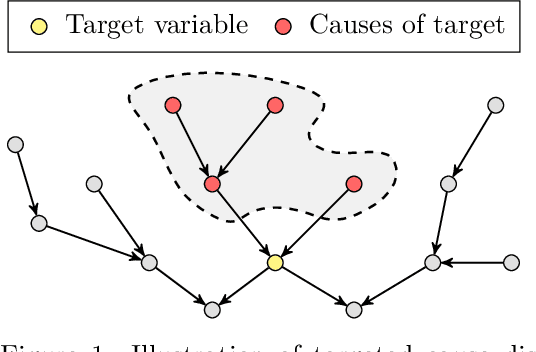


We propose a novel machine learning approach for inferring causal variables of a target variable from observations. Our goal is to identify both direct and indirect causes within a system, thereby efficiently regulating the target variable when the difficulty and cost of intervening on each causal variable vary. Our method employs a neural network trained to identify causality through supervised learning on simulated data. By implementing a local-inference strategy, we achieve linear complexity with respect to the number of variables, efficiently scaling up to thousands of variables. Empirical results demonstrate the effectiveness of our method in identifying causal relationships within large-scale gene regulatory networks, outperforming existing causal discovery methods that primarily focus on direct causality. We validate our model's generalization capability across novel graph structures and generating mechanisms, including gene regulatory networks of E. coli and the human K562 cell line. Implementation codes are available at https://github.com/snu-mllab/Targeted-Cause-Discovery.
TimeChara: Evaluating Point-in-Time Character Hallucination of Role-Playing Large Language Models
May 28, 2024While Large Language Models (LLMs) can serve as agents to simulate human behaviors (i.e., role-playing agents), we emphasize the importance of point-in-time role-playing. This situates characters at specific moments in the narrative progression for three main reasons: (i) enhancing users' narrative immersion, (ii) avoiding spoilers, and (iii) fostering engagement in fandom role-playing. To accurately represent characters at specific time points, agents must avoid character hallucination, where they display knowledge that contradicts their characters' identities and historical timelines. We introduce TimeChara, a new benchmark designed to evaluate point-in-time character hallucination in role-playing LLMs. Comprising 10,895 instances generated through an automated pipeline, this benchmark reveals significant hallucination issues in current state-of-the-art LLMs (e.g., GPT-4o). To counter this challenge, we propose Narrative-Experts, a method that decomposes the reasoning steps and utilizes narrative experts to reduce point-in-time character hallucinations effectively. Still, our findings with TimeChara highlight the ongoing challenges of point-in-time character hallucination, calling for further study.
HYPE: Hyperbolic Entailment Filtering for Underspecified Images and Texts
Apr 26, 2024In an era where the volume of data drives the effectiveness of self-supervised learning, the specificity and clarity of data semantics play a crucial role in model training. Addressing this, we introduce HYPerbolic Entailment filtering (HYPE), a novel methodology designed to meticulously extract modality-wise meaningful and well-aligned data from extensive, noisy image-text pair datasets. Our approach leverages hyperbolic embeddings and the concept of entailment cones to evaluate and filter out samples with meaningless or underspecified semantics, focusing on enhancing the specificity of each data sample. HYPE not only demonstrates a significant improvement in filtering efficiency but also sets a new state-of-the-art in the DataComp benchmark when combined with existing filtering techniques. This breakthrough showcases the potential of HYPE to refine the data selection process, thereby contributing to the development of more accurate and efficient self-supervised learning models. Additionally, the image specificity $\epsilon_{i}$ can be independently applied to induce an image-only dataset from an image-text or image-only data pool for training image-only self-supervised models and showed superior performance when compared to the dataset induced by CLIP score.
Model Stock: All we need is just a few fine-tuned models
Mar 28, 2024This paper introduces an efficient fine-tuning method for large pre-trained models, offering strong in-distribution (ID) and out-of-distribution (OOD) performance. Breaking away from traditional practices that need a multitude of fine-tuned models for averaging, our approach employs significantly fewer models to achieve final weights yet yield superior accuracy. Drawing from key insights in the weight space of fine-tuned weights, we uncover a strong link between the performance and proximity to the center of weight space. Based on this, we introduce a method that approximates a center-close weight using only two fine-tuned models, applicable during or after training. Our innovative layer-wise weight averaging technique surpasses state-of-the-art model methods such as Model Soup, utilizing only two fine-tuned models. This strategy can be aptly coined Model Stock, highlighting its reliance on selecting a minimal number of models to draw a more optimized-averaged model. We demonstrate the efficacy of Model Stock with fine-tuned models based upon pre-trained CLIP architectures, achieving remarkable performance on both ID and OOD tasks on the standard benchmarks, all while barely bringing extra computational demands. Our code and pre-trained models are available at https://github.com/naver-ai/model-stock.
Toward Interactive Regional Understanding in Vision-Large Language Models
Mar 27, 2024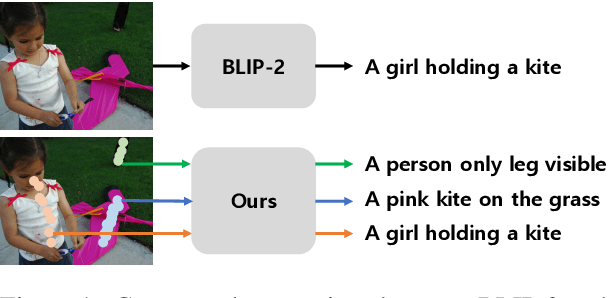
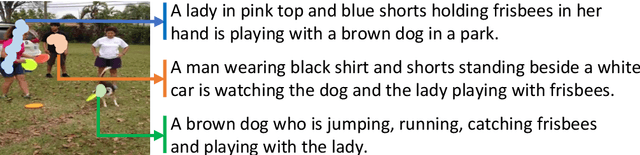
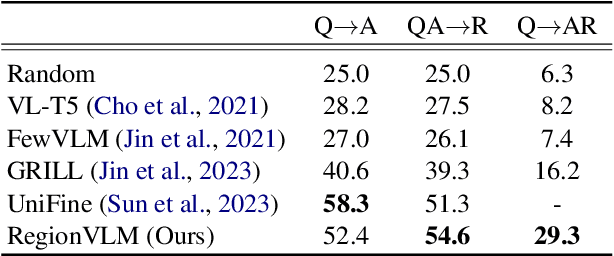
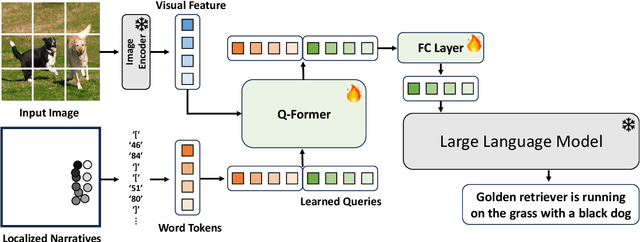
Recent Vision-Language Pre-training (VLP) models have demonstrated significant advancements. Nevertheless, these models heavily rely on image-text pairs that capture only coarse and global information of an image, leading to a limitation in their regional understanding ability. In this work, we introduce \textbf{RegionVLM}, equipped with explicit regional modeling capabilities, allowing them to understand user-indicated image regions. To achieve this, we design a simple yet innovative architecture, requiring no modifications to the model architecture or objective function. Additionally, we leverage a dataset that contains a novel source of information, namely Localized Narratives, which has been overlooked in previous VLP research. Our experiments demonstrate that our single generalist model not only achieves an interactive dialogue system but also exhibits superior performance on various zero-shot region understanding tasks, without compromising its ability for global image understanding.
Rotary Position Embedding for Vision Transformer
Mar 20, 2024Rotary Position Embedding (RoPE) performs remarkably on language models, especially for length extrapolation of Transformers. However, the impacts of RoPE on computer vision domains have been underexplored, even though RoPE appears capable of enhancing Vision Transformer (ViT) performance in a way similar to the language domain. This study provides a comprehensive analysis of RoPE when applied to ViTs, utilizing practical implementations of RoPE for 2D vision data. The analysis reveals that RoPE demonstrates impressive extrapolation performance, i.e., maintaining precision while increasing image resolution at inference. It eventually leads to performance improvement for ImageNet-1k, COCO detection, and ADE-20k segmentation. We believe this study provides thorough guidelines to apply RoPE into ViT, promising improved backbone performance with minimal extra computational overhead. Our code and pre-trained models are available at https://github.com/naver-ai/rope-vit
Calibrating Large Language Models Using Their Generations Only
Mar 09, 2024As large language models (LLMs) are increasingly deployed in user-facing applications, building trust and maintaining safety by accurately quantifying a model's confidence in its prediction becomes even more important. However, finding effective ways to calibrate LLMs - especially when the only interface to the models is their generated text - remains a challenge. We propose APRICOT (auxiliary prediction of confidence targets): A method to set confidence targets and train an additional model that predicts an LLM's confidence based on its textual input and output alone. This approach has several advantages: It is conceptually simple, does not require access to the target model beyond its output, does not interfere with the language generation, and has a multitude of potential usages, for instance by verbalizing the predicted confidence or adjusting the given answer based on the confidence. We show how our approach performs competitively in terms of calibration error for white-box and black-box LLMs on closed-book question-answering to detect incorrect LLM answers.
TRAP: Targeted Random Adversarial Prompt Honeypot for Black-Box Identification
Feb 20, 2024
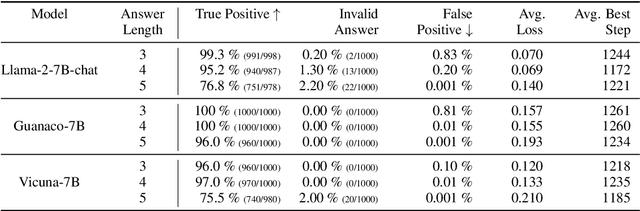


Large Language Model (LLM) services and models often come with legal rules on who can use them and how they must use them. Assessing the compliance of the released LLMs is crucial, as these rules protect the interests of the LLM contributor and prevent misuse. In this context, we describe the novel problem of Black-box Identity Verification (BBIV). The goal is to determine whether a third-party application uses a certain LLM through its chat function. We propose a method called Targeted Random Adversarial Prompt (TRAP) that identifies the specific LLM in use. We repurpose adversarial suffixes, originally proposed for jailbreaking, to get a pre-defined answer from the target LLM, while other models give random answers. TRAP detects the target LLMs with over 95% true positive rate at under 0.2% false positive rate even after a single interaction. TRAP remains effective even if the LLM has minor changes that do not significantly alter the original function.
Compressed Context Memory For Online Language Model Interaction
Dec 06, 2023This paper presents a novel context compression method for Transformer language models in online scenarios such as ChatGPT, where the context continually expands. As the context lengthens, the attention process requires more memory and computational resources, which in turn reduces the throughput of the language model. To this end, we propose a compressed context memory system that continually compresses the growing context into a compact memory space. The compression process simply involves integrating a lightweight conditional LoRA into the language model's forward pass during inference. Based on the compressed context memory, the language model can perform inference with reduced memory and attention operations. Through evaluations on conversation, personalization, and multi-task learning, we demonstrate that our approach achieves the performance level of a full context model with $5\times$ smaller context memory space. Codes are available at https://github.com/snu-mllab/context-memory.