 Add to Chrome
 Add to Firefox
 Add to Edge
NVIDIA NeMo Neural Machine Translation Systems for English-German and English-Russian News and Biomedical Tasks at WMT21
Nov 16, 2021
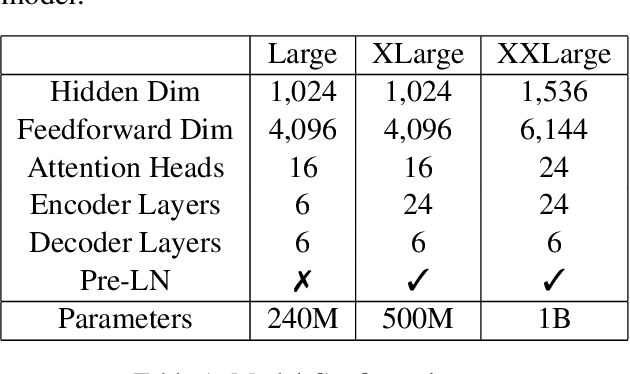
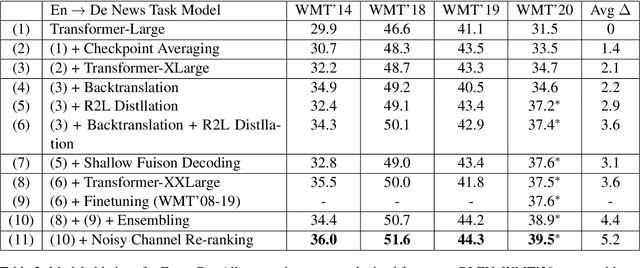
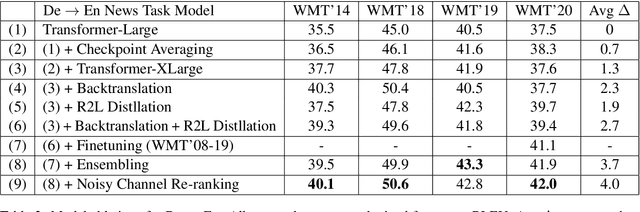
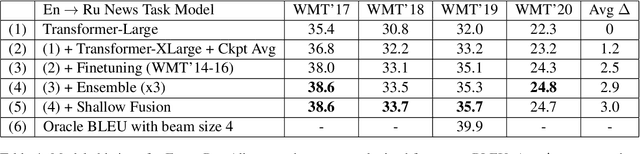
This paper provides an overview of NVIDIA NeMo's neural machine translation systems for the constrained data track of the WMT21 News and Biomedical Shared Translation Tasks. Our news task submissions for English-German (En-De) and English-Russian (En-Ru) are built on top of a baseline transformer-based sequence-to-sequence model. Specifically, we use a combination of 1) checkpoint averaging 2) model scaling 3) data augmentation with backtranslation and knowledge distillation from right-to-left factorized models 4) finetuning on test sets from previous years 5) model ensembling 6) shallow fusion decoding with transformer language models and 7) noisy channel re-ranking. Additionally, our biomedical task submission for English-Russian uses a biomedically biased vocabulary and is trained from scratch on news task data, medically relevant text curated from the news task dataset, and biomedical data provided by the shared task. Our news system achieves a sacreBLEU score of 39.5 on the WMT'20 En-De test set outperforming the best submission from last year's task of 38.8. Our biomedical task Ru-En and En-Ru systems reach BLEU scores of 43.8 and 40.3 respectively on the WMT'20 Biomedical Task Test set, outperforming the previous year's best submissions.

Multi-scale Transformer Language Models
May 01, 2020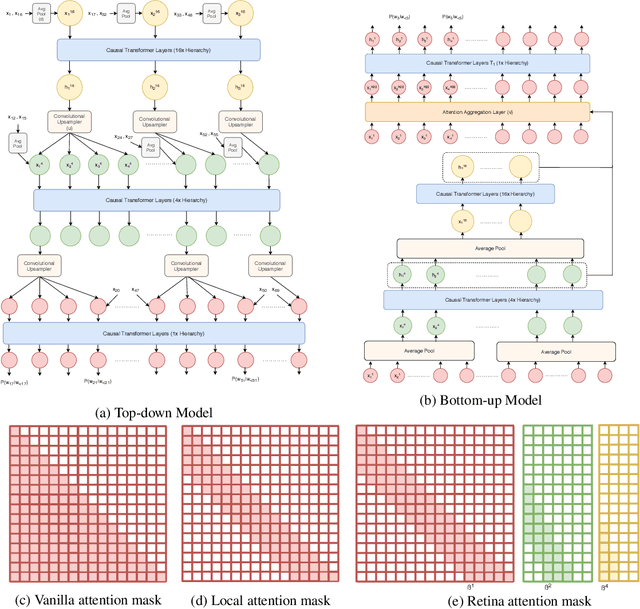
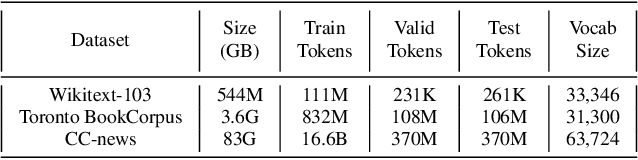
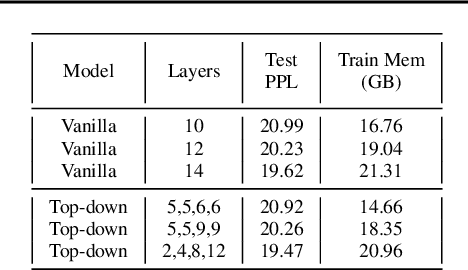
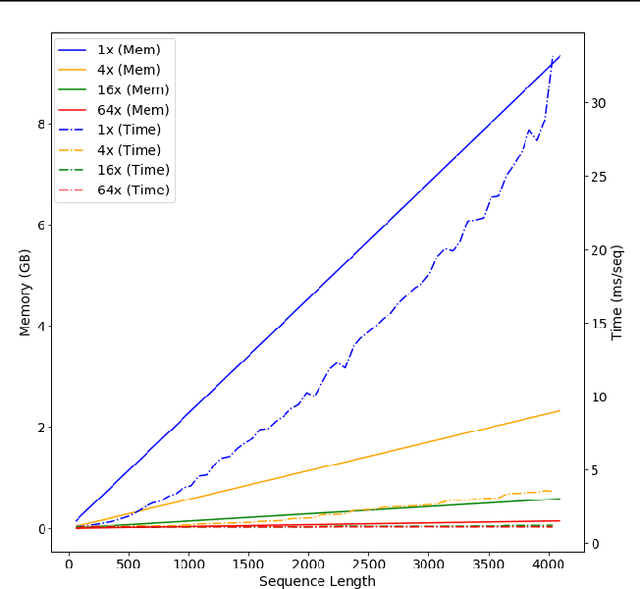
We investigate multi-scale transformer language models that learn representations of text at multiple scales, and present three different architectures that have an inductive bias to handle the hierarchical nature of language. Experiments on large-scale language modeling benchmarks empirically demonstrate favorable likelihood vs memory footprint trade-offs, e.g. we show that it is possible to train a hierarchical variant with 30 layers that has 23% smaller memory footprint and better perplexity, compared to a vanilla transformer with less than half the number of layers, on the Toronto BookCorpus. We analyze the advantages of learned representations at multiple scales in terms of memory footprint, compute time, and perplexity, which are particularly appealing given the quadratic scaling of transformers' run time and memory usage with respect to sequence length.
On Extractive and Abstractive Neural Document Summarization with Transformer Language Models
Sep 07, 2019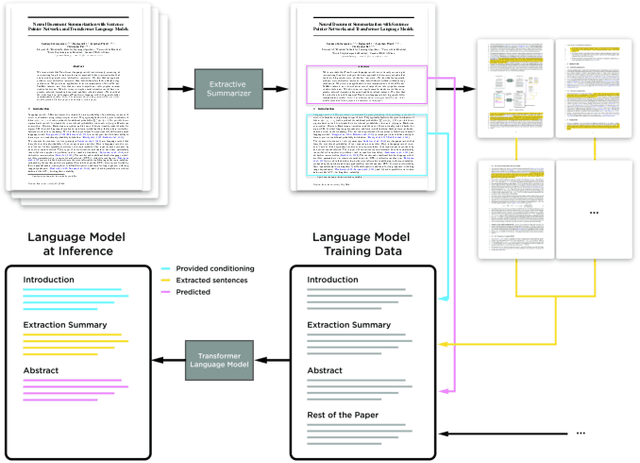
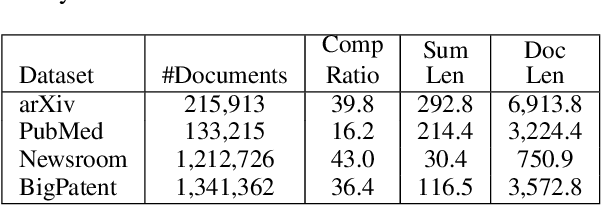
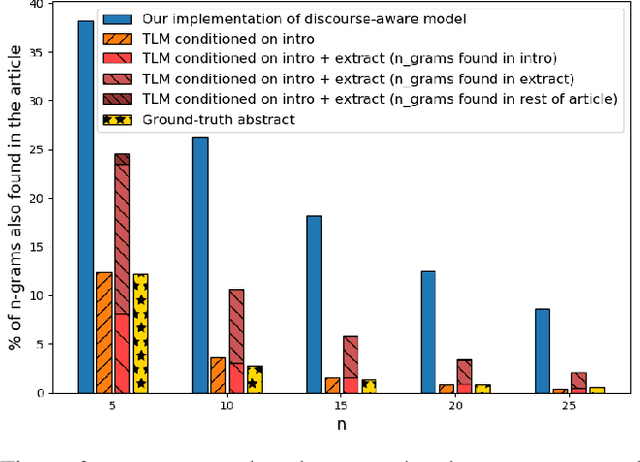
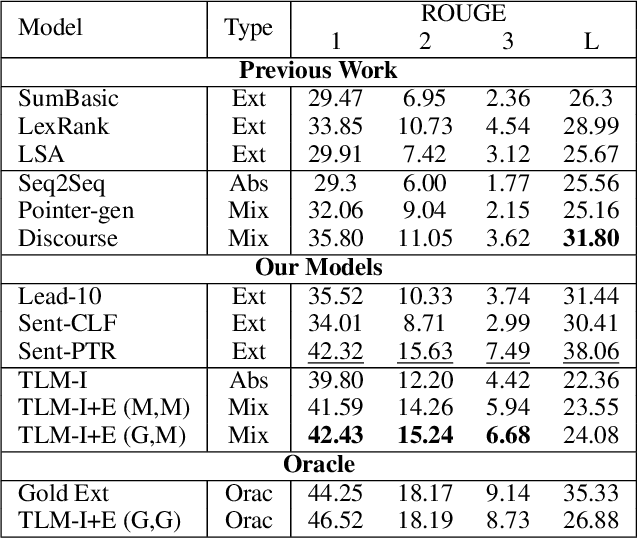
We present a method to produce abstractive summaries of long documents that exceed several thousand words via neural abstractive summarization. We perform a simple extractive step before generating a summary, which is then used to condition the transformer language model on relevant information before being tasked with generating a summary. We show that this extractive step significantly improves summarization results. We also show that this approach produces more abstractive summaries compared to prior work that employs a copy mechanism while still achieving higher rouge scores. Note: The abstract above was not written by the authors, it was generated by one of the models presented in this paper.
Do Neural Dialog Systems Use the Conversation History Effectively? An Empirical Study
Jun 04, 2019
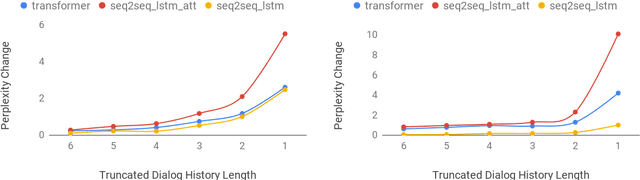
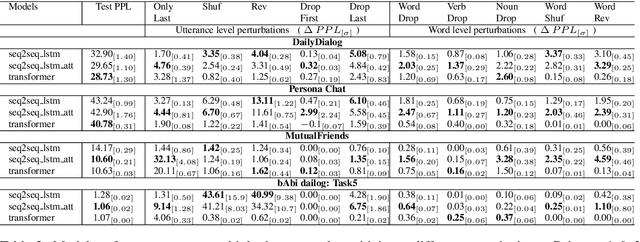
Neural generative models have been become increasingly popular when building conversational agents. They offer flexibility, can be easily adapted to new domains, and require minimal domain engineering. A common criticism of these systems is that they seldom understand or use the available dialog history effectively. In this paper, we take an empirical approach to understanding how these models use the available dialog history by studying the sensitivity of the models to artificially introduced unnatural changes or perturbations to their context at test time. We experiment with 10 different types of perturbations on 4 multi-turn dialog datasets and find that commonly used neural dialog architectures like recurrent and transformer-based seq2seq models are rarely sensitive to most perturbations such as missing or reordering utterances, shuffling words, etc. Also, by open-sourcing our code, we believe that it will serve as a useful diagnostic tool for evaluating dialog systems in the future.
State-Reification Networks: Improving Generalization by Modeling the Distribution of Hidden Representations
May 26, 2019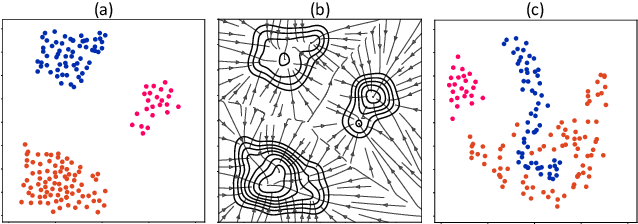
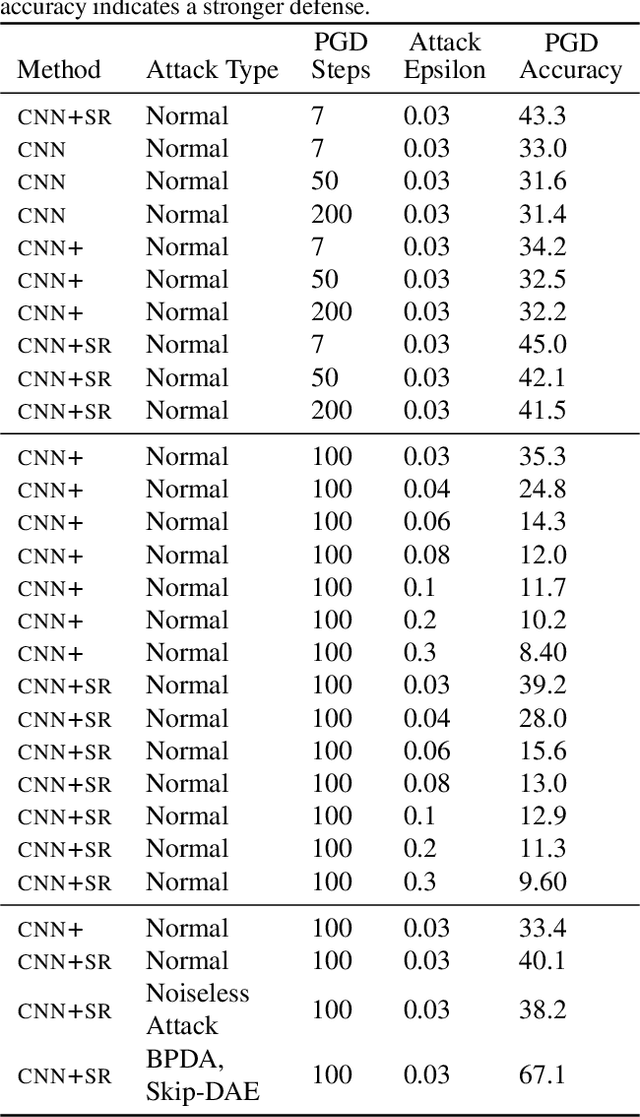
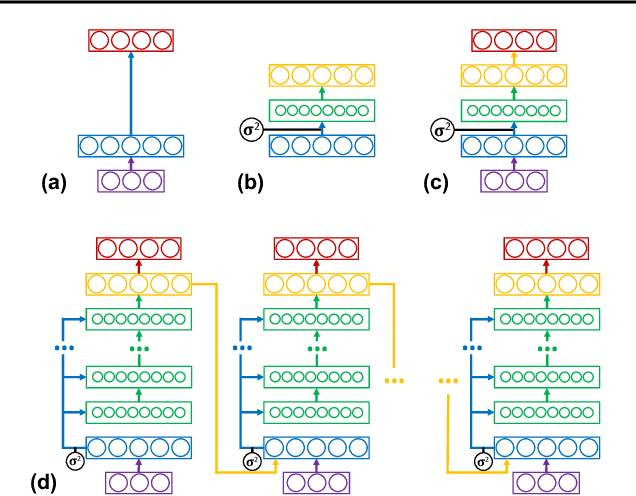
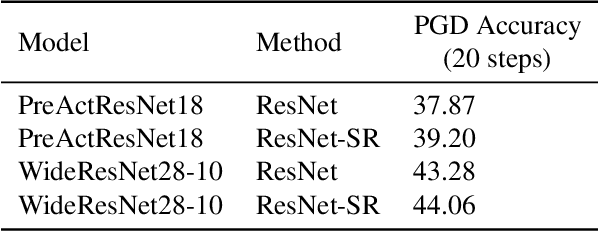
Machine learning promises methods that generalize well from finite labeled data. However, the brittleness of existing neural net approaches is revealed by notable failures, such as the existence of adversarial examples that are misclassified despite being nearly identical to a training example, or the inability of recurrent sequence-processing nets to stay on track without teacher forcing. We introduce a method, which we refer to as \emph{state reification}, that involves modeling the distribution of hidden states over the training data and then projecting hidden states observed during testing toward this distribution. Our intuition is that if the network can remain in a familiar manifold of hidden space, subsequent layers of the net should be well trained to respond appropriately. We show that this state-reification method helps neural nets to generalize better, especially when labeled data are sparse, and also helps overcome the challenge of achieving robust generalization with adversarial training.
Multiple-Attribute Text Style Transfer
Nov 01, 2018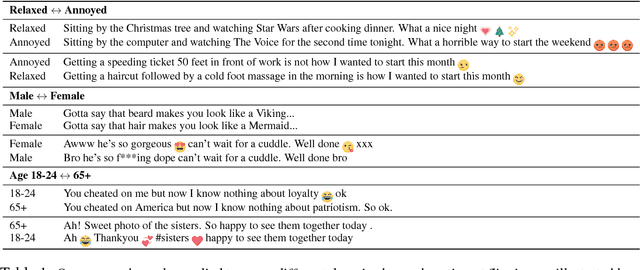
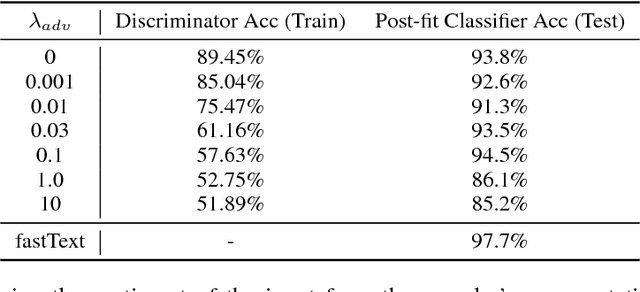
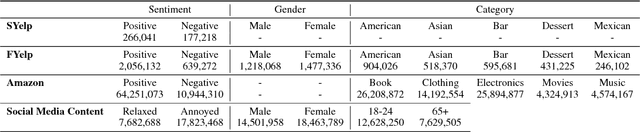
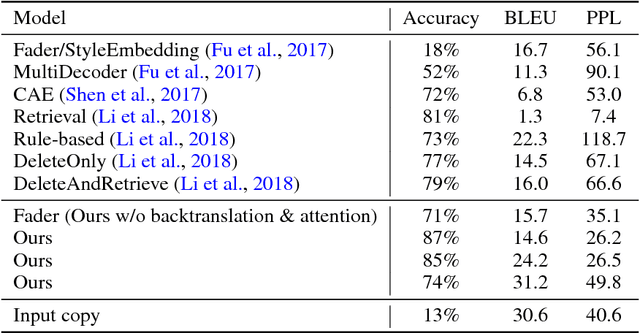
The dominant approach to unsupervised "style transfer" in text is based on the idea of learning a latent representation, which is independent of the attributes specifying its "style". In this paper, we show that this condition is not necessary and is not always met in practice, even with domain adversarial training that explicitly aims at learning such disentangled representations. We thus propose a new model that controls several factors of variation in textual data where this condition on disentanglement is replaced with a simpler mechanism based on back-translation. Our method allows control over multiple attributes, like gender, sentiment, product type, etc., and a more fine-grained control on the trade-off between content preservation and change of style with a pooling operator in the latent space. Our experiments demonstrate that the fully entangled model produces better generations, even when tested on new and more challenging benchmarks comprising reviews with multiple sentences and multiple attributes.
A Framework towards Domain Specific Video Summarization
Sep 24, 2018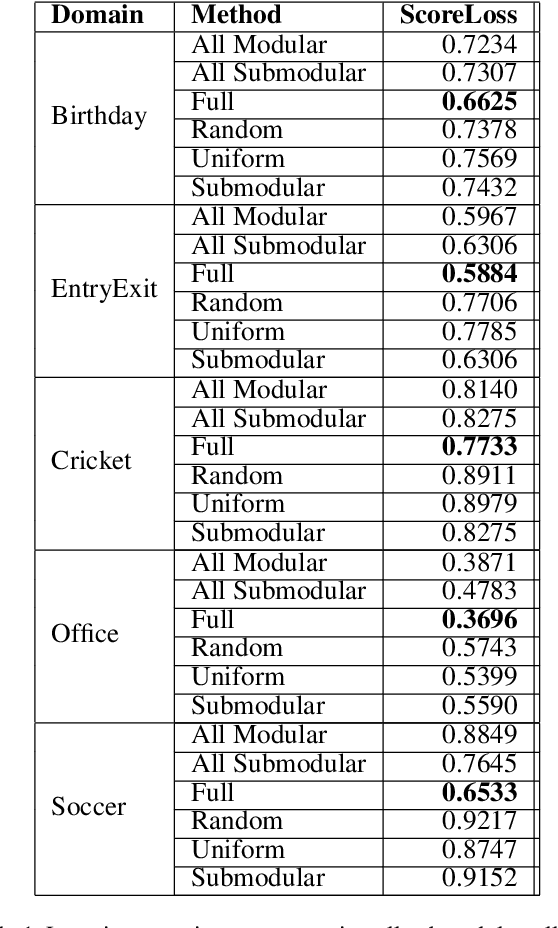
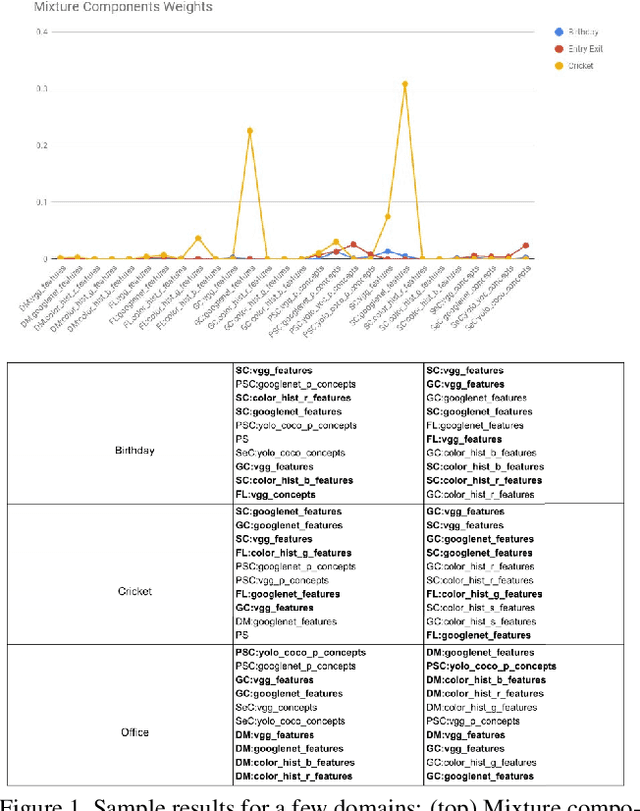
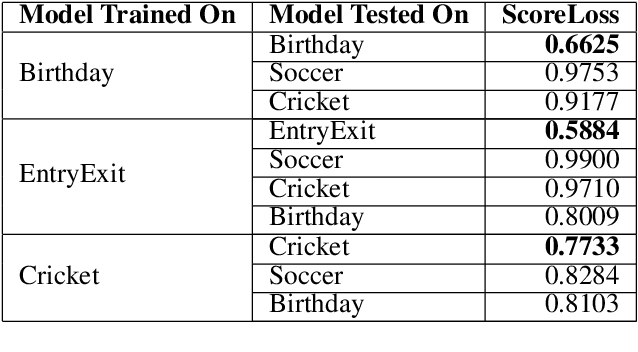
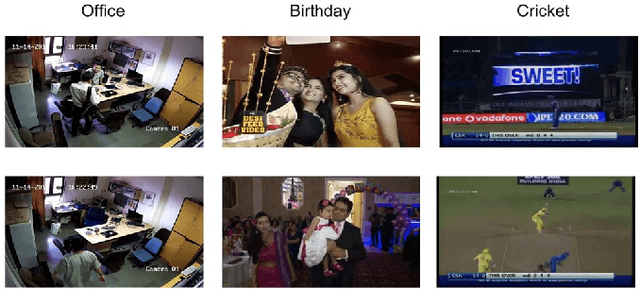
In the light of exponentially increasing video content, video summarization has attracted a lot of attention recently due to its ability to optimize time and storage. Characteristics of a good summary of a video depend on the particular domain under question. We propose a novel framework for domain specific video summarization. Given a video of a particular domain, our system can produce a summary based on what is important for that domain in addition to possessing other desired characteristics like representativeness, coverage, diversity etc. as suitable to that domain. Past related work has focused either on using supervised approaches for ranking the snippets to produce summary or on using unsupervised approaches of generating the summary as a subset of snippets with the above characteristics. We look at the joint problem of learning domain specific importance of segments as well as the desired summary characteristic for that domain. Our studies show that the more efficient way of incorporating domain specific relevances into a summary is by obtaining ratings of shots as opposed to binary inclusion/exclusion information. We also argue that ratings can be seen as unified representation of all possible ground truth summaries of a video, taking us one step closer in dealing with challenges associated with multiple ground truth summaries of a video. We also propose a novel evaluation measure which is more naturally suited in assessing the quality of video summary for the task at hand than F1 like measures. It leverages the ratings information and is richer in appropriately modeling desirable and undesirable characteristics of a summary. Lastly, we release a gold standard dataset for furthering research in domain specific video summarization, which to our knowledge is the first dataset with long videos across several domains with rating annotations.
Neural Models for Key Phrase Detection and Question Generation
May 30, 2018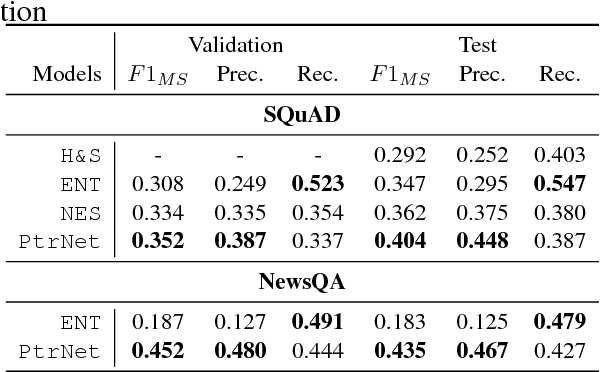
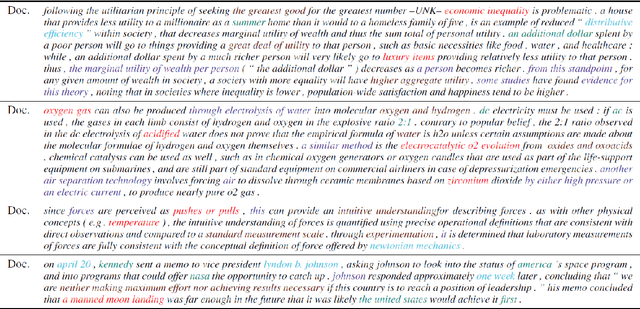
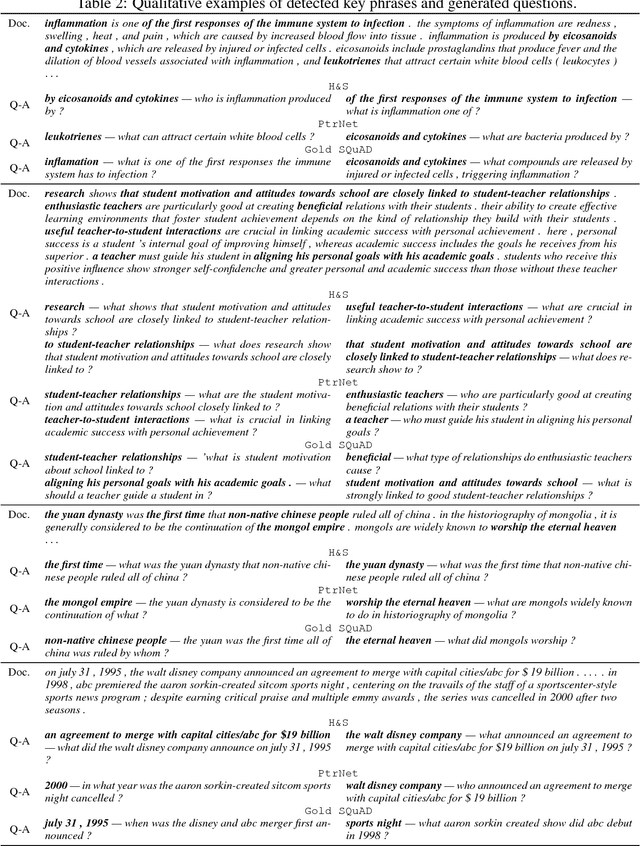
We propose a two-stage neural model to tackle question generation from documents. First, our model estimates the probability that word sequences in a document are ones that a human would pick when selecting candidate answers by training a neural key-phrase extractor on the answers in a question-answering corpus. Predicted key phrases then act as target answers and condition a sequence-to-sequence question-generation model with a copy mechanism. Empirically, our key-phrase extraction model significantly outperforms an entity-tagging baseline and existing rule-based approaches. We further demonstrate that our question generation system formulates fluent, answerable questions from key phrases. This two-stage system could be used to augment or generate reading comprehension datasets, which may be leveraged to improve machine reading systems or in educational settings.
Fortified Networks: Improving the Robustness of Deep Networks by Modeling the Manifold of Hidden Representations
Apr 07, 2018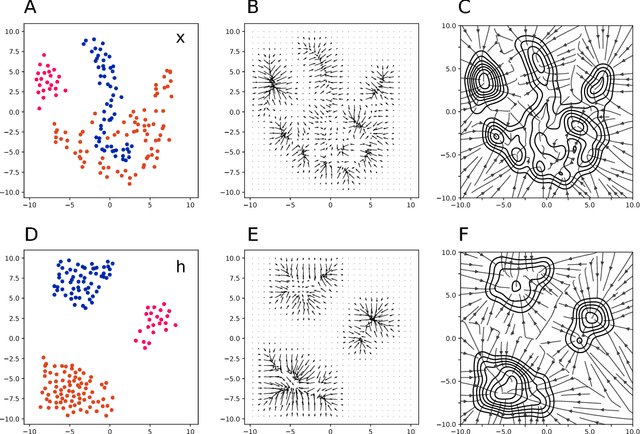
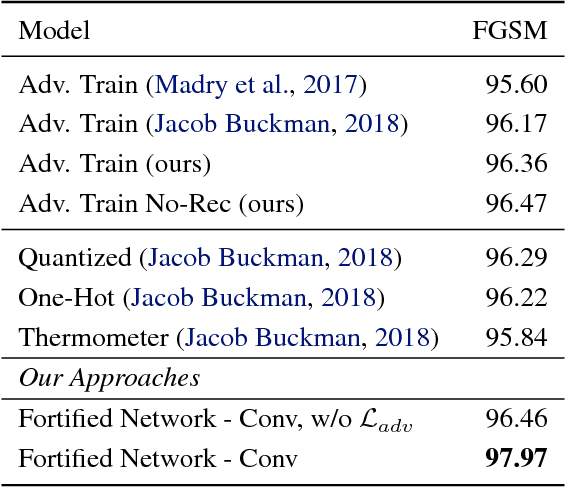
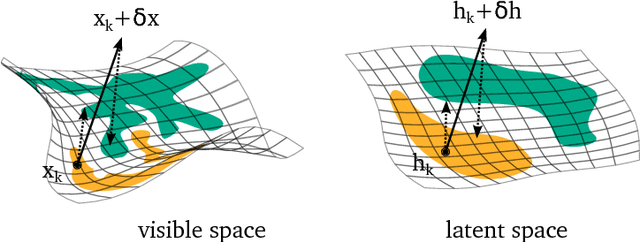
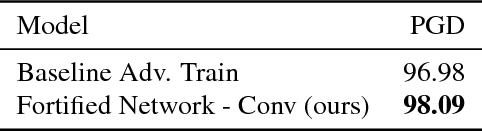
Deep networks have achieved impressive results across a variety of important tasks. However a known weakness is a failure to perform well when evaluated on data which differ from the training distribution, even if these differences are very small, as is the case with adversarial examples. We propose Fortified Networks, a simple transformation of existing networks, which fortifies the hidden layers in a deep network by identifying when the hidden states are off of the data manifold, and maps these hidden states back to parts of the data manifold where the network performs well. Our principal contribution is to show that fortifying these hidden states improves the robustness of deep networks and our experiments (i) demonstrate improved robustness to standard adversarial attacks in both black-box and white-box threat models; (ii) suggest that our improvements are not primarily due to the gradient masking problem and (iii) show the advantage of doing this fortification in the hidden layers instead of the input space.
Learning General Purpose Distributed Sentence Representations via Large Scale Multi-task Learning
Mar 30, 2018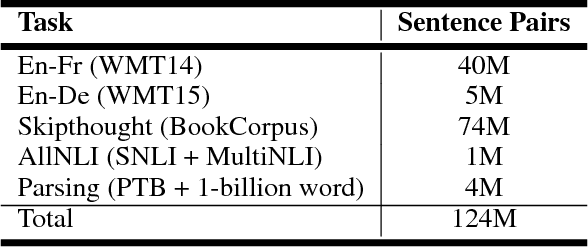
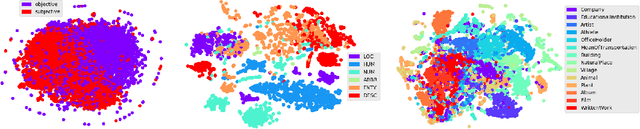
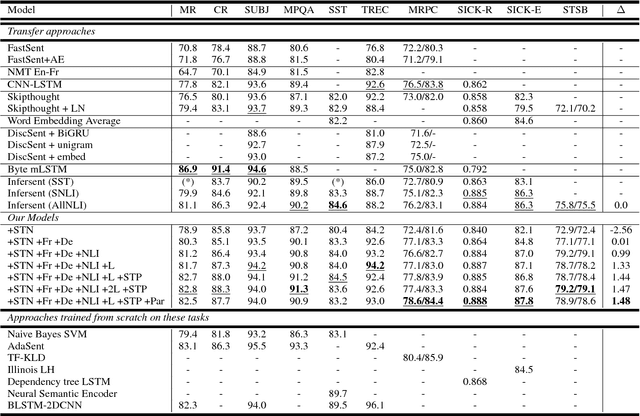
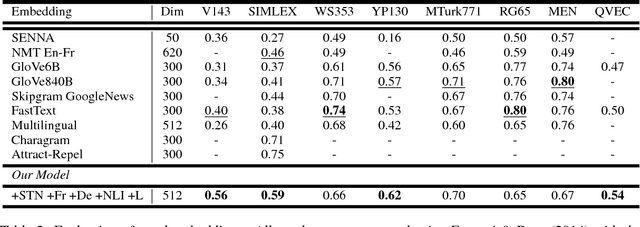
A lot of the recent success in natural language processing (NLP) has been driven by distributed vector representations of words trained on large amounts of text in an unsupervised manner. These representations are typically used as general purpose features for words across a range of NLP problems. However, extending this success to learning representations of sequences of words, such as sentences, remains an open problem. Recent work has explored unsupervised as well as supervised learning techniques with different training objectives to learn general purpose fixed-length sentence representations. In this work, we present a simple, effective multi-task learning framework for sentence representations that combines the inductive biases of diverse training objectives in a single model. We train this model on several data sources with multiple training objectives on over 100 million sentences. Extensive experiments demonstrate that sharing a single recurrent sentence encoder across weakly related tasks leads to consistent improvements over previous methods. We present substantial improvements in the context of transfer learning and low-resource settings using our learned general-purpose representations.