 Add to Chrome
 Add to Firefox
 Add to Edge
Convex Compositional Reasoning Models
May 25, 2026
Compositional energy-based models can generalize to larger combinatorial reasoning problems by reusing a learned factor energy across many local constraints. In our paper, we show that a key bottleneck in compositional reasoning is not composition itself, but the non-convex geometry of the learned energy landscape. To solve this problem, we introduce Convex Compositional Energy Minimization (CCEM), a framework that parameterizes each factor with an input-convex neural network and optimizes the composed energy over a tight convex relaxation of the feasible set. Because convexity is preserved under summation, the global relaxed objective remains convex, enabling deterministic projected first-order optimization. CCEM is trained in two stages: factor-level contrastive learning to shape local energy basins, followed by end-to-end refinement through an unrolled projected solver. Our experiments show that our models trained on small subproblems or a single problem size transfer to larger instances without retraining.

Who to Trust? Aggregating Client Knowledge in Logit-Based Federated Learning
Sep 18, 2025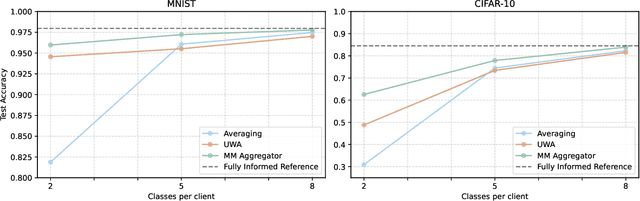
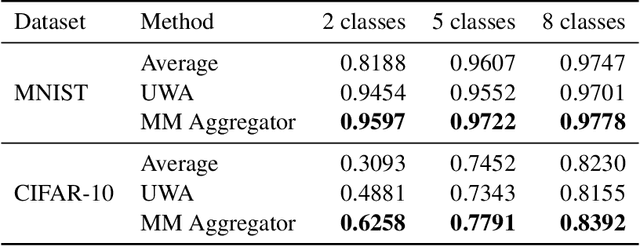
Federated learning (FL) usually shares model weights or gradients, which is costly for large models. Logit-based FL reduces this cost by sharing only logits computed on a public proxy dataset. However, aggregating information from heterogeneous clients is still challenging. This paper studies this problem, introduces and compares three logit aggregation methods: simple averaging, uncertainty-weighted averaging, and a learned meta-aggregator. Evaluated on MNIST and CIFAR-10, these methods reduce communication overhead, improve robustness under non-IID data, and achieve accuracy competitive with centralized training.