 Add to Chrome
 Add to Firefox
 Add to Edge
Multi-LCB: Extending LiveCodeBench to Multiple Programming Languages
Jun 18, 2026
LiveCodeBench (LCB) has recently become a widely adopted benchmark for evaluating large language models (LLMs) on code-generation tasks. By curating competitive programming problems, constantly adding fresh problems to the set, and filtering them by release dates, LCB provides contamination-aware evaluation and offers a holistic view of coding capability. However, LCB remains restricted to Python, leaving open the question of whether LLMs can generalize across the diverse programming languages required in real-world software engineering. We introduce Multi-LCB, a benchmark for evaluating LLMs across twelve programming languages, including Python. Multi-LCB transforms Python tasks from the LCB dataset into equivalent tasks in other languages while preserving LCB's contamination controls and evaluation protocol. Because it is fully compatible with the original LCB format, Multi-LCB will automatically track future LCB updates, enabling systematic assessment of cross-language code generation competence and requiring models to sustain performance well beyond Python. We evaluated 24 LLMs for instruction and reasoning on Multi-LCB, uncovering evidence of Python overfitting, language-specific contamination, and substantial disparities in multilingual performance. Our results establish Multi-LCB as a rigorous new benchmark for multi-programming-language code evaluation, directly addressing LCB's primary limitation and exposing critical gaps in current LLM capabilities.

Prior Knowledge or Search? A Study of LLM Agents in Hardware-Aware Code Optimization
May 19, 2026LLM discovery and optimization systems are increasingly applied across domains, implementing a common propose-evaluate-revise loop. Such optimization or discovery progresses via context conditioning on received feedback from an environment. However, as modern LLM agents are increasingly complex in their structure, it is difficult to evaluate which components contribute the most, and when and how this exploration may fail. We answer these questions through three controlled experiments. Our findings: (1) In pure black-box optimization, LLMs act as greedy optimizers. (2) In zero-shot kernel generation, providing explicit input-size information has no measurable effect, models converge to the same kernel parameters regardless of size or temperature, as though the size instruction were invisible. Moreover, when tasked to perform kernel optimization for uncommon kernel sizes, performance sharply degrades regardless of the language used. (3) In feedback-loop kernel optimization, CUDA improves monotonically under iterative feedback, while TVM IR actively degrades, which demonstrates that kernel optimization degrades when models operate with low-density language. Our results conclude that LLMs in code optimization tasks highly depend on pretrained priors rather than provided feedback or agentic structure.
Beyond SGD, Without SVD: Proximal Subspace Iteration LoRA with Diagonal Fractional K-FAC
Feb 18, 2026Low-Rank Adaptation (LoRA) fine-tunes large models by learning low-rank updates on top of frozen weights, dramatically reducing trainable parameters and memory. In this work, we address the gap between training with full steps with low-rank projections (SVDLoRA) and LoRA fine-tuning. We propose LoRSum, a memory-efficient subroutine that closes this gap for gradient descent by casting LoRA optimization as a proximal sub-problem and solving it efficiently with alternating least squares updates, which we prove to be an implicit block power method. We recover several recently proposed preconditioning methods for LoRA as special cases, and show that LoRSum can also be used for updating a low-rank momentum. In order to address full steps with preconditioned gradient descent, we propose a scaled variant of LoRSum that uses structured metrics such as K-FAC and Shampoo, and we show that storing the diagonal of these metrics still allows them to perform well while remaining memory-efficient. Experiments on a synthetic task, CIFAR-100, and language-model fine-tuning on GLUE, SQuAD v2, and WikiText-103, show that our method can match or improve LoRA baselines given modest compute overhead, while avoiding full-matrix SVD projections and retaining LoRA-style parameter efficiency.
PRS: Sharp Feature Priors for Resolution-Free Surface Remeshing
Nov 30, 2023Surface reconstruction with preservation of geometric features is a challenging computer vision task. Despite significant progress in implicit shape reconstruction, state-of-the-art mesh extraction methods often produce aliased, perceptually distorted surfaces and lack scalability to high-resolution 3D shapes. We present a data-driven approach for automatic feature detection and remeshing that requires only a coarse, aliased mesh as input and scales to arbitrary resolution reconstructions. We define and learn a collection of surface-based fields to (1) capture sharp geometric features in the shape with an implicit vertexwise model and (2) approximate improvements in normals alignment obtained by applying edge-flips with an edgewise model. To support scaling to arbitrary complexity shapes, we learn our fields using local triangulated patches, fusing estimates on complete surface meshes. Our feature remeshing algorithm integrates the learned fields as sharp feature priors and optimizes vertex placement and mesh connectivity for maximum expected surface improvement. On a challenging collection of high-resolution shape reconstructions in the ABC dataset, our algorithm improves over state-of-the-art by 26% normals F-score and 42% perceptual $\text{RMSE}_{\text{v}}$.
Continuous-time convolutions model of event sequences
Feb 13, 2023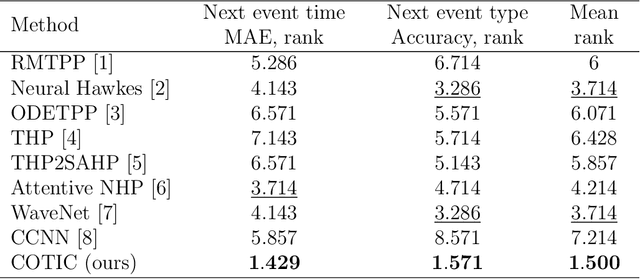
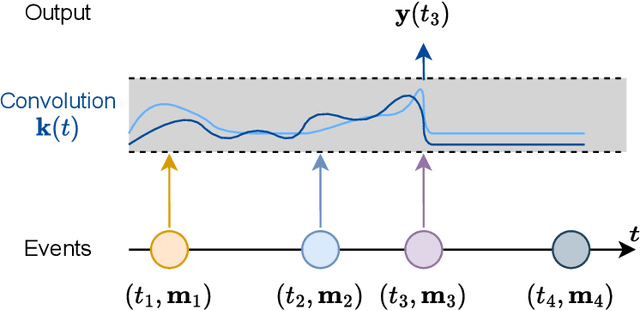
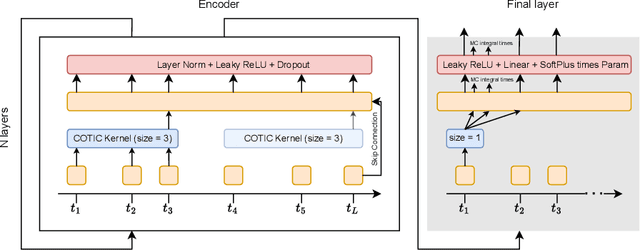

Massive samples of event sequences data occur in various domains, including e-commerce, healthcare, and finance. There are two main challenges regarding inference of such data: computational and methodological. The amount of available data and the length of event sequences per client are typically large, thus it requires long-term modelling. Moreover, this data is often sparse and non-uniform, making classic approaches for time series processing inapplicable. Existing solutions include recurrent and transformer architectures in such cases. To allow continuous time, the authors introduce specific parametric intensity functions defined at each moment on top of existing models. Due to the parametric nature, these intensities represent only a limited class of event sequences. We propose the COTIC method based on a continuous convolution neural network suitable for non-uniform occurrence of events in time. In COTIC, dilations and multi-layer architecture efficiently handle dependencies between events. Furthermore, the model provides general intensity dynamics in continuous time - including self-excitement encountered in practice. The COTIC model outperforms existing approaches on majority of the considered datasets, producing embeddings for an event sequence that can be used to solve downstream tasks - e.g. predicting next event type and return time. The code of the proposed method can be found in the GitHub repository (https://github.com/VladislavZh/COTIC).