 Add to Chrome
 Add to Firefox
 Add to Edge
MARCO: Click-Intent Decomposition for Calibrated Ads Conversion Prediction
Aug 11, 2026
Not all clicks are equal. Industrial ads ranking decouples conversion probability into click-through rate (CTR) and post-click conversion rate (CVR), yet treats every click as the same event. In reality, users provide a free, self-generated signal of intent through their physical UI interactions. Different click types on the same ad exhibit a 4-fold difference in actual conversion rates. By conflating these signals, the standard CVR model under-predicts high-intent clicks and over-predicts low-intent ones, which is a bias masked by near-perfect aggregate calibration. We propose MARCO (Multi-intent Ads Ranking Composition Optimization), a framework that resolves this bias by decomposing each click by intent. Using the logged click type as a free behavioral label, MARCO trains per-intent CVR heads on homogeneous populations, and at serving time composes their per-intent CVR estimates under a predicted distribution over intents. Theoretically, we prove that decomposition never raises population risk, give the exact headroom under squared loss and non-negativity under the deployed loss, and show through a routing-efficiency dial how much of it reaches serving. Because the population-optimal score is unchanged, any gain is a finite-capacity estimation and calibration effect that we validated both offline and online. For deployment at scale, we further cast multi-impression, multi-click attribution as credit assignment with a bias-variance tradeoff analogous to RL return estimation, showing last-impression, first-click attribution is the low-bias, low-variance, deterministic choice under production constraints, and derive three consistency conditions enforced end-to-end at scale. Deployed at binary intent granularity, MARCO corrects per-intent calibration to approximately 100%, lifts conversions per click by +2.80%, and drives +0.98% cumulative improvement in topline metrics.

TALAN: Task-Aligned Latent Adaptation Networks for Targeted Post-Training of Large Language Models
Jun 05, 2026Targeted post-training aims to improve reasoning, math, and code without degrading strengths. Low-rank adapters are efficient but task-global; activation interventions are input-aware but often require separate probes, vectors, or inference-time steering. We introduce TALAN (Task-Aligned Latent Adaptation Networks), a sequence-conditioned latent side path inserted into a transformer's residual stream and co-trained with a low-rank adapter in one SFT loop. TALAN compresses the active sequence into latent memory, remixes it into token-level perturbations, and writes them back through a controlled residual update. It is configured along six axes: insertion location, memory size, mixer, writeback rule, trainability scope, and gradient scale. Across four Qwen3-family backbones and four STEM/code benchmarks, TALAN improves matched LoRA and DoRA baselines. With LoRA, it yields a +1.41 point cross-model mean gain, positive on all four backbones and non-negative on all 16 model-benchmark cells. With DoRA, it yields a +1.85 point mean gain, positive on all backbones and on 13 of 16 cells. Paired seed checks support positive average effects but show nontrivial variance, so we treat them as sensitivity checks. Cost is small: <1% trainable parameters relative to the backbone and 1.01-1.02x inference overhead versus matched LoRA. A Llama-3.2-1B transfer probe is also positive under LoRA and rsLoRA across seven paired seeds, supporting a transfer beyond Qwen. Internal-state analyses suggest TALAN is a small complementary activation intervention. The matched adapter update is 80-1,700x larger than the TALAN perturbation, yet their directions have near-zero cosine; per-layer measurements show this small orthogonal perturbation propagates and amplifies through depth. TALAN offers a practical platform for studying steerable activation-level adaptation within standard adapter-based post-training.
C2AL: Cohort-Contrastive Auxiliary Learning for Large-scale Recommendation Systems
Oct 02, 2025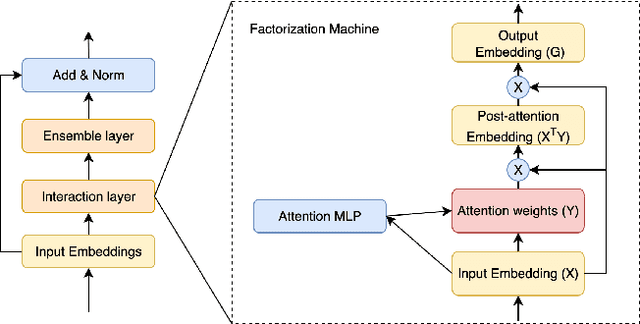
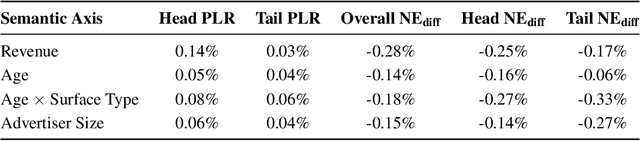
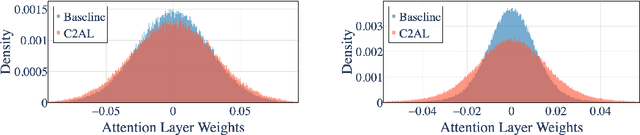

Training large-scale recommendation models under a single global objective implicitly assumes homogeneity across user populations. However, real-world data are composites of heterogeneous cohorts with distinct conditional distributions. As models increase in scale and complexity and as more data is used for training, they become dominated by central distribution patterns, neglecting head and tail regions. This imbalance limits the model's learning ability and can result in inactive attention weights or dead neurons. In this paper, we reveal how the attention mechanism can play a key role in factorization machines for shared embedding selection, and propose to address this challenge by analyzing the substructures in the dataset and exposing those with strong distributional contrast through auxiliary learning. Unlike previous research, which heuristically applies weighted labels or multi-task heads to mitigate such biases, we leverage partially conflicting auxiliary labels to regularize the shared representation. This approach customizes the learning process of attention layers to preserve mutual information with minority cohorts while improving global performance. We evaluated C2AL on massive production datasets with billions of data points each for six SOTA models. Experiments show that the factorization machine is able to capture fine-grained user-ad interactions using the proposed method, achieving up to a 0.16% reduction in normalized entropy overall and delivering gains exceeding 0.30% on targeted minority cohorts.
External Large Foundation Model: How to Efficiently Serve Trillions of Parameters for Online Ads Recommendation
Feb 26, 2025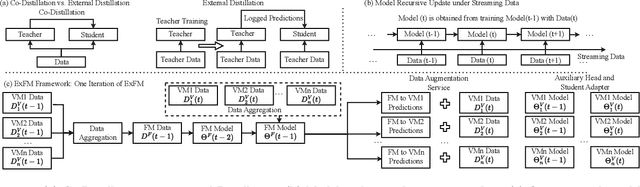
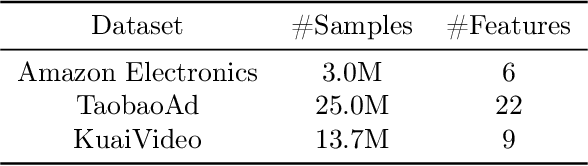
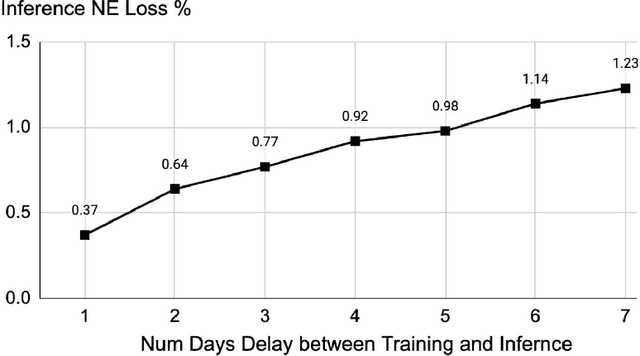
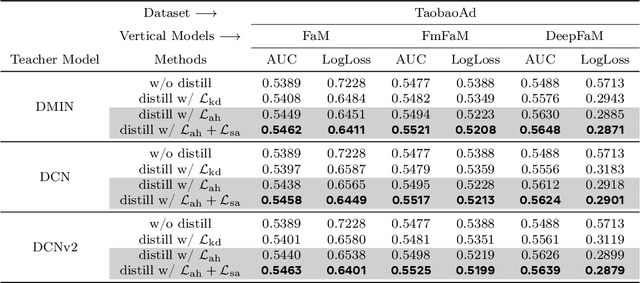
Ads recommendation is a prominent service of online advertising systems and has been actively studied. Recent studies indicate that scaling-up and advanced design of the recommendation model can bring significant performance improvement. However, with a larger model scale, such prior studies have a significantly increasing gap from industry as they often neglect two fundamental challenges in industrial-scale applications. First, training and inference budgets are restricted for the model to be served, exceeding which may incur latency and impair user experience. Second, large-volume data arrive in a streaming mode with data distributions dynamically shifting, as new users/ads join and existing users/ads leave the system. We propose the External Large Foundation Model (ExFM) framework to address the overlooked challenges. Specifically, we develop external distillation and a data augmentation system (DAS) to control the computational cost of training/inference while maintaining high performance. We design the teacher in a way like a foundation model (FM) that can serve multiple students as vertical models (VMs) to amortize its building cost. We propose Auxiliary Head and Student Adapter to mitigate the data distribution gap between FM and VMs caused by the streaming data issue. Comprehensive experiments on internal industrial-scale applications and public datasets demonstrate significant performance gain by ExFM.
Towards the Better Ranking Consistency: A Multi-task Learning Framework for Early Stage Ads Ranking
Jul 12, 2023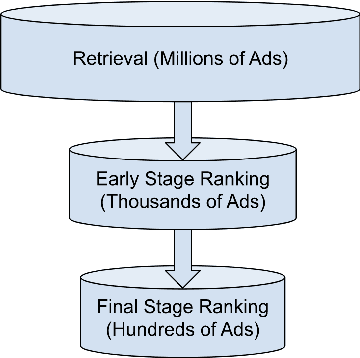


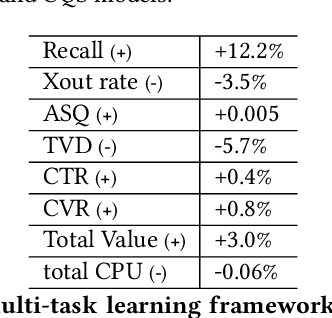
Dividing ads ranking system into retrieval, early, and final stages is a common practice in large scale ads recommendation to balance the efficiency and accuracy. The early stage ranking often uses efficient models to generate candidates out of a set of retrieved ads. The candidates are then fed into a more computationally intensive but accurate final stage ranking system to produce the final ads recommendation. As the early and final stage ranking use different features and model architectures because of system constraints, a serious ranking consistency issue arises where the early stage has a low ads recall, i.e., top ads in the final stage are ranked low in the early stage. In order to pass better ads from the early to the final stage ranking, we propose a multi-task learning framework for early stage ranking to capture multiple final stage ranking components (i.e. ads clicks and ads quality events) and their task relations. With our multi-task learning framework, we can not only achieve serving cost saving from the model consolidation, but also improve the ads recall and ranking consistency. In the online A/B testing, our framework achieves significantly higher click-through rate (CTR), conversion rate (CVR), total value and better ads-quality (e.g. reduced ads cross-out rate) in a large scale industrial ads ranking system.