 Add to Chrome
 Add to Firefox
 Add to Edge
Benchmarking Multi-turn Medical Diagnosis: Hold, Lure, and Self-Correction
Apr 06, 2026
Large language models (LLMs) achieve high accuracy in medical diagnosis when all clinical information is provided in a single turn, yet how they behave under multi-turn evidence accumulation closer to real clinical reasoning remains unexplored. We introduce MINT (Medical Incremental N-Turn Benchmark), a high-fidelity, multi-turn medical diagnosis benchmark comprising 1,035 cases with clinically labeled evidence shards, controlled turn granularity, and information-preserving decomposition. Through systematic evaluation of 11 LLMs on MINT, we uncover three persistent behavioral patterns that significantly impact diagnostic decisions: (1) intent to answer, models rush to answer before sufficient evidence has been observed, with over 55% of answers committed within the first two turns; (2) self-correction, incorrect-to-correct answer revisions occur at up to 10.6 times the rate of correct-to-incorrect flips, revealing a latent capacity for self-correction that premature commitment forecloses; and (3) strong lures, clinically salient information such as laboratory results trigger premature answering even when models are explicitly instructed to wait. We translate these findings into clinically actionable guidance: deferring the diagnostic question to later turns reduces premature answering and improves accuracy at the first point of commitment by up to 62.6%, while reserving salient clinical evidence for later turns prevents a catastrophic accuracy drop of up to 23.3% caused by premature commitment. Our work provides both a controlled evaluation framework and concrete recommendations for improving the reliability of LLMs in multi-turn medical diagnosis.

Reproducibility Assessment of Magnetic Resonance Spectroscopy of Pregenual Anterior Cingulate Cortex across Sessions and Vendors via the Cloud Computing Platform CloudBrain-MRS
Mar 06, 2025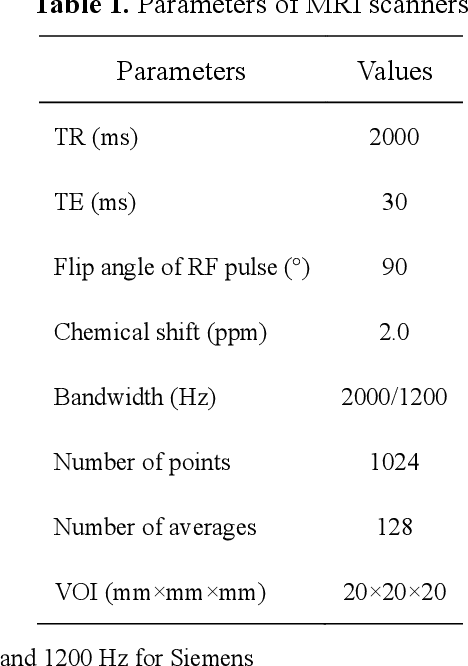
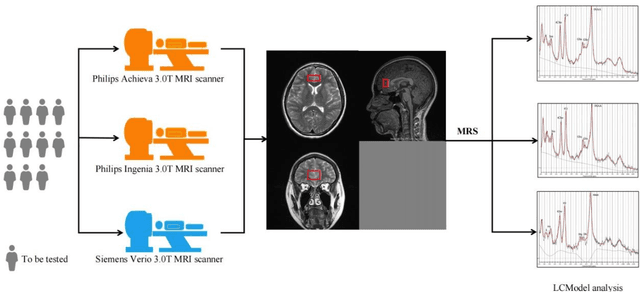
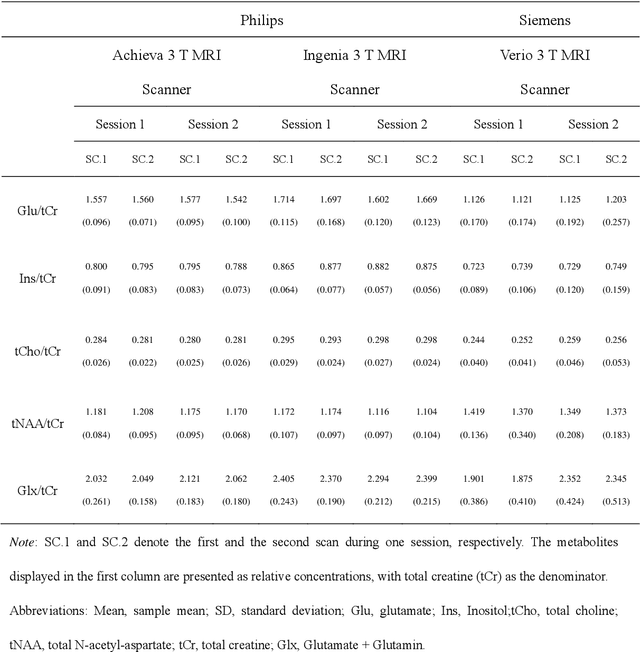
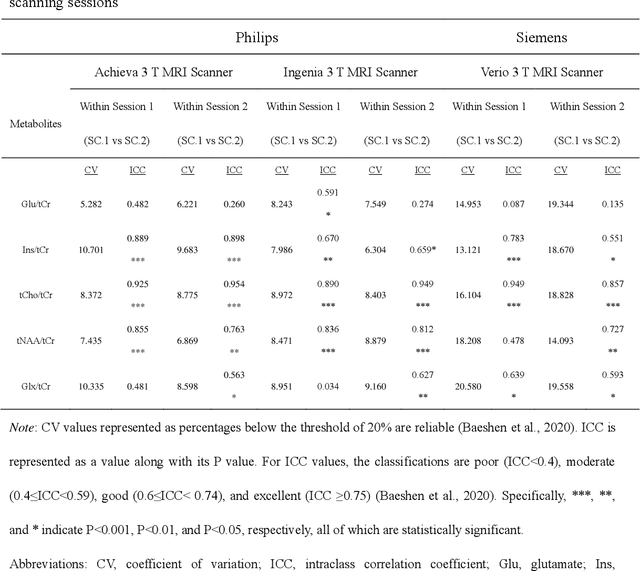
Given the need to elucidate the mechanisms underlying illnesses and their treatment, as well as the lack of harmonization of acquisition and post-processing protocols among different magnetic resonance system vendors, this work is to determine if metabolite concentrations obtained from different sessions, machine models and even different vendors of 3 T scanners can be highly reproducible and be pooled for diagnostic analysis, which is very valuable for the research of rare diseases. Participants underwent magnetic resonance imaging (MRI) scanning once on two separate days within one week (one session per day, each session including two proton magnetic resonance spectroscopy (1H-MRS) scans with no more than a 5-minute interval between scans (no off-bed activity)) on each machine. were analyzed for reliability of within- and between- sessions using the coefficient of variation (CV) and intraclass correlation coefficient (ICC), and for reproducibility of across the machines using correlation coefficient. As for within- and between- session, all CV values for a group of all the first or second scans of a session, or for a session were almost below 20%, and most of the ICCs for metabolites range from moderate (0.4-0.59) to excellent (0.75-1), indicating high data reliability. When it comes to the reproducibility across the three scanners, all Pearson correlation coefficients across the three machines approached 1 with most around 0.9, and majority demonstrated statistical significance (P<0.01). Additionally, the intra-vendor reproducibility was greater than the inter-vendor ones.