 Add to Chrome
 Add to Firefox
 Add to Edge
Uncertainty-Aware Web-Conditioned Scientific Fact-Checking
Apr 13, 2026
Scientific fact-checking is vital for assessing claims in specialized domains such as biomedicine and materials science, yet existing systems often hallucinate or apply inconsistent reasoning, especially when verifying technical, compositional claims against an evidence snippet under source and cost/latency constraints. We present a pipeline centered on atomic predicate-argument decomposition and calibrated, uncertainty-gated corroboration: atomic facts are aligned to local snippets via embeddings, verified by a compact evidence-grounded checker, and only facts with uncertain support trigger domain-restricted web search over authoritative sources. The system supports both binary and tri-valued classification where it predicts labels from Supported, Refuted, NEI for three-way tasks. We evaluate under two regimes, Context-Only (no web) and Context+Web (uncertainty-gated web corroboration); when retrieved evidence conflicts with the provided context, we abstain with NEI rather than overriding the context. On multiple benchmarks, our framework surpasses the strongest benchmarks. In our experiments, web corroboration was invoked for only a minority of atomic facts on average, indicating that external evidence is consulted selectively under calibrated uncertainty rather than routinely. Overall, coupling atomic granularity with calibrated, uncertainty-gated corroboration yields more interpretable and context-conditioned verification, making the approach well-suited to high-stakes, single-document settings that demand traceable rationales, predictable cost/latency, and conservative.

Benchmarking Multi-turn Medical Diagnosis: Hold, Lure, and Self-Correction
Apr 06, 2026Large language models (LLMs) achieve high accuracy in medical diagnosis when all clinical information is provided in a single turn, yet how they behave under multi-turn evidence accumulation closer to real clinical reasoning remains unexplored. We introduce MINT (Medical Incremental N-Turn Benchmark), a high-fidelity, multi-turn medical diagnosis benchmark comprising 1,035 cases with clinically labeled evidence shards, controlled turn granularity, and information-preserving decomposition. Through systematic evaluation of 11 LLMs on MINT, we uncover three persistent behavioral patterns that significantly impact diagnostic decisions: (1) intent to answer, models rush to answer before sufficient evidence has been observed, with over 55% of answers committed within the first two turns; (2) self-correction, incorrect-to-correct answer revisions occur at up to 10.6 times the rate of correct-to-incorrect flips, revealing a latent capacity for self-correction that premature commitment forecloses; and (3) strong lures, clinically salient information such as laboratory results trigger premature answering even when models are explicitly instructed to wait. We translate these findings into clinically actionable guidance: deferring the diagnostic question to later turns reduces premature answering and improves accuracy at the first point of commitment by up to 62.6%, while reserving salient clinical evidence for later turns prevents a catastrophic accuracy drop of up to 23.3% caused by premature commitment. Our work provides both a controlled evaluation framework and concrete recommendations for improving the reliability of LLMs in multi-turn medical diagnosis.
Teaching with Lies: Curriculum DPO on Synthetic Negatives for Hallucination Detection
May 23, 2025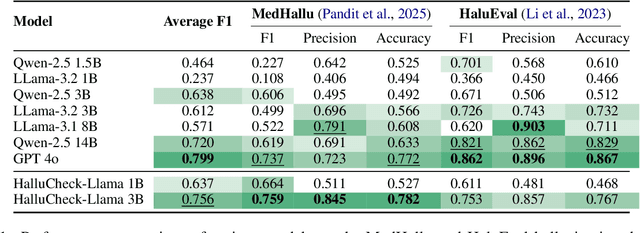
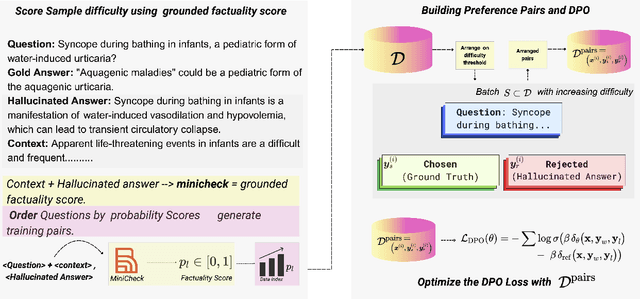
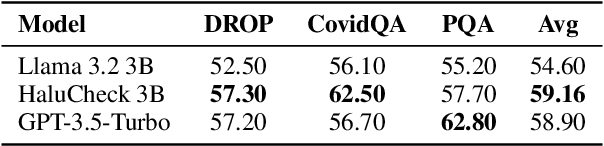
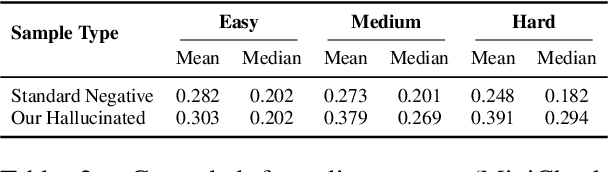
Aligning large language models (LLMs) to accurately detect hallucinations remains a significant challenge due to the sophisticated nature of hallucinated text. Recognizing that hallucinated samples typically exhibit higher deceptive quality than traditional negative samples, we use these carefully engineered hallucinations as negative examples in the DPO alignment procedure. Our method incorporates a curriculum learning strategy, gradually transitioning the training from easier samples, identified based on the greatest reduction in probability scores from independent fact checking models, to progressively harder ones. This structured difficulty scaling ensures stable and incremental learning. Experimental evaluation demonstrates that our HaluCheck models, trained with curriculum DPO approach and high quality negative samples, significantly improves model performance across various metrics, achieving improvements of upto 24% on difficult benchmarks like MedHallu and HaluEval. Additionally, HaluCheck models demonstrate robustness in zero-shot settings, significantly outperforming larger state-of-the-art models across various benchmarks.
Scalable Robust Bayesian Co-Clustering with Compositional ELBOs
Apr 08, 2025Co-clustering exploits the duality of instances and features to simultaneously uncover meaningful groups in both dimensions, often outperforming traditional clustering in high-dimensional or sparse data settings. Although recent deep learning approaches successfully integrate feature learning and cluster assignment, they remain susceptible to noise and can suffer from posterior collapse within standard autoencoders. In this paper, we present the first fully variational Co-clustering framework that directly learns row and column clusters in the latent space, leveraging a doubly reparameterized ELBO to improve gradient signal-to-noise separation. Our unsupervised model integrates a Variational Deep Embedding with a Gaussian Mixture Model (GMM) prior for both instances and features, providing a built-in clustering mechanism that naturally aligns latent modes with row and column clusters. Furthermore, our regularized end-to-end noise learning Compositional ELBO architecture jointly reconstructs the data while regularizing against noise through the KL divergence, thus gracefully handling corrupted or missing inputs in a single training pipeline. To counteract posterior collapse, we introduce a scale modification that increases the encoder's latent means only in the reconstruction pathway, preserving richer latent representations without inflating the KL term. Finally, a mutual information-based cross-loss ensures coherent co-clustering of rows and columns. Empirical results on diverse real-world datasets from multiple modalities, numerical, textual, and image-based, demonstrate that our method not only preserves the advantages of prior Co-clustering approaches but also exceeds them in accuracy and robustness, particularly in high-dimensional or noisy settings.
Curvature Informed Furthest Point Sampling
Nov 25, 2024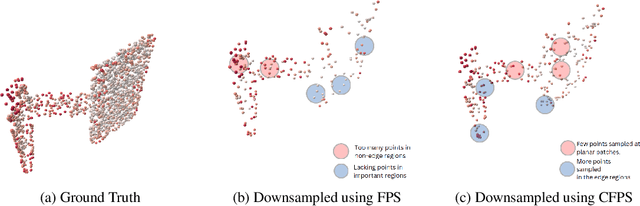
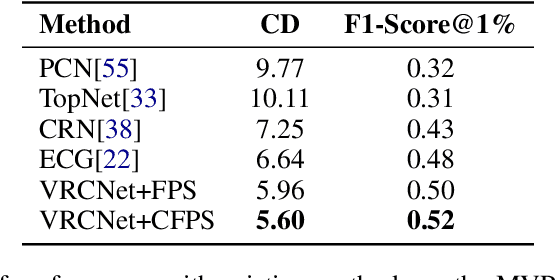
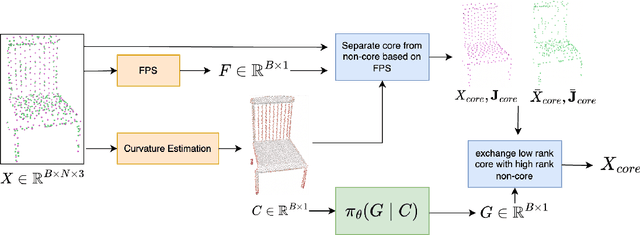
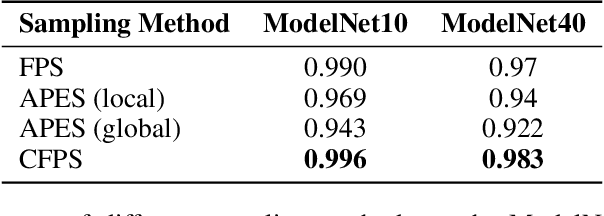
Point cloud representation has gained traction due to its efficient memory usage and simplicity in acquisition, manipulation, and storage. However, as point cloud sizes increase, effective down-sampling becomes essential to address the computational requirements of downstream tasks. Classical approaches, such as furthest point sampling (FPS), perform well on benchmarks but rely on heuristics and overlook geometric features, like curvature, during down-sampling. In this paper, We introduce a reinforcement learning-based sampling algorithm that enhances FPS by integrating curvature information. Our approach ranks points by combining FPS-derived soft ranks with curvature scores computed by a deep neural network, allowing us to replace a proportion of low-curvature points in the FPS set with high-curvature points from the unselected set. Existing differentiable sampling techniques often suffer from training instability, hindering their integration into end-to-end learning frameworks. By contrast, our method achieves stable end-to-end learning, consistently outperforming baseline models across multiple downstream geometry processing tasks. We provide comprehensive ablation studies, with both qualitative and quantitative insights into the effect of each feature on performance. Our algorithm establishes state-of-the-art results for classification, segmentation and shape completion, showcasing its robustness and adaptability.