 Add to Chrome
 Add to Firefox
 Add to Edge
Multicalibration yields better matchings
Nov 14, 2025
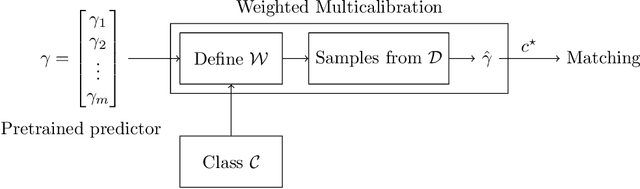
Consider the problem of finding the best matching in a weighted graph where we only have access to predictions of the actual stochastic weights, based on an underlying context. If the predictor is the Bayes optimal one, then computing the best matching based on the predicted weights is optimal. However, in practice, this perfect information scenario is not realistic. Given an imperfect predictor, a suboptimal decision rule may compensate for the induced error and thus outperform the standard optimal rule. In this paper, we propose multicalibration as a way to address this problem. This fairness notion requires a predictor to be unbiased on each element of a family of protected sets of contexts. Given a class of matching algorithms $\mathcal C$ and any predictor $γ$ of the edge-weights, we show how to construct a specific multicalibrated predictor $\hat γ$, with the following property. Picking the best matching based on the output of $\hat γ$ is competitive with the best decision rule in $\mathcal C$ applied onto the original predictor $γ$. We complement this result by providing sample complexity bounds.

Online Learning with Sublinear Best-Action Queries
Jul 23, 2024In online learning, a decision maker repeatedly selects one of a set of actions, with the goal of minimizing the overall loss incurred. Following the recent line of research on algorithms endowed with additional predictive features, we revisit this problem by allowing the decision maker to acquire additional information on the actions to be selected. In particular, we study the power of \emph{best-action queries}, which reveal beforehand the identity of the best action at a given time step. In practice, predictive features may be expensive, so we allow the decision maker to issue at most $k$ such queries. We establish tight bounds on the performance any algorithm can achieve when given access to $k$ best-action queries for different types of feedback models. In particular, we prove that in the full feedback model, $k$ queries are enough to achieve an optimal regret of $\Theta\left(\min\left\{\sqrt T, \frac Tk\right\}\right)$. This finding highlights the significant multiplicative advantage in the regret rate achievable with even a modest (sublinear) number $k \in \Omega(\sqrt{T})$ of queries. Additionally, we study the challenging setting in which the only available feedback is obtained during the time steps corresponding to the $k$ best-action queries. There, we provide a tight regret rate of $\Theta\left(\min\left\{\frac{T}{\sqrt k},\frac{T^2}{k^2}\right\}\right)$, which improves over the standard $\Theta\left(\frac{T}{\sqrt k}\right)$ regret rate for label efficient prediction for $k \in \Omega(T^{2/3})$.