 Add to Chrome
 Add to Firefox
 Add to Edge
Online Convex Optimization with Sublinear Noisy Probes
Jun 12, 2026
We study Online Convex Optimization (OCO) over a convex set $K\subseteq \mathbb R^d$, where in each round $t$ the learner selects $x_t\in K$ and then observes a convex loss $f_t:K\to[0,1]$, with the goal of minimizing regret to the best fixed decision in hindsight. We introduce a unified probing model that generalizes two recent lines of work: sublinear best-expert queries in the experts setting, and pairwise (comparison-based) feedback available every round in OCO. In our framework, the learner has a budget of $k\le T$ pairwise probes; on a probed round it may query two points and learn which one has smaller loss. Our main result shows that even a sublinear and noisy probe budget can provably improve worst-case regret in the full feedback OCO regime. With $k$ $δ$-noisy pairwise probes, we obtain: $ \text{Reg}_T \le O\left(\min\left\{\sqrt{dT\ln T},\; \frac{dT\ln T}{k|1-2δ|}\right\}\right) $, which is tight (up to logarithmic factors in $T$) across $T$, $k$ and $δ$. Specifically regarding the noise parameter $δ\in [0,1]$, the regret guarantee smoothly degrades as the oracle response approaches a coin flip, i.e., $δ$ is close to $\frac{1}{2}$. When applying the same techniques to a finite $K$ for the prediction with $d$ experts setting, the resulting rates are instead completely tight in all parameters, including $d$. Our analysis gives a streamlined treatment of pairwise probing in OCO by quantifying the benefit of probing via a variance reduction effect, combined with a second-order (variance-based) analysis of Continuous Exponential Weights.

Profit Maximization in Bilateral Trade against a Smooth Adversary
May 12, 2026Bilateral trade models the task of intermediating between two strategic agents, a seller and a buyer, who wish to trade a good. We study this problem from the perspective of a profit-maximizing broker within an online learning framework, where the agents' valuations are generated by a smooth adversary. We devise a learning algorithm that guarantees a $\tilde{O}(\sqrt{T})$ regret bound, which is tight in the time horizon $T$ up to poly-logarithmic factors. This matches the minimax rate for the stochastic i.i.d. case, and is also well separated from the adversarial setting, where sublinear-regret is unattainable. By extending the strong regret guarantees from the i.i.d. case to the smooth adversary, we significantly broaden the scope of settings where such fast rate is achievable, while closing an important gap in the regret landscape of this fundamental economic problem. To overcome the challenges posed by this adversary, we leverage a continuity property of smooth instances and combines this with a hierarchical net-construction of the broker's action space, which is analyzed via algorithmic chaining. We showcase the applicability of these techniques by deriving a similarly tight $\tilde{O}(\sqrt{T})$ regret bound for a related mechanism design model: the joint ads problem.
Multicalibration yields better matchings
Nov 14, 2025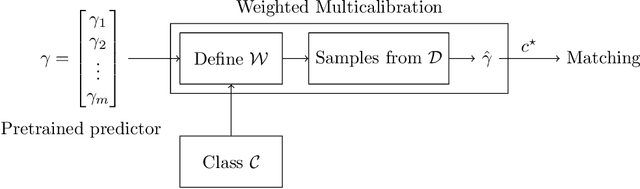
Consider the problem of finding the best matching in a weighted graph where we only have access to predictions of the actual stochastic weights, based on an underlying context. If the predictor is the Bayes optimal one, then computing the best matching based on the predicted weights is optimal. However, in practice, this perfect information scenario is not realistic. Given an imperfect predictor, a suboptimal decision rule may compensate for the induced error and thus outperform the standard optimal rule. In this paper, we propose multicalibration as a way to address this problem. This fairness notion requires a predictor to be unbiased on each element of a family of protected sets of contexts. Given a class of matching algorithms $\mathcal C$ and any predictor $γ$ of the edge-weights, we show how to construct a specific multicalibrated predictor $\hat γ$, with the following property. Picking the best matching based on the output of $\hat γ$ is competitive with the best decision rule in $\mathcal C$ applied onto the original predictor $γ$. We complement this result by providing sample complexity bounds.
Nearly Tight Regret Bounds for Profit Maximization in Bilateral Trade
Sep 26, 2025Bilateral trade models the task of intermediating between two strategic agents, a seller and a buyer, willing to trade a good for which they hold private valuations. We study this problem from the perspective of a broker, in a regret minimization framework. At each time step, a new seller and buyer arrive, and the broker has to propose a mechanism that is incentive-compatible and individually rational, with the goal of maximizing profit. We propose a learning algorithm that guarantees a nearly tight $\tilde{O}(\sqrt{T})$ regret in the stochastic setting when seller and buyer valuations are drawn i.i.d. from a fixed and possibly correlated unknown distribution. We further show that it is impossible to achieve sublinear regret in the non-stationary scenario where valuations are generated upfront by an adversary. Our ambitious benchmark for these results is the best incentive-compatible and individually rational mechanism. This separates us from previous works on efficiency maximization in bilateral trade, where the benchmark is a single number: the best fixed price in hindsight. A particular challenge we face is that uniform convergence for all mechanisms' profits is impossible. We overcome this difficulty via a careful chaining analysis that proves convergence for a provably near-optimal mechanism at (essentially) optimal rate. We further showcase the broader applicability of our techniques by providing nearly optimal results for the joint ads problem.
Neural Drift Estimation for Ergodic Diffusions: Non-parametric Analysis and Numerical Exploration
May 30, 2025We take into consideration generalization bounds for the problem of the estimation of the drift component for ergodic stochastic differential equations, when the estimator is a ReLU neural network and the estimation is non-parametric with respect to the statistical model. We show a practical way to enforce the theoretical estimation procedure, enabling inference on noisy and rough functional data. Results are shown for a simulated It\^o-Taylor approximation of the sample paths.