 Add to Chrome
 Add to Firefox
 Add to Edge
Theoretical Foundations of $\max$@$k$ Reinforcement Learning
Jul 20, 2026
Reinforcement Learning is a cornerstone technique for modern large reasoning models. Usually, for difficult tasks such as code generation and theorem proving, the agent is evaluated by generating $K$ responses rather than sampling a single response, and performance is then measured using a retry-aware metric such as $\max$@$k$. Despite their practical importance, the theoretical foundations of learning under such criteria remain limited. In this work, we provide a theoretical study of the $\max$@$k$ learning problem in finite-horizon reinforcement learning. We show that optimizing the $\max$@$k$ objectives is fundamentally different from standard expected-return maximization. In particular, we prove that Markovian policies are in general insufficient, identify a compact state augmentation that restores optimality, and explicitly characterize the performance gap that can arise between history-dependent and non-history-dependent policies. Moreover, we show that learning $\max$@$k$-optimal policies is statistically harder than standard reinforcement learning and provide an efficient algorithm that achieves the optimal sample complexity rate.

The Complexity of Min-Max Optimization for Quadratic Polynomials
Jun 15, 2026We prove that computing approximate stationary points of min-max optimization over the hypercube is PPAD-hard for quadratic polynomials. This holds even when the polynomials are multilinear, each variable appears in at most three monomials, and the approximation factor is inverse polynomial. As a direct consequence, we obtain the first PPAD-hardness results for two-team zero-sum polymatrix games.
Min-Max Optimization Requires Exponentially Many Queries
May 13, 2026We study the query complexity of min-max optimization of a nonconvex-nonconcave function $f$ over $[0,1]^d \times [0,1]^d$. We show that, given oracle access to $f$ and to its gradient $\nabla f$, any algorithm that finds an $\varepsilon$-approximate stationary point must make a number of queries that is exponential in $1/\varepsilon$ or $d$.
Nonparametric Contextual Online Bilateral Trade
Feb 13, 2026We study the problem of contextual online bilateral trade. At each round, the learner faces a seller-buyer pair and must propose a trade price without observing their private valuations for the item being sold. The goal of the learner is to post prices to facilitate trades between the two parties. Before posting a price, the learner observes a $d$-dimensional context vector that influences the agent's valuations. Prior work in the contextual setting has focused on linear models. In this work, we tackle a general nonparametric setting in which the buyer's and seller's valuations behave according to arbitrary Lipschitz functions of the context. We design an algorithm that leverages contextual information through a hierarchical tree construction and guarantees regret $\widetilde{O}(T^{{(d-1)}/d})$. Remarkably, our algorithm operates under two stringent features of the setting: (1) one-bit feedback, where the learner only observes whether a trade occurred or not, and (2) strong budget balance, where the learner cannot subsidize or profit from the market participants. We further provide a matching lower bound in the full-feedback setting, demonstrating the tightness of our regret bound.
Optimal Rates for Feasible Payoff Set Estimation in Games
Feb 04, 2026We study a setting in which two players play a (possibly approximate) Nash equilibrium of a bimatrix game, while a learner observes only their actions and has no knowledge of the equilibrium or the underlying game. A natural question is whether the learner can rationalize the observed behavior by inferring the players' payoff functions. Rather than producing a single payoff estimate, inverse game theory aims to identify the entire set of payoffs consistent with observed behavior, enabling downstream use in, e.g., counterfactual analysis and mechanism design across applications like auctions, pricing, and security games. We focus on the problem of estimating the set of feasible payoffs with high probability and up to precision $ε$ on the Hausdorff metric. We provide the first minimax-optimal rates for both exact and approximate equilibrium play, in zero-sum as well as general-sum games. Our results provide learning-theoretic foundations for set-valued payoff inference in multi-agent environments.
Non-Asymptotic Analysis of (Sticky) Track-and-Stop
May 28, 2025In pure exploration problems, a statistician sequentially collects information to answer a question about some stochastic and unknown environment. The probability of returning a wrong answer should not exceed a maximum risk parameter $\delta$ and good algorithms make as few queries to the environment as possible. The Track-and-Stop algorithm is a pioneering method to solve these problems. Specifically, it is well-known that it enjoys asymptotic optimality sample complexity guarantees for $\delta\to 0$ whenever the map from the environment to its correct answers is single-valued (e.g., best-arm identification with a unique optimal arm). The Sticky Track-and-Stop algorithm extends these results to settings where, for each environment, there might exist multiple correct answers (e.g., $\epsilon$-optimal arm identification). Although both methods are optimal in the asymptotic regime, their non-asymptotic guarantees remain unknown. In this work, we fill this gap and provide non-asymptotic guarantees for both algorithms.
Pure Exploration with Infinite Answers
May 28, 2025We study pure exploration problems where the set of correct answers is possibly infinite, e.g., the regression of any continuous function of the means of the bandit. We derive an instance-dependent lower bound for these problems. By analyzing it, we discuss why existing methods (i.e., Sticky Track-and-Stop) for finite answer problems fail at being asymptotically optimal in this more general setting. Finally, we present a framework, Sticky-Sequence Track-and-Stop, which generalizes both Track-and-Stop and Sticky Track-and-Stop, and that enjoys asymptotic optimality. Due to its generality, our analysis also highlights special cases where existing methods enjoy optimality.
Online Learning with Sublinear Best-Action Queries
Jul 23, 2024In online learning, a decision maker repeatedly selects one of a set of actions, with the goal of minimizing the overall loss incurred. Following the recent line of research on algorithms endowed with additional predictive features, we revisit this problem by allowing the decision maker to acquire additional information on the actions to be selected. In particular, we study the power of \emph{best-action queries}, which reveal beforehand the identity of the best action at a given time step. In practice, predictive features may be expensive, so we allow the decision maker to issue at most $k$ such queries. We establish tight bounds on the performance any algorithm can achieve when given access to $k$ best-action queries for different types of feedback models. In particular, we prove that in the full feedback model, $k$ queries are enough to achieve an optimal regret of $\Theta\left(\min\left\{\sqrt T, \frac Tk\right\}\right)$. This finding highlights the significant multiplicative advantage in the regret rate achievable with even a modest (sublinear) number $k \in \Omega(\sqrt{T})$ of queries. Additionally, we study the challenging setting in which the only available feedback is obtained during the time steps corresponding to the $k$ best-action queries. There, we provide a tight regret rate of $\Theta\left(\min\left\{\frac{T}{\sqrt k},\frac{T^2}{k^2}\right\}\right)$, which improves over the standard $\Theta\left(\frac{T}{\sqrt k}\right)$ regret rate for label efficient prediction for $k \in \Omega(T^{2/3})$.
Beyond Primal-Dual Methods in Bandits with Stochastic and Adversarial Constraints
May 25, 2024We address a generalization of the bandit with knapsacks problem, where a learner aims to maximize rewards while satisfying an arbitrary set of long-term constraints. Our goal is to design best-of-both-worlds algorithms that perform optimally under both stochastic and adversarial constraints. Previous works address this problem via primal-dual methods, and require some stringent assumptions, namely the Slater's condition, and in adversarial settings, they either assume knowledge of a lower bound on the Slater's parameter, or impose strong requirements on the primal and dual regret minimizers such as requiring weak adaptivity. We propose an alternative and more natural approach based on optimistic estimations of the constraints. Surprisingly, we show that estimating the constraints with an UCB-like approach guarantees optimal performances. Our algorithm consists of two main components: (i) a regret minimizer working on \emph{moving strategy sets} and (ii) an estimate of the feasible set as an optimistic weighted empirical mean of previous samples. The key challenge in this approach is designing adaptive weights that meet the different requirements for stochastic and adversarial constraints. Our algorithm is significantly simpler than previous approaches, and has a cleaner analysis. Moreover, ours is the first best-of-both-worlds algorithm providing bounds logarithmic in the number of constraints. Additionally, in stochastic settings, it provides $\widetilde O(\sqrt{T})$ regret \emph{without} Slater's condition.
No-Regret is not enough! Bandits with General Constraints through Adaptive Regret Minimization
May 10, 2024
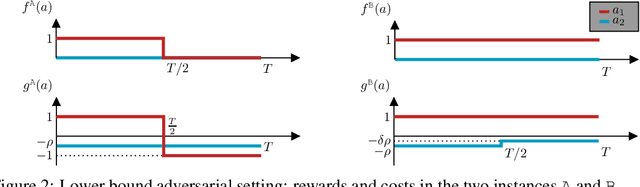
In the bandits with knapsacks framework (BwK) the learner has $m$ resource-consumption (packing) constraints. We focus on the generalization of BwK in which the learner has a set of general long-term constraints. The goal of the learner is to maximize their cumulative reward, while at the same time achieving small cumulative constraints violations. In this scenario, there exist simple instances where conventional methods for BwK fail to yield sublinear violations of constraints. We show that it is possible to circumvent this issue by requiring the primal and dual algorithm to be weakly adaptive. Indeed, even in absence on any information on the Slater's parameter $\rho$ characterizing the problem, the interplay between weakly adaptive primal and dual regret minimizers yields a "self-bounding" property of dual variables. In particular, their norm remains suitably upper bounded across the entire time horizon even without explicit projection steps. By exploiting this property, we provide best-of-both-worlds guarantees for stochastic and adversarial inputs. In the first case, we show that the algorithm guarantees sublinear regret. In the latter case, we establish a tight competitive ratio of $\rho/(1+\rho)$. In both settings, constraints violations are guaranteed to be sublinear in time. Finally, this results allow us to obtain new result for the problem of contextual bandits with linear constraints, providing the first no-$\alpha$-regret guarantees for adversarial contexts.