 Add to Chrome
 Add to Firefox
 Add to Edge
How Much Dense Attention is Necessary? Oracle-Guided Sparse Prefill for Full/GQA Layers in Hybrid Long-Context Models
Jun 05, 2026
Long-context prefill remains expensive because full/GQA layers still score the historical sequence, even in hybrid models with local, sparse, linear, or recurrent components. We study how much dense attention is needed to preserve task-level behavior under explicit support granularity and top-k budgets. We introduce an attention-mass top-k oracle for existing GQA checkpoints: for each layer and query position, it computes dense attention, selects head-averaged token support, and recomputes attention only on that support. The oracle is a diagnostic reference, not a deployable accelerator, and separates sparse-budget feasibility from indexer error and runtime realization effects. On Qwen-family retrieval-heavy evaluations, the longest per-query oracle rows stay within 1 point of dense, and a Qwen3.5-9B RULER-style sweep from 4K to 100K stays within 0.48 points. Guided by the oracle, we derive a head-collapsed auxiliary indexer trained by KL distillation from dense attention-mass distributions while keeping the backbone frozen. With separately distilled Qwen3.5-0.8B and Qwen3.5-9B indexers, the reported 16K/32K validation macro gaps are +2.04 and +1.13 points, treated as quality preservation rather than improvement; fused selection-block-shared support can introduce a larger realization gap. Preliminary single-card TTFT measurements show distilled-indexer sparse serving speedups of 1.71x for Qwen3.5-0.8B on NPU and 1.93x for Qwen3.5-9B on GPU against its dense FlashAttention-2 baseline. Additional random-init stress rows reach 3.44x, indicating sparse-runtime headroom but not validated output quality. This first release separates oracle feasibility, distilled-indexer quality, and runtime headroom, leaving a fully matched quality-latency frontier to future work.

PolyTOPS: Reconfigurable and Flexible Polyhedral Scheduler
Jan 12, 2024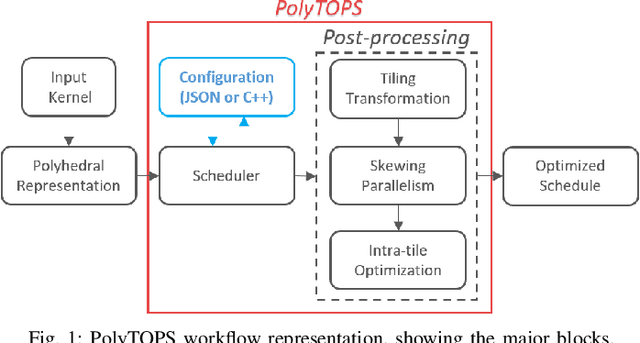
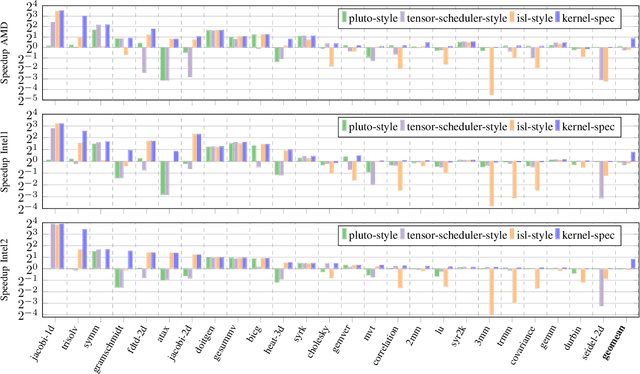
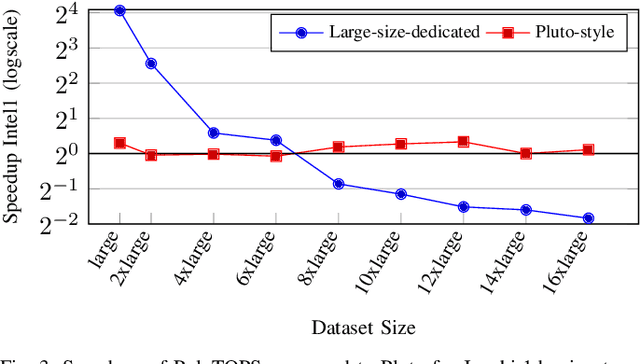
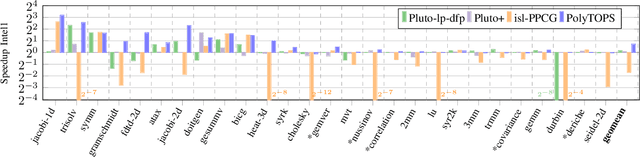
Polyhedral techniques have been widely used for automatic code optimization in low-level compilers and higher-level processes. Loop optimization is central to this technique, and several polyhedral schedulers like Feautrier, Pluto, isl and Tensor Scheduler have been proposed, each of them targeting a different architecture, parallelism model, or application scenario. The need for scenario-specific optimization is growing due to the heterogeneity of architectures. One of the most critical cases is represented by NPUs (Neural Processing Units) used for AI, which may require loop optimization with different objectives. Another factor to be considered is the framework or compiler in which polyhedral optimization takes place. Different scenarios, depending on the target architecture, compilation environment, and application domain, may require different kinds of optimization to best exploit the architecture feature set. We introduce a new configurable polyhedral scheduler, PolyTOPS, that can be adjusted to various scenarios with straightforward, high-level configurations. This scheduler allows the creation of diverse scheduling strategies that can be both scenario-specific (like state-of-the-art schedulers) and kernel-specific, breaking the concept of a one-size-fits-all scheduler approach. PolyTOPS has been used with isl and CLooG as code generators and has been integrated in MindSpore AKG deep learning compiler. Experimental results in different scenarios show good performance: a geomean speedup of 7.66x on MindSpore (for the NPU Ascend architecture) hybrid custom operators over isl scheduling, a geomean speedup up to 1.80x on PolyBench on different multicore architectures over Pluto scheduling. Finally, some comparisons with different state-of-the-art tools are presented in the PolyMage scenario.