 Add to Chrome
 Add to Firefox
 Add to Edge
VoxCPM2 Technical Report
Jun 05, 2026
We present VoxCPM2, a https://info.arxiv.org/help/prep#abstractsfully open-source multilingual and controllable speech generation foundation model that extends the hierarchical diffusion-autoregressive modeling paradigm of VoxCPM. VoxCPM2 advances the framework in three key dimensions: (i) capability, by unifying 30 languages, 9 Chinese dialects, natural-language voice design, style-controllable voice cloning, and high-fidelity continuation cloning within a single backbone; (ii) quality, through an asymmetric AudioVAE that encodes at 16 kHz and reconstructs at 48 kHz, enabling implicit super-resolution with high encoding efficiency; and (iii) scale, by jointly scaling the model to 2B parameters and the training data to over 2 million hours of multilingual speech. To support these diverse capabilities within one model, we introduce a unified sequence organization that expresses all generation modes through different arrangements of the same input building blocks, allowing joint training under a single set of parameters and objective. VoxCPM2 achieves state-of-the-art or competitive performance on public zero-shot and instruction-following TTS benchmarks. On our internal 30-language evaluation set, it attains an average WER of 1.68%. These results demonstrate that hierarchical continuous-latent modeling, without relying on any external discrete speech tokenizer, offers a viable and powerful foundation for large-scale multilingual and controllable speech generation. The model weights, fine-tuning code, and inference tools are publicly released under the Apache 2.0 license to foster community research and development.

Step-GUI Technical Report
Dec 19, 2025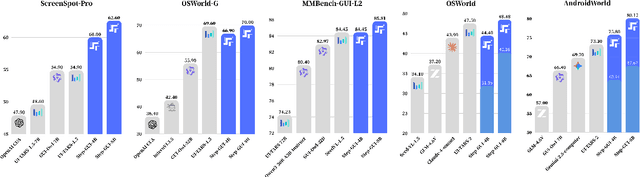
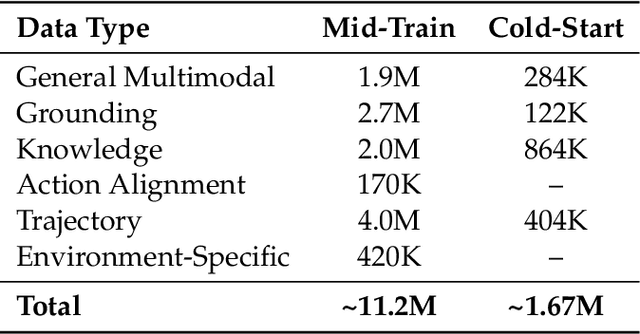
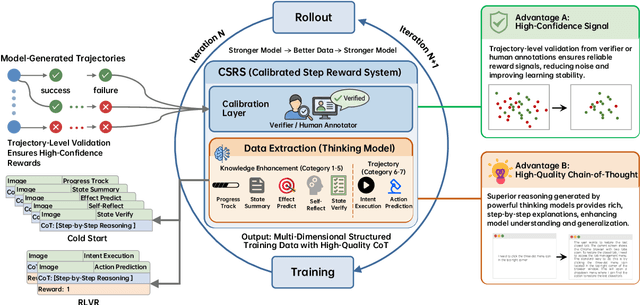
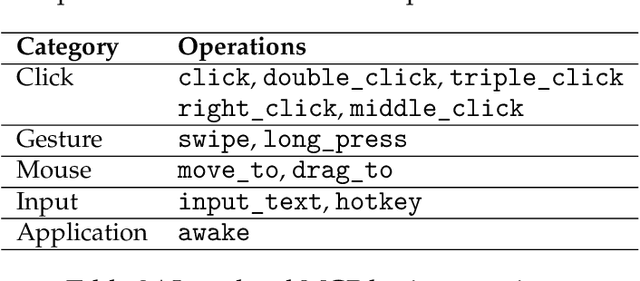
Recent advances in multimodal large language models unlock unprecedented opportunities for GUI automation. However, a fundamental challenge remains: how to efficiently acquire high-quality training data while maintaining annotation reliability? We introduce a self-evolving training pipeline powered by the Calibrated Step Reward System, which converts model-generated trajectories into reliable training signals through trajectory-level calibration, achieving >90% annotation accuracy with 10-100x lower cost. Leveraging this pipeline, we introduce Step-GUI, a family of models (4B/8B) that achieves state-of-the-art GUI performance (8B: 80.2% AndroidWorld, 48.5% OSWorld, 62.6% ScreenShot-Pro) while maintaining robust general capabilities. As GUI agent capabilities improve, practical deployment demands standardized interfaces across heterogeneous devices while protecting user privacy. To this end, we propose GUI-MCP, the first Model Context Protocol for GUI automation with hierarchical architecture that combines low-level atomic operations and high-level task delegation to local specialist models, enabling high-privacy execution where sensitive data stays on-device. Finally, to assess whether agents can handle authentic everyday usage, we introduce AndroidDaily, a benchmark grounded in real-world mobile usage patterns with 3146 static actions and 235 end-to-end tasks across high-frequency daily scenarios (8B: static 89.91%, end-to-end 52.50%). Our work advances the development of practical GUI agents and demonstrates strong potential for real-world deployment in everyday digital interactions.
A Scalable Pipeline for Enabling Non-Verbal Speech Generation and Understanding
Aug 07, 2025Human spoken communication involves not only lexical content but also non-verbal vocalizations (NVs) such as laughter, sighs, and coughs, which convey emotions, intentions, and social signals. However, most existing speech systems focus solely on verbal content and lack the ability to understand and generate such non-verbal cues, reducing the emotional intelligence and communicative richness of spoken interfaces. In this work, we introduce $\textbf{NonVerbalSpeech-38K}$, a large and diverse dataset for non-verbal speech generation and understanding, collected from real-world media and annotated using an automatic pipeline. The dataset contains 38,718 samples (about 131 hours) with 10 categories of non-verbal cues, such as laughter, sniff, and throat clearing. We further validate the dataset by fine-tuning state-of-the-art models, including F5-TTS and Qwen2-Audio, demonstrating its effectiveness in non-verbal speech generation and understanding tasks. Our contributions are threefold: (1) We propose a practical pipeline for building natural and diverse non-verbal speech datasets; (2) We release a large-scale dataset to advance research on non-verbal speech generation and understanding; (3) We validate the dataset's effectiveness by demonstrating improvements in both non-verbal speech synthesis and captioning, thereby facilitating richer human-computer interaction.