 Add to Chrome
 Add to Firefox
 Add to Edge
Rethinking Training & Inference for Forecasting: Linking Winner-Take-All back to GMMs
Jun 24, 2026
Trajectory forecasting for autonomous driving has advanced rapidly, yet representative models often produce uninformative posteriors over forecast modes, causing problems for mode pruning. We trace this to a modeling-training mismatch: forecasters are typically modeled as conditional Gaussian mixture models (GMMs) but trained with a winner-take-all (WTA) loss that assigns each sample to its nearest mode. We argue that this K-means-like hard assignment (one-hot), while preventing mode collapse, is the source of uninformative mode probabilities: it over-segments the trajectory space, ignores relatedness among nearby modes, and yields assignment instability under small perturbations. Guided by this lens, we introduce two post-hoc treatments: (1) test-time posterior-weighted merging that aggregates nearby candidate trajectories; and (2) a one-step expectation-maximization (EM) update that replaces hard labels with soft responsibilities, sharing probability mass across neighboring modes. Across several WTA-trained architectures, these lightweight steps produce more informative, faithfully ranked mode posteriors and strengthen final forecasts on popular displacement metrics -- without retraining. Our analysis unifies recent design choices through a GMM-vs-K-means perspective and offers principled, practical corrections that better align training objectives with inference.

4D Radar Meets LiDAR and Camera: Cooperative Perception under Adverse Weather
May 29, 2026Cooperative perception is important for autonomous driving but remains fragile when cameras and LiDAR degrade in adverse weather. We address this challenge by integrating 4D imaging radar as a weather-robust modality into collaborative perception and introducing a Doppler-guided spatial attention mechanism for multi-agent fusion. Our approach extends two representative backbones: a radar-camera pipeline where radar substitutes LiDAR, and a LiDAR-radar pipeline where radar complements LiDAR. To support evaluation, we release radar-augmented benchmarks, OPV2V-R and Adver-City-R, with physics-based LiDAR degradation. Experiments show strong robustness gains in fog and rain, including substantial improvements when radar replaces degraded LiDAR. Additional validation on MAN TruckScenes demonstrates transfer beyond simulation. Overall, our results highlight 4D imaging radar as a robust modality for all-weather collaborative perception. Dataset and code are available at: https://url.fzi.de/SlimComm.
Behavioral Anomaly Detection in Distributed Systems via Federated Contrastive Learning
Jun 24, 2025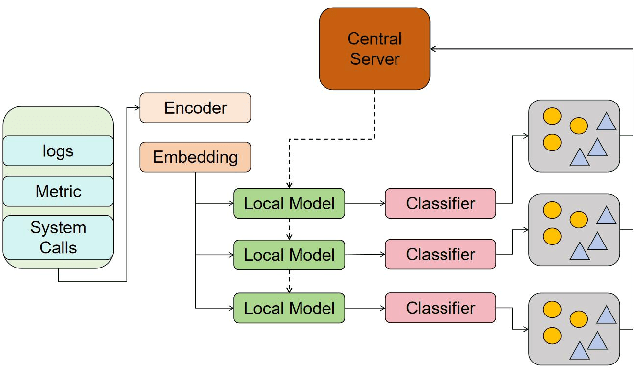
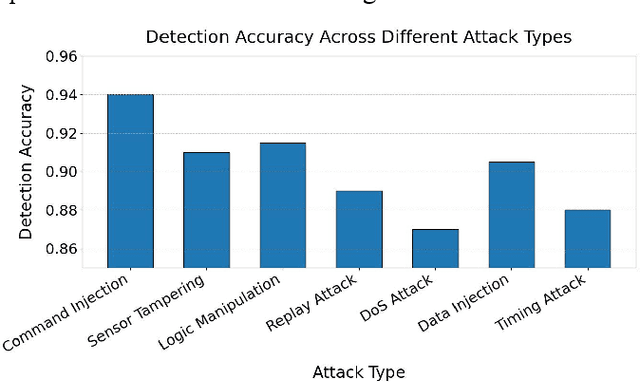
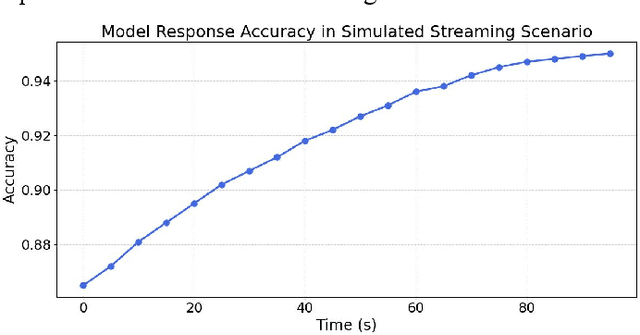
This paper addresses the increasingly prominent problem of anomaly detection in distributed systems. It proposes a detection method based on federated contrastive learning. The goal is to overcome the limitations of traditional centralized approaches in terms of data privacy, node heterogeneity, and anomaly pattern recognition. The proposed method combines the distributed collaborative modeling capabilities of federated learning with the feature discrimination enhancement of contrastive learning. It builds embedding representations on local nodes and constructs positive and negative sample pairs to guide the model in learning a more discriminative feature space. Without exposing raw data, the method optimizes a global model through a federated aggregation strategy. Specifically, the method uses an encoder to represent local behavior data in high-dimensional space. This includes system logs, operational metrics, and system calls. The model is trained using both contrastive loss and classification loss to improve its ability to detect fine-grained anomaly patterns. The method is evaluated under multiple typical attack types. It is also tested in a simulated real-time data stream scenario to examine its responsiveness. Experimental results show that the proposed method outperforms existing approaches across multiple performance metrics. It demonstrates strong detection accuracy and adaptability, effectively addressing complex anomalies in distributed environments. Through careful design of key modules and optimization of the training mechanism, the proposed method achieves a balance between privacy preservation and detection performance. It offers a feasible technical path for intelligent security management in distributed systems.
Time-Series Learning for Proactive Fault Prediction in Distributed Systems with Deep Neural Structures
May 27, 2025This paper addresses the challenges of fault prediction and delayed response in distributed systems by proposing an intelligent prediction method based on temporal feature learning. The method takes multi-dimensional performance metric sequences as input. We use a Gated Recurrent Unit (GRU) to model the evolution of system states over time. An attention mechanism is then applied to enhance key temporal segments, improving the model's ability to identify potential faults. On this basis, a feedforward neural network is designed to perform the final classification, enabling early warning of system failures. To validate the effectiveness of the proposed approach, comparative experiments and ablation analyses were conducted using data from a large-scale real-world cloud system. The experimental results show that the model outperforms various mainstream time-series models in terms of Accuracy, F1-Score, and AUC. This demonstrates strong prediction capability and stability. Furthermore, the loss function curve confirms the convergence and reliability of the training process. It indicates that the proposed method effectively learns system behavior patterns and achieves efficient fault detection.
Graph Neural Network-Based Collaborative Perception for Adaptive Scheduling in Distributed Systems
May 22, 2025This paper addresses the limitations of multi-node perception and delayed scheduling response in distributed systems by proposing a GNN-based multi-node collaborative perception mechanism. The system is modeled as a graph structure. Message-passing and state-update modules are introduced. A multi-layer graph neural network is constructed to enable efficient information aggregation and dynamic state inference among nodes. In addition, a perception representation method is designed by fusing local states with global features. This improves each node's ability to perceive the overall system status. The proposed method is evaluated within a customized experimental framework. A dataset featuring heterogeneous task loads and dynamic communication topologies is used. Performance is measured in terms of task completion rate, average latency, load balancing, and transmission efficiency. Experimental results show that the proposed method outperforms mainstream algorithms under various conditions, including limited bandwidth and dynamic structural changes. It demonstrates superior perception capabilities and cooperative scheduling performance. The model achieves rapid convergence and efficient responses to complex system states.