 Add to Chrome
 Add to Firefox
 Add to Edge
4D Radar Meets LiDAR and Camera: Cooperative Perception under Adverse Weather
May 29, 2026
Cooperative perception is important for autonomous driving but remains fragile when cameras and LiDAR degrade in adverse weather. We address this challenge by integrating 4D imaging radar as a weather-robust modality into collaborative perception and introducing a Doppler-guided spatial attention mechanism for multi-agent fusion. Our approach extends two representative backbones: a radar-camera pipeline where radar substitutes LiDAR, and a LiDAR-radar pipeline where radar complements LiDAR. To support evaluation, we release radar-augmented benchmarks, OPV2V-R and Adver-City-R, with physics-based LiDAR degradation. Experiments show strong robustness gains in fog and rain, including substantial improvements when radar replaces degraded LiDAR. Additional validation on MAN TruckScenes demonstrates transfer beyond simulation. Overall, our results highlight 4D imaging radar as a robust modality for all-weather collaborative perception. Dataset and code are available at: https://url.fzi.de/SlimComm.

AnoVox: A Benchmark for Multimodal Anomaly Detection in Autonomous Driving
May 13, 2024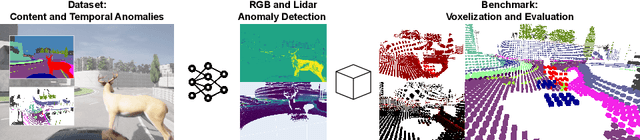
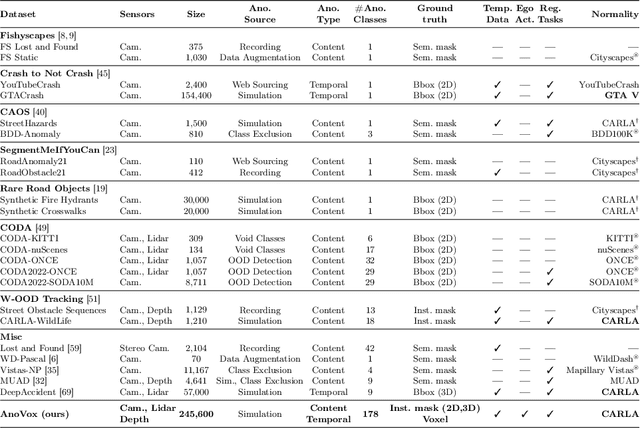
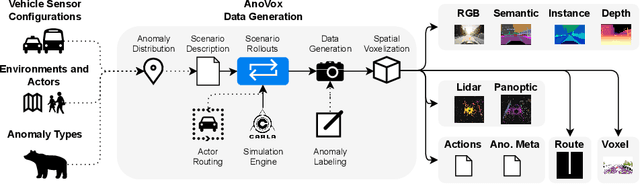
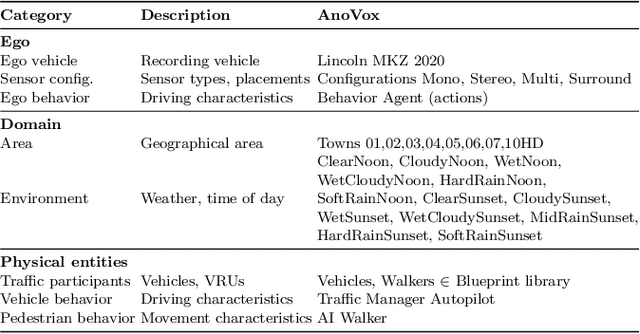
The scale-up of autonomous vehicles depends heavily on their ability to deal with anomalies, such as rare objects on the road. In order to handle such situations, it is necessary to detect anomalies in the first place. Anomaly detection for autonomous driving has made great progress in the past years but suffers from poorly designed benchmarks with a strong focus on camera data. In this work, we propose AnoVox, the largest benchmark for ANOmaly detection in autonomous driving to date. AnoVox incorporates large-scale multimodal sensor data and spatial VOXel ground truth, allowing for the comparison of methods independent of their used sensor. We propose a formal definition of normality and provide a compliant training dataset. AnoVox is the first benchmark to contain both content and temporal anomalies.