 Add to Chrome
 Add to Firefox
 Add to Edge
MOSS-Audio-Tokenizer: Scaling Audio Tokenizers for Future Audio Foundation Models
Feb 12, 2026
Discrete audio tokenizers are fundamental to empowering large language models with native audio processing and generation capabilities. Despite recent progress, existing approaches often rely on pretrained encoders, semantic distillation, or heterogeneous CNN-based architectures. These designs introduce fixed inductive biases that limit reconstruction fidelity and hinder effective scaling. In this paper, we argue that discrete audio tokenization should be learned fully end-to-end using a homogeneous and scalable architecture. To this end, we first propose CAT (Causal Audio Tokenizer with Transformer), a purely Transformer-based architecture that jointly optimizes the encoder, quantizer, and decoder from scratch for high-fidelity reconstruction. Building on the CAT architecture, we develop MOSS-Audio-Tokenizer, a large-scale audio tokenizer featuring 1.6 billion parameters, pre-trained on 3 million hours of diverse, general audio data. We show that this simple, fully end-to-end approach built from homogeneous, causal Transformer blocks scales gracefully and supports high-fidelity reconstruction across diverse audio domains. Across speech, sound, and music, MOSS-Audio-Tokenizer consistently outperforms prior codecs over a wide range of bitrates, while exhibiting predictable improvements with increased scale. Notably, leveraging the discrete tokens from our model, we develop the first purely autoregressive TTS model that surpasses prior non-autoregressive and cascaded systems. Furthermore, MOSS-Audio-Tokenizer enables competitive ASR performance without auxiliary encoders. Our findings position the CAT architecture as a unified, scalable interface for the next generation of native audio foundation models.

Inference-Time Decontamination: Reusing Leaked Benchmarks for Large Language Model Evaluation
Jun 20, 2024
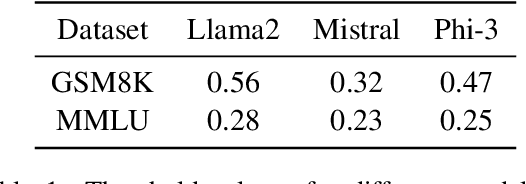
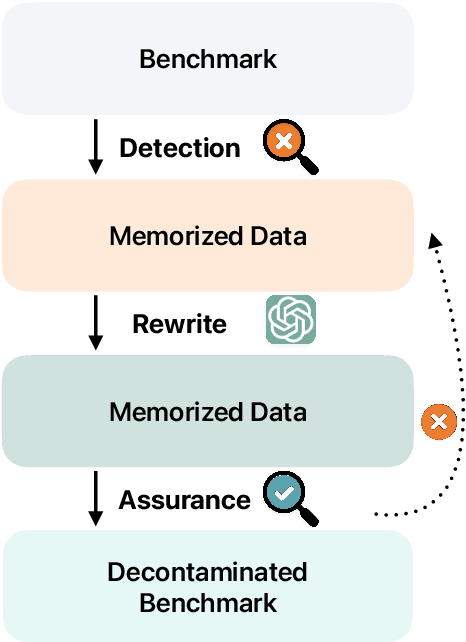
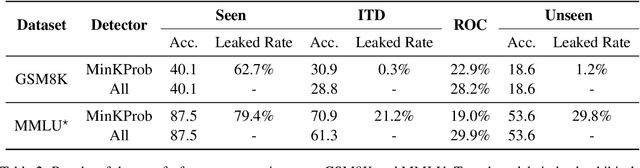
The training process of large language models (LLMs) often involves varying degrees of test data contamination. Although current LLMs are achieving increasingly better performance on various benchmarks, their performance in practical applications does not always match their benchmark results. Leakage of benchmarks can prevent the accurate assessment of LLMs' true performance. However, constructing new benchmarks is costly, labor-intensive and still carries the risk of leakage. Therefore, in this paper, we ask the question, Can we reuse these leaked benchmarks for LLM evaluation? We propose Inference-Time Decontamination (ITD) to address this issue by detecting and rewriting leaked samples without altering their difficulties. ITD can mitigate performance inflation caused by memorizing leaked benchmarks. Our proof-of-concept experiments demonstrate that ITD reduces inflated accuracy by 22.9% on GSM8K and 19.0% on MMLU. On MMLU, using Inference-time Decontamination can lead to a decrease in the results of Phi3 and Mistral by 6.7% and 3.6% respectively. We hope that ITD can provide more truthful evaluation results for large language models.
In-Memory Learning: A Declarative Learning Framework for Large Language Models
Mar 05, 2024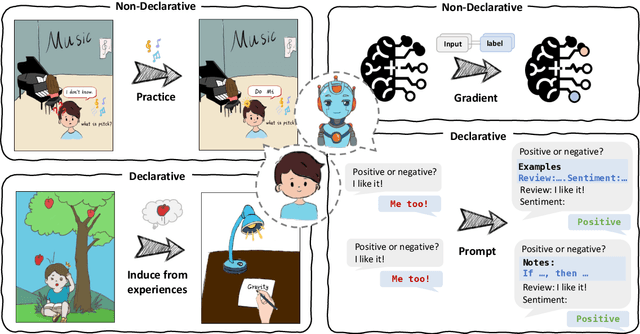
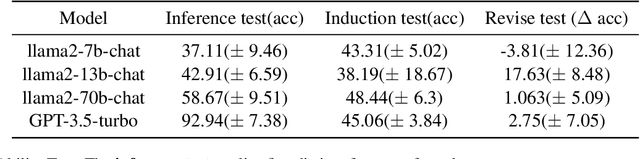
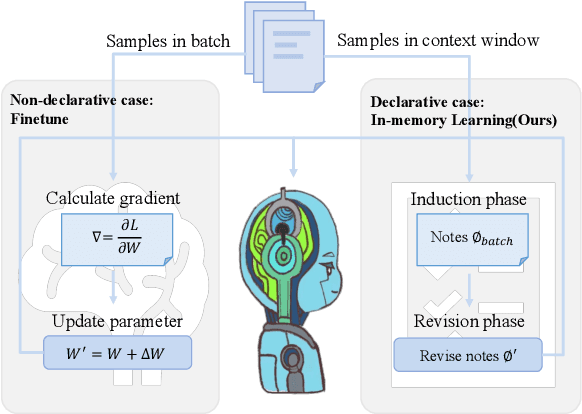

The exploration of whether agents can align with their environment without relying on human-labeled data presents an intriguing research topic. Drawing inspiration from the alignment process observed in intelligent organisms, where declarative memory plays a pivotal role in summarizing past experiences, we propose a novel learning framework. The agents adeptly distill insights from past experiences, refining and updating existing notes to enhance their performance in the environment. This entire process transpires within the memory components and is implemented through natural language, so we character this framework as In-memory Learning. We also delve into the key features of benchmarks designed to evaluate the self-improvement process. Through systematic experiments, we demonstrate the effectiveness of our framework and provide insights into this problem.