 Add to Chrome
 Add to Firefox
 Add to Edge
EVA: Aligning Video World Models with Executable Robot Actions via Inverse Dynamics Rewards
Mar 18, 2026
Video generative models are increasingly used as world models for robotics, where a model generates a future visual rollout conditioned on the current observation and task instruction, and an inverse dynamics model (IDM) converts the generated frames into executable robot actions. However, current video world models lack explicit executability constraints. As a result, visually coherent rollouts may still violate rigid-body and kinematic consistency, producing unstable or infeasible control commands when decoded by an IDM. We refer to this mismatch between visual generation and physically executable control as the executability gap. While this gap can be mitigated at inference time using techniques such as rejection sampling, such approaches are inefficient due to the high cost of video generation. In this paper, we leverage the executability gap as a training signal and introduce Executable Video Alignment (EVA), a reinforcement-learning post-training framework for aligning video world models. EVA trains an inverse dynamics model on real robot trajectories and repurposes it as a reward model that evaluates generated videos through the action sequences they induce, encouraging smooth motions measured by velocity, acceleration, and jerk while penalizing actions that violate embodiment constraints. Importantly, the reward remains informative even when generated videos contain severe visual artifacts, since such artifacts typically translate into unstable or out-of-bound actions. Experiments on the RoboTwin benchmark and a real bimanual robot show that EVA reduces embodiment-specific artifacts in generated rollouts and improves downstream task execution success.

PAct: Part-Decomposed Single-View Articulated Object Generation
Feb 16, 2026Articulated objects are central to interactive 3D applications, including embodied AI, robotics, and VR/AR, where functional part decomposition and kinematic motion are essential. Yet producing high-fidelity articulated assets remains difficult to scale because it requires reliable part decomposition and kinematic rigging. Existing approaches largely fall into two paradigms: optimization-based reconstruction or distillation, which can be accurate but often takes tens of minutes to hours per instance, and inference-time methods that rely on template or part retrieval, producing plausible results that may not match the specific structure and appearance in the input observation. We introduce a part-centric generative framework for articulated object creation that synthesizes part geometry, composition, and articulation under explicit part-aware conditioning. Our representation models an object as a set of movable parts, each encoded by latent tokens augmented with part identity and articulation cues. Conditioned on a single image, the model generates articulated 3D assets that preserve instance-level correspondence while maintaining valid part structure and motion. The resulting approach avoids per-instance optimization, enables fast feed-forward inference, and supports controllable assembly and articulation, which are important for embodied interaction. Experiments on common articulated categories (e.g., drawers and doors) show improved input consistency, part accuracy, and articulation plausibility over optimization-based and retrieval-driven baselines, while substantially reducing inference time.
Nabla-R2D3: Effective and Efficient 3D Diffusion Alignment with 2D Rewards
Jun 18, 2025Generating high-quality and photorealistic 3D assets remains a longstanding challenge in 3D vision and computer graphics. Although state-of-the-art generative models, such as diffusion models, have made significant progress in 3D generation, they often fall short of human-designed content due to limited ability to follow instructions, align with human preferences, or produce realistic textures, geometries, and physical attributes. In this paper, we introduce Nabla-R2D3, a highly effective and sample-efficient reinforcement learning alignment framework for 3D-native diffusion models using 2D rewards. Built upon the recently proposed Nabla-GFlowNet method, which matches the score function to reward gradients in a principled manner for reward finetuning, our Nabla-R2D3 enables effective adaptation of 3D diffusion models using only 2D reward signals. Extensive experiments show that, unlike vanilla finetuning baselines which either struggle to converge or suffer from reward hacking, Nabla-R2D3 consistently achieves higher rewards and reduced prior forgetting within a few finetuning steps.
MoDGS: Dynamic Gaussian Splatting from Causually-captured Monocular Videos
Jun 01, 2024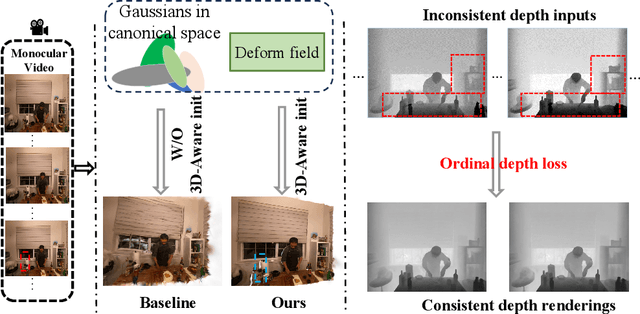
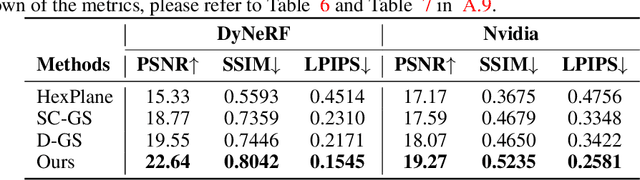
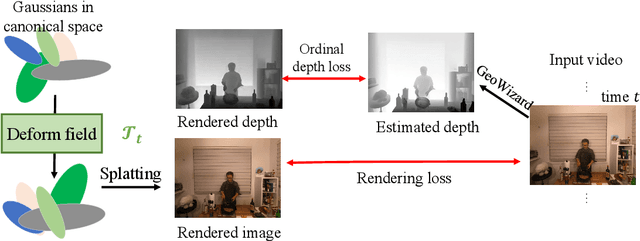
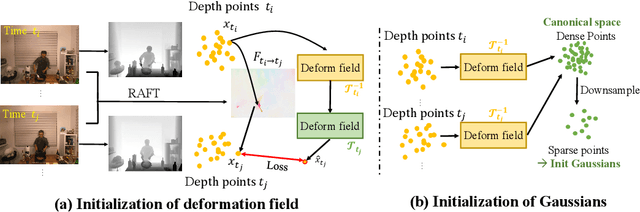
In this paper, we propose MoDGS, a new pipeline to render novel-view images in dynamic scenes using only casually captured monocular videos. Previous monocular dynamic NeRF or Gaussian Splatting methods strongly rely on the rapid movement of input cameras to construct multiview consistency but fail to reconstruct dynamic scenes on casually captured input videos whose cameras are static or move slowly. To address this challenging task, MoDGS adopts recent single-view depth estimation methods to guide the learning of the dynamic scene. Then, a novel 3D-aware initialization method is proposed to learn a reasonable deformation field and a new robust depth loss is proposed to guide the learning of dynamic scene geometry. Comprehensive experiments demonstrate that MoDGS is able to render high-quality novel view images of dynamic scenes from just a casually captured monocular video, which outperforms baseline methods by a significant margin.