 Add to Chrome
 Add to Firefox
 Add to Edge
Privacy-Preserving Data Drift Detection and Recovery for Large-Scale LLM Applications via Proxy Representations
Aug 08, 2026
LLM applications deployed at scale face a fundamental challenge: privacy constraints prevent direct inspection of user interactions, making it difficult to obtain any representative evaluation dataset or to track the ongoing evolution of production traffic. We present ProxyDrift, a framework that (i) identifies and measures drift between production traffic and offline evaluation sets, and (ii) constructs and refreshes those evaluation sets accordingly; all without access to raw user data. Our approach operates entirely on non-PII proxy representations: structured, multi-dimensional descriptors derived from LLM-based classification of user interactions. We introduce (1) a chance-calibrated, redundancy-aware (RA) alignment score that aggregates per-dimension drift measurements via mutual information; (2) a conditional sampler that generates synthetic proxies respecting inter-dimensional dependencies; (3) a roundtrip consistency analysis that exposes generator/classifier disagreements and guides proxy taxonomy refinement; and (4) a feedback-linkage analysis that ties per-dimension and per-value proxy distributions to user satisfaction, surfacing actionable failure and success modes. Serving hundreds of millions of users, ProxyDrift enables continuous drift monitoring and targeted synthetic data generation without exposing sensitive user data. Experiments confirm strong roundtrip consistency, discriminator-level indistinguishability of synthetic queries from human queries, and tight end-to-end alignment (RA~0.9) with production.

FORCE: A Framework of Rule-Based Conversational Recommender System
Mar 18, 2022
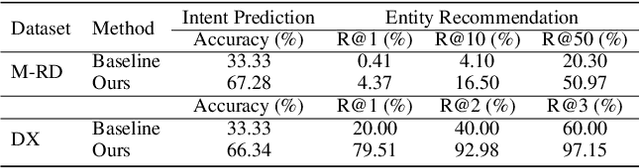
The conversational recommender systems (CRSs) have received extensive attention in recent years. However, most of the existing works focus on various deep learning models, which are largely limited by the requirement of large-scale human-annotated datasets. Such methods are not able to deal with the cold-start scenarios in industrial products. To alleviate the problem, we propose FORCE, a Framework Of Rule-based Conversational Recommender system that helps developers to quickly build CRS bots by simple configuration. We conduct experiments on two datasets in different languages and domains to verify its effectiveness and usability.
Integrating Pre-trained Model into Rule-based Dialogue Management
Feb 17, 2021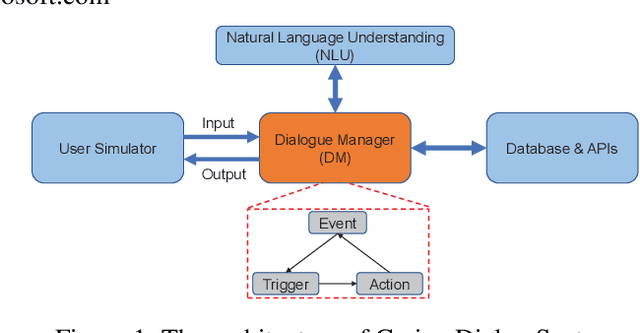
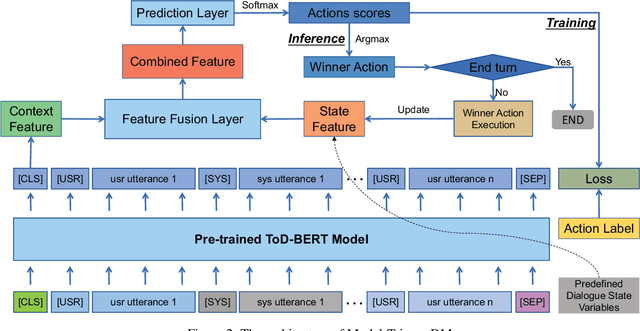
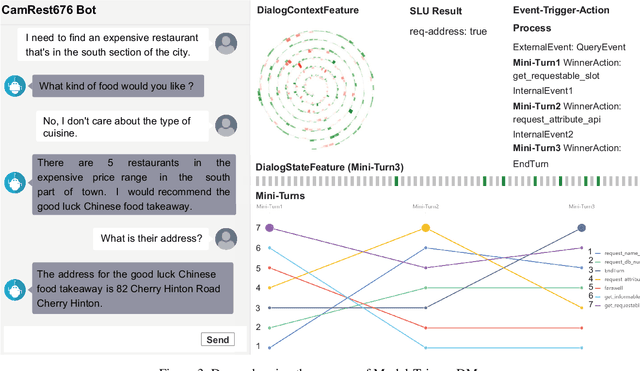
Rule-based dialogue management is still the most popular solution for industrial task-oriented dialogue systems for their interpretablility. However, it is hard for developers to maintain the dialogue logic when the scenarios get more and more complex. On the other hand, data-driven dialogue systems, usually with end-to-end structures, are popular in academic research and easier to deal with complex conversations, but such methods require plenty of training data and the behaviors are less interpretable. In this paper, we propose a method to leverages the strength of both rule-based and data-driven dialogue managers (DM). We firstly introduce the DM of Carina Dialog System (CDS, an advanced industrial dialogue system built by Microsoft). Then we propose the "model-trigger" design to make the DM trainable thus scalable to scenario changes. Furthermore, we integrate pre-trained models and empower the DM with few-shot capability. The experimental results demonstrate the effectiveness and strong few-shot capability of our method.