 Add to Chrome
 Add to Firefox
 Add to Edge
An Ontology for Machine Learning Interatomic Potentials
Jul 25, 2026
Machine learning interatomic potentials (MLIPs) approximate quantum-mechanical energies and forces---conventionally computed by density functional theory (DFT) or wave-function methods---at a fraction of the cost. The field encompasses a growing ecosystem of algorithms, training datasets, hyperparameters, and target materials, yet the metadata needed to systematically compare, reproduce, and build upon MLIP studies remains scattered across papers, scripts, and ad-hoc file formats. We present the MLIPs ontology, an OWL 2 DL ontology that captures the concepts needed to describe MLIP methods, their hyperparameters, training datasets with DFT provenance, and published benchmarks. The ontology is organized into three modules---Method, Training Data, and Benchmark---and connects existing ontologies in materials science (MDO, CMSO/ASMO) and machine learning (ML-Schema), complementing dataset-side schemas such as Croissant. It declares 27 formal axioms enforcing data completeness and consistency, including property chains that link trained models to their methods and training data. We demonstrate the ontology through a running example based on Moment Tensor Potentials and evaluate it through competency-question execution on a 20-paper seeded knowledge graph, OWL reasoning, and comparison with existing ontologies.

Diffusion Meets DAgger: Supercharging Eye-in-hand Imitation Learning
Feb 27, 2024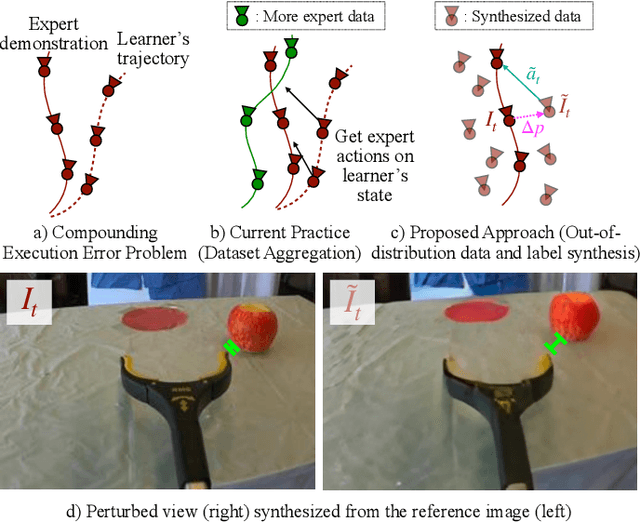
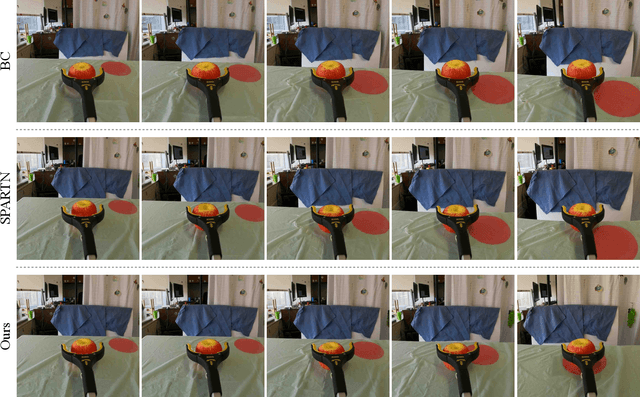
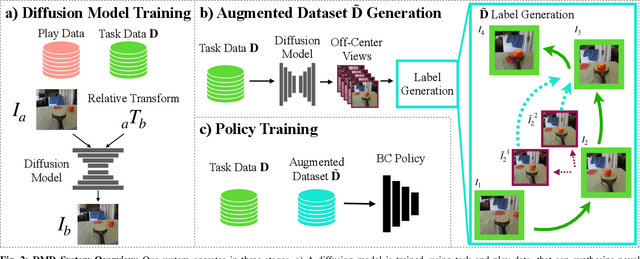
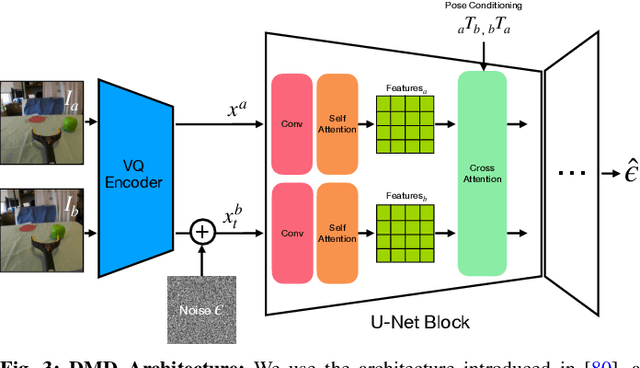
A common failure mode for policies trained with imitation is compounding execution errors at test time. When the learned policy encounters states that were not present in the expert demonstrations, the policy fails, leading to degenerate behavior. The Dataset Aggregation, or DAgger approach to this problem simply collects more data to cover these failure states. However, in practice, this is often prohibitively expensive. In this work, we propose Diffusion Meets DAgger (DMD), a method to reap the benefits of DAgger without the cost for eye-in-hand imitation learning problems. Instead of collecting new samples to cover out-of-distribution states, DMD uses recent advances in diffusion models to create these samples with diffusion models. This leads to robust performance from few demonstrations. In experiments conducted for non-prehensile pushing on a Franka Research 3, we show that DMD can achieve a success rate of 80% with as few as 8 expert demonstrations, where naive behavior cloning reaches only 20%. DMD also outperform competing NeRF-based augmentation schemes by 50%.
Black holes and the loss landscape in machine learning
Jun 26, 2023Understanding the loss landscape is an important problem in machine learning. One key feature of the loss function, common to many neural network architectures, is the presence of exponentially many low lying local minima. Physical systems with similar energy landscapes may provide useful insights. In this work, we point out that black holes naturally give rise to such landscapes, owing to the existence of black hole entropy. For definiteness, we consider 1/8 BPS black holes in $\mathcal{N} = 8$ string theory. These provide an infinite family of potential landscapes arising in the microscopic descriptions of corresponding black holes. The counting of minima amounts to black hole microstate counting. Moreover, the exact numbers of the minima for these landscapes are a priori known from dualities in string theory. Some of the minima are connected by paths of low loss values, resembling mode connectivity. We estimate the number of runs needed to find all the solutions. Initial explorations suggest that Stochastic Gradient Descent can find a significant fraction of the minima.
An Unsupervised Approach for Overlapping Cervical Cell Cytoplasm Segmentation
Feb 17, 2017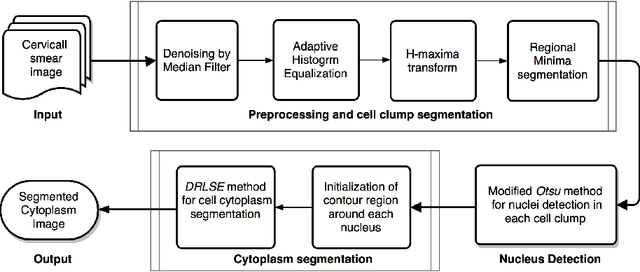
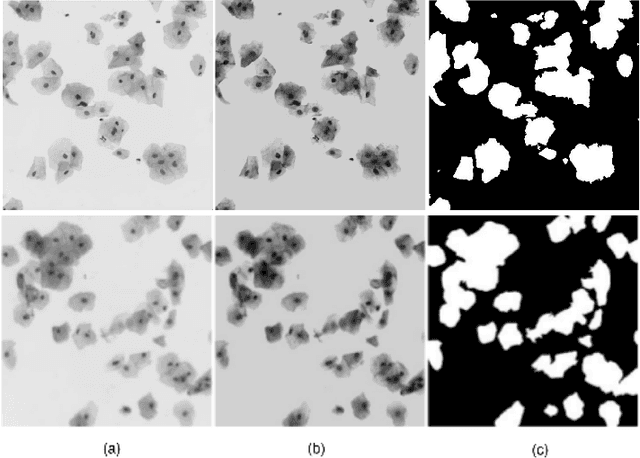
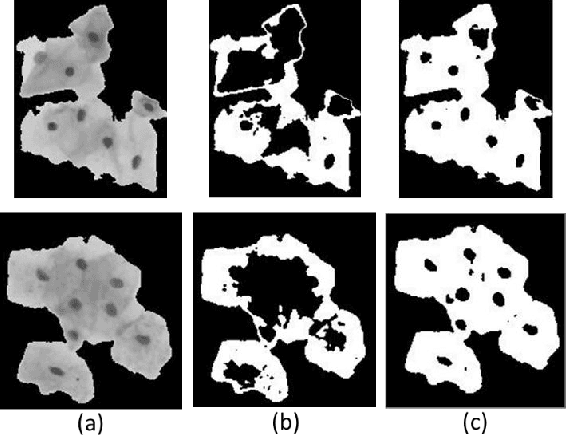
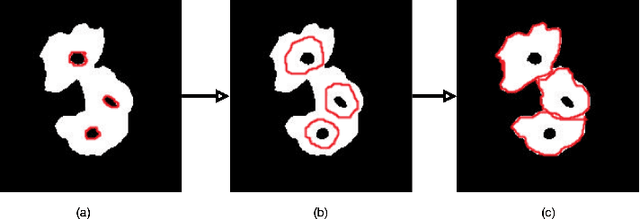
The poor contrast and the overlapping of cervical cell cytoplasm are the major issues in the accurate segmentation of cervical cell cytoplasm. This paper presents an automated unsupervised cytoplasm segmentation approach which can effectively find the cytoplasm boundaries in overlapping cells. The proposed approach first segments the cell clumps from the cervical smear image and detects the nuclei in each cell clump. A modified Otsu method with prior class probability is proposed for accurate segmentation of nuclei from the cell clumps. Using distance regularized level set evolution, the contour around each nucleus is evolved until it reaches the cytoplasm boundaries. Promising results were obtained by experimenting on ISBI 2015 challenge dataset.
* 4 pages, 4 figures, Biomedical Engineering and Sciences (IECBES), 2016 IEEE EMBS Conference on. IEEE, 2016