 Add to Chrome
 Add to Firefox
 Add to Edge
Transforming Shape Schemas with Composable Property-Graph Queries (Extended Version)
Jun 12, 2026
Property graphs may be constrained by schemas that inform both query engines and human users about the shape of valid data, enforcing a contract between data provider and consumer. Composable property-graph queries transform input graphs into output graphs. Then, the question arises of which schema can be expected after one (or several) transformation steps. We investigate how schema constraints can be inferred given an input schema and a transforming query. Specifically, we propose a reasoning procedure that, given an input schema in ProGS and a query in G-CORE infers an output schema. Since graph updates will happen frequently, our inference procedure does not rely on graph instances, such that the computed output schema applies to all graphs originating from any input graph complying with the input schema. Related work has addressed this problem for SPARQL CONSTRUCT queries, encoding it in Description Logics (DLs) so that the output schema is entailed by axioms inferred from input schema and queries. Property graphs and their queries, however, complicate the matter, as property graphs feature label and property annotations as well as first-class edges. Thus, reification has to be used in one way or another, though available DLs lack the means to encode such features directly. We approach this novel challenge via a family of mappings for i) property graphs reified in RDF, aligned with ii) a mapping from ProGS to SHACL and iii) a mapping from G-CORE to SPARQL CONSTRUCT queries. In this manner, schema inference for property graphs becomes manageable, as we break apart the problem through the extra mapping layer and utilize efficient DL reasoners. We develop the metatheory regarding the soundness of inferred schema constraints and the semantic equivalence of mapped schemas and queries.

KAPPS: A knowledge-based CPPS Architecture for the Circular Factory
May 21, 2026While linear manufacturing relies on homogeneous materials and predefined process sequences, circular manufacturing reintroduces used products with heterogeneous and uncertain conditions. This shift demands manufacturing systems capable of handling variable product states, dynamically reconfigurable processes, and the integration of human and machine knowledge. Conventional manufacturing IT architectures, designed for stable structures and deterministic execution, are unable to meet these requirements, as they cannot adequately represent and manage the uniqueness of individual components at runtime. Following a design science methodology for developing a Cyber Physical Production System for circular manufacturing, we derive 14 requirements from five complementary perspectives. Based on these requirements, we design KAPPS, a knowledge-based architecture that uses an ontology-grounded knowledge graph as a unifying data backbone, combined with a semantic interface layer to enable consistent data and information integration, reasoning, and communication across heterogeneous systems and services, turning the knowledge graph from an integration layer into the factories authoritative write-time state. KAPPS incorporates modules for constraint enforcement and event-driven planning, enabling incremental adaptation of execution plans under uncertainty and human-machine knowledge exchange. The applicability of KAPPS is demonstrated through two implemented use cases: (i) Anomaly detection and learning through knowledge graph mediated services and (ii) runtime constraint enforcement in a modular conveyor system. Subsequently, the architecture is evaluated against the 14 requirements (ed. abstract shortened)
Predicate-Conditional Conformalized Answer Sets for Knowledge Graph Embeddings
May 22, 2025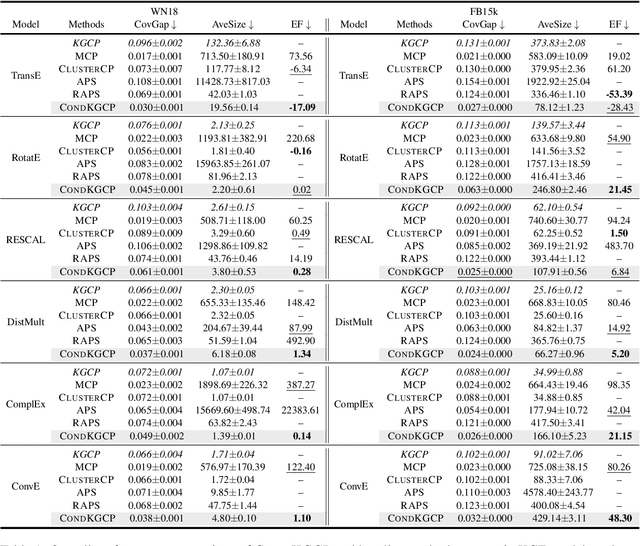
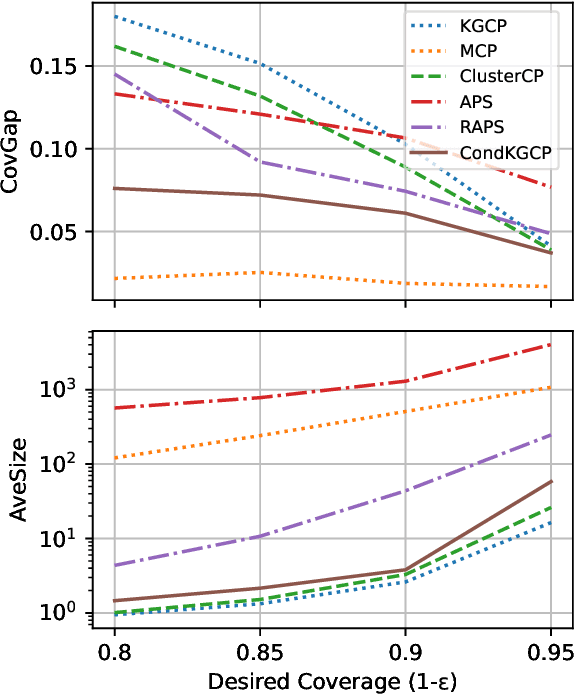
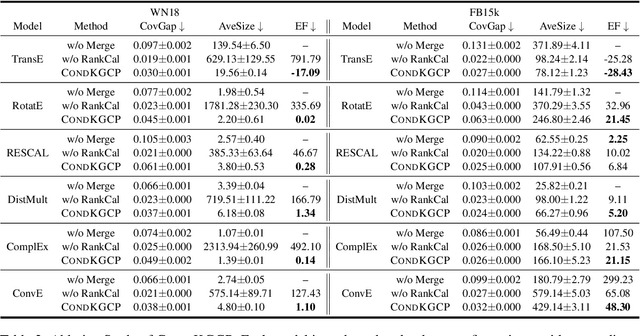
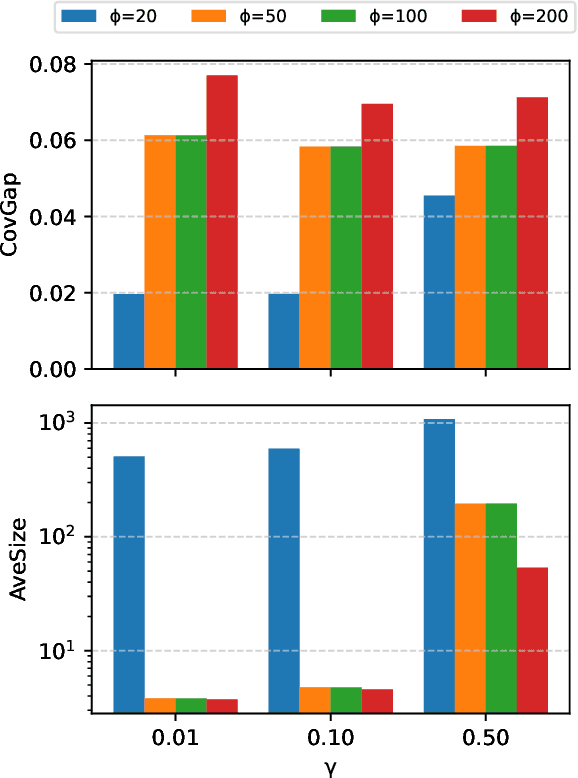
Uncertainty quantification in Knowledge Graph Embedding (KGE) methods is crucial for ensuring the reliability of downstream applications. A recent work applies conformal prediction to KGE methods, providing uncertainty estimates by generating a set of answers that is guaranteed to include the true answer with a predefined confidence level. However, existing methods provide probabilistic guarantees averaged over a reference set of queries and answers (marginal coverage guarantee). In high-stakes applications such as medical diagnosis, a stronger guarantee is often required: the predicted sets must provide consistent coverage per query (conditional coverage guarantee). We propose CondKGCP, a novel method that approximates predicate-conditional coverage guarantees while maintaining compact prediction sets. CondKGCP merges predicates with similar vector representations and augments calibration with rank information. We prove the theoretical guarantees and demonstrate empirical effectiveness of CondKGCP by comprehensive evaluations.
DAGE: DAG Query Answering via Relational Combinator with Logical Constraints
Oct 29, 2024Predicting answers to queries over knowledge graphs is called a complex reasoning task because answering a query requires subdividing it into subqueries. Existing query embedding methods use this decomposition to compute the embedding of a query as the combination of the embedding of the subqueries. This requirement limits the answerable queries to queries having a single free variable and being decomposable, which are called tree-form queries and correspond to the $\mathcal{SROI}^-$ description logic. In this paper, we define a more general set of queries, called DAG queries and formulated in the $\mathcal{ALCOIR}$ description logic, propose a query embedding method for them, called DAGE, and a new benchmark to evaluate query embeddings on them. Given the computational graph of a DAG query, DAGE combines the possibly multiple paths between two nodes into a single path with a trainable operator that represents the intersection of relations and learns DAG-DL from tautologies. We show that it is possible to implement DAGE on top of existing query embedding methods, and we empirically measure the improvement of our method over the results of vanilla methods evaluated in tree-form queries that approximate the DAG queries of our proposed benchmark.
eSPARQL: Representing and Reconciling Agnostic and Atheistic Beliefs in RDF-star Knowledge Graphs
Aug 01, 2024Over the past few years, we have seen the emergence of large knowledge graphs combining information from multiple sources. Sometimes, this information is provided in the form of assertions about other assertions, defining contexts where assertions are valid. A recent extension to RDF which admits statements over statements, called RDF-star, is in revision to become a W3C standard. However, there is no proposal for a semantics of these RDF-star statements nor a built-in facility to operate over them. In this paper, we propose a query language for epistemic RDF-star metadata based on a four-valued logic, called eSPARQL. Our proposed query language extends SPARQL-star, the query language for RDF-star, with a new type of FROM clause to facilitate operating with multiple and sometimes conflicting beliefs. We show that the proposed query language can express four use case queries, including the following features: (i) querying the belief of an individual, (ii) the aggregating of beliefs, (iii) querying who is conflicting with somebody, and (iv) beliefs about beliefs (i.e., nesting of beliefs).
From Shapes to Shapes: Inferring SHACL Shapes for Results of SPARQL CONSTRUCT Queries
Feb 13, 2024
SPARQL CONSTRUCT queries allow for the specification of data processing pipelines that transform given input graphs into new output graphs. It is now common to constrain graphs through SHACL shapes allowing users to understand which data they can expect and which not. However, it becomes challenging to understand what graph data can be expected at the end of a data processing pipeline without knowing the particular input data: Shape constraints on the input graph may affect the output graph, but may no longer apply literally, and new shapes may be imposed by the query template. In this paper, we study the derivation of shape constraints that hold on all possible output graphs of a given SPARQL CONSTRUCT query. We assume that the SPARQL CONSTRUCT query is fixed, e.g., being part of a program, whereas the input graphs adhere to input shape constraints but may otherwise vary over time and, thus, are mostly unknown. We study a fragment of SPARQL CONSTRUCT queries (SCCQ) and a fragment of SHACL (Simple SHACL). We formally define the problem of deriving the most restrictive set of Simple SHACL shapes that constrain the results from evaluating a SCCQ over any input graph restricted by a given set of Simple SHACL shapes. We propose and implement an algorithm that statically analyses input SHACL shapes and CONSTRUCT queries and prove its soundness and complexity.
Link Prediction with Attention Applied on Multiple Knowledge Graph Embedding Models
Feb 13, 2023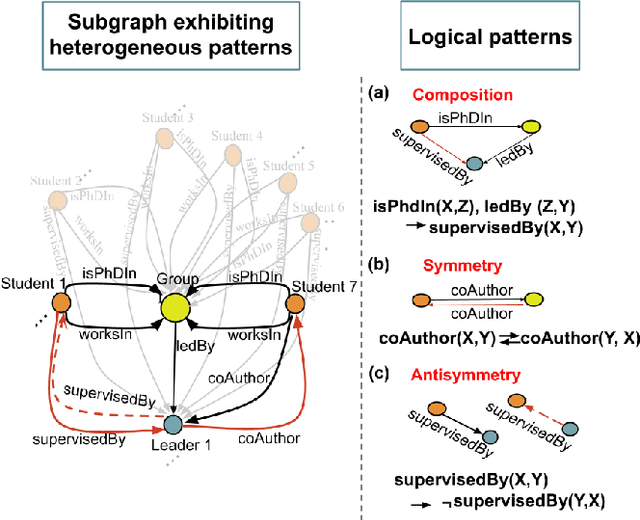

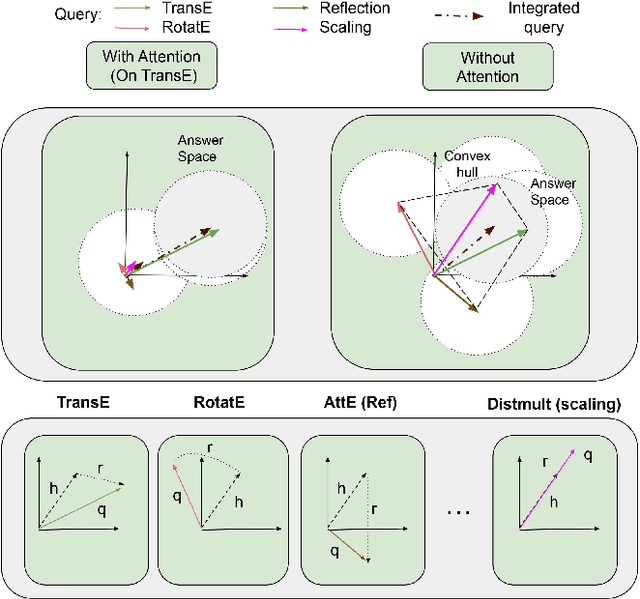
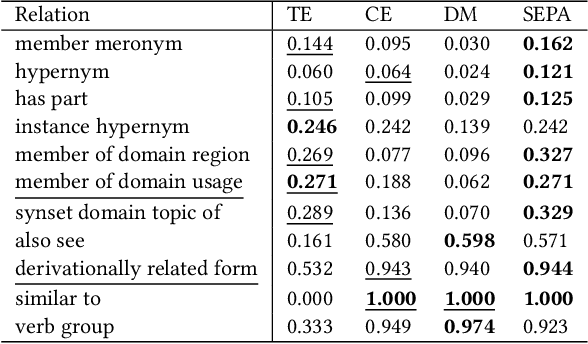
Predicting missing links between entities in a knowledge graph is a fundamental task to deal with the incompleteness of data on the Web. Knowledge graph embeddings map nodes into a vector space to predict new links, scoring them according to geometric criteria. Relations in the graph may follow patterns that can be learned, e.g., some relations might be symmetric and others might be hierarchical. However, the learning capability of different embedding models varies for each pattern and, so far, no single model can learn all patterns equally well. In this paper, we combine the query representations from several models in a unified one to incorporate patterns that are independently captured by each model. Our combination uses attention to select the most suitable model to answer each query. The models are also mapped onto a non-Euclidean manifold, the Poincar\'e ball, to capture structural patterns, such as hierarchies, besides relational patterns, such as symmetry. We prove that our combination provides a higher expressiveness and inference power than each model on its own. As a result, the combined model can learn relational and structural patterns. We conduct extensive experimental analysis with various link prediction benchmarks showing that the combined model outperforms individual models, including state-of-the-art approaches.