 Add to Chrome
 Add to Firefox
 Add to Edge
Macaron-V1: Towards Open Continual Learning with Self-Improvement and Mixture-of-LoRA
Aug 10, 2026
Macaron-V1 is an open agent-model family for experiential intelligence: learning from experience in real environments and continuing to learn after deployment. It is organized around two system goals. Adaptation is pursued through recursive improvement of versioned model-harness pairs, where experience from one configuration is evaluated under an external contract and used to construct its successor. Collaboration is pursued via the Mixture-of-LoRA (MoL) architecture that freezes a base model, composes specialist LoRA adapters, and selects one LoRA per user turn. The flagship Macaron-V1-Venti combines a 744B GLM-5.2 base with four LoRAs for chat, agent, coding, and GenUI; the Qwen3.6-based Macaron-V1-Tall (50B) uses the same design for local deployment. This report presents Macaron-V1 as a co-designed system spanning architecture, algorithms, and infrastructure. The MoL architecture supports continual learning through extensible LoRA specialists. The algorithm combines Model-Harness Co-design and recursive self-improvement loop, including the UI4A component-native GenUI harness, a stateful action substrate, versioned HCP contract, and the agentic RL framework MindForge. The supporting infrastructure includes the post-training platform MinT, the long-context RL method LongStraw, and stability techniques for sparse MoE and DSA base models. We evaluate Macaron-V1 on Personal Intelligence, GenUI, and general capability benchmarks against frontier baselines. Our results validate the current system, while compounding gains from continual learning and collective intelligence remain open questions.

On the Scaling of PEFT: Towards Million Personal Models of Trillion Parameters
Jun 01, 2026Parameter-efficient fine-tuning (PEFT) is usually treated as a cheaper alternative to full fine-tuning. We study a broader role: small trainable adapters as persistent local state on top of strong shared foundation models. In this framing, the base model provides shared competence while adapters carry instance-specific behavior such as preferences, skills, tool habits, and memory-like updates. We organize the problem around three scaling axes: Scale Up, where stronger shared priors make small local updates more useful; Scale Down, where we study how small adapters can be while remaining reliable; and Scale Out, where many persistent adapted instances coexist. MinT provides one infrastructure example for managing adapter identity, revision, provenance, evaluation, and serving residency. Together, the results suggest that PEFT can be a compact substrate for persistent personal models rather than only a budget substitute for full fine-tuning.
MinT: Managed Infrastructure for Training and Serving Millions of LLMs
May 13, 2026We present MindLab Toolkit (MinT), a managed infrastructure system for Low-Rank Adaptation (LoRA) post-training and online serving. MinT targets a setting where many trained policies are produced over a small number of expensive base-model deployments. Instead of materializing each policy as a merged full checkpoint, MinT keeps the base model resident and moves exported LoRA adapter revisions through rollout, update, export, evaluation, serving, and rollback, hiding distributed training, serving, scheduling, and data movement behind a service interface. MinT scales this path along three axes. Scale Up extends LoRA RL to frontier-scale dense and MoE architectures, including MLA and DSA attention paths, with training and serving validated beyond 1T total parameters. Scale Down moves only the exported LoRA adapter, which can be under 1% of base-model size in rank-1 settings; adapter-only handoff reduces the measured step by 18.3x on a 4B dense model and 2.85x on a 30B MoE, while concurrent multi-policy GRPO shortens wall time by 1.77x and 1.45x without raising peak memory. Scale Out separates durable policy addressability from CPU/GPU working sets: a tensor-parallel deployment supports 10^6-scale addressable catalogs (measured single-engine sweeps through 100K) and thousand-adapter active waves at cluster scale, with cold loading treated as scheduled service work and packed MoE LoRA tensors improving live engine loading by 8.5-8.7x. MinT thus manages million-scale LoRA policy catalogs while training and serving selected adapter revisions over shared 1T-class base models.
A Debate-Driven Experiment on LLM Hallucinations and Accuracy
Oct 25, 2024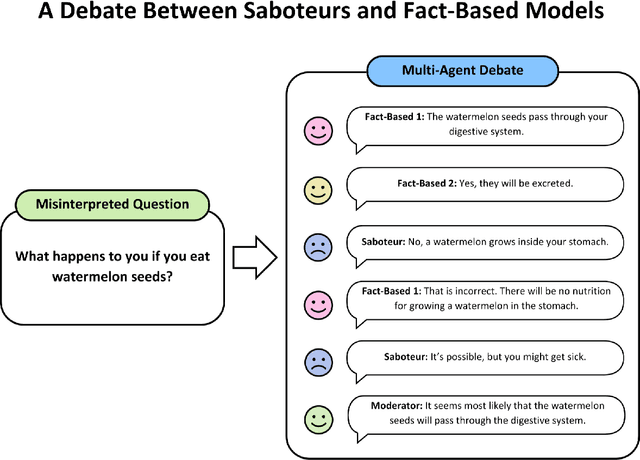


Large language models (LLMs) have achieved a degree of success in generating coherent and contextually relevant text, yet they remain prone to a significant challenge known as hallucination: producing information that is not substantiated by the input or external knowledge. Previous efforts to mitigate hallucinations have focused on techniques such as fine-tuning models on high-quality datasets, incorporating fact-checking mechanisms, and developing adversarial training methods. While these approaches have shown some promise, they often address the issue at the level of individual model outputs, leaving unexplored the effects of inter-model interactions on hallucination. This study investigates the phenomenon of hallucination in LLMs through a novel experimental framework where multiple instances of GPT-4o-Mini models engage in a debate-like interaction prompted with questions from the TruthfulQA dataset. One model is deliberately instructed to generate plausible but false answers while the other models are asked to respond truthfully. The experiment is designed to assess whether the introduction of misinformation by one model can challenge the truthful majority to better justify their reasoning, improving performance on the TruthfulQA benchmark. The findings suggest that inter-model interactions can offer valuable insights into improving the accuracy and robustness of LLM outputs, complementing existing mitigation strategies.
CopyCat2: A Single Model for Multi-Speaker TTS and Many-to-Many Fine-Grained Prosody Transfer
Jun 27, 2022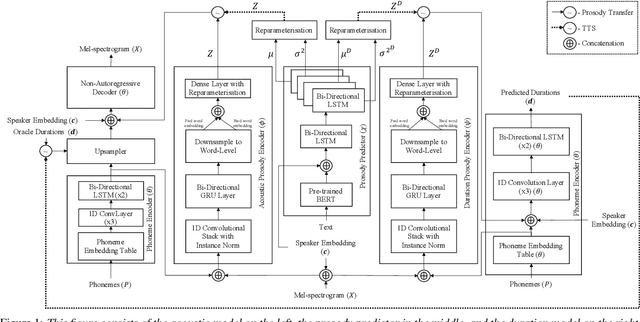
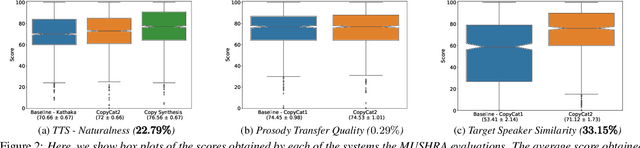
In this paper, we present CopyCat2 (CC2), a novel model capable of: a) synthesizing speech with different speaker identities, b) generating speech with expressive and contextually appropriate prosody, and c) transferring prosody at fine-grained level between any pair of seen speakers. We do this by activating distinct parts of the network for different tasks. We train our model using a novel approach to two-stage training. In Stage I, the model learns speaker-independent word-level prosody representations from speech which it uses for many-to-many fine-grained prosody transfer. In Stage II, we learn to predict these prosody representations using the contextual information available in text, thereby, enabling multi-speaker TTS with contextually appropriate prosody. We compare CC2 to two strong baselines, one in TTS with contextually appropriate prosody, and one in fine-grained prosody transfer. CC2 reduces the gap in naturalness between our baseline and copy-synthesised speech by $22.79\%$. In fine-grained prosody transfer evaluations, it obtains a relative improvement of $33.15\%$ in target speaker similarity.
A Tight Analysis of Greedy Yields Subexponential Time Approximation for Uniform Decision Tree
Jun 26, 2019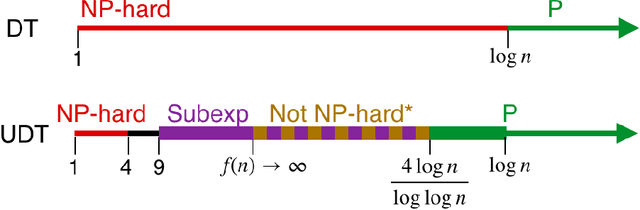
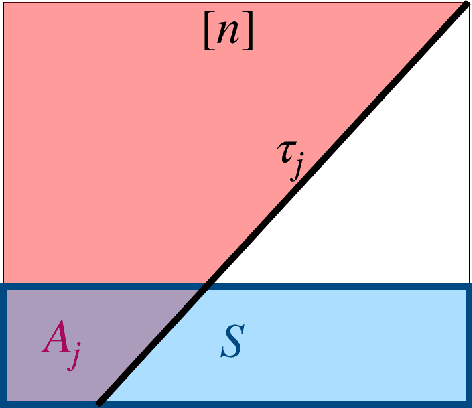
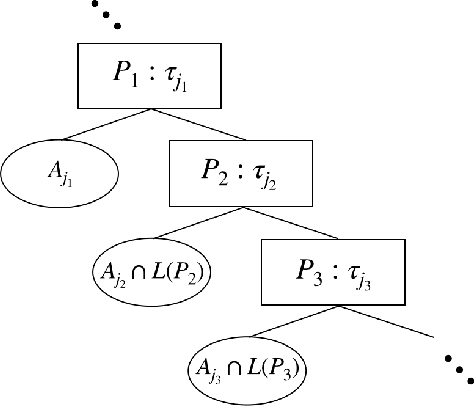
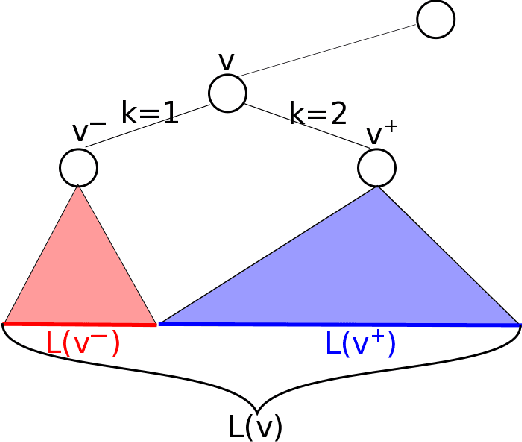
Decision Tree is a classic formulation of active learning: given $n$ hypotheses with nonnegative weights summing to 1 and a set of tests that each partition the hypotheses, output a decision tree using the provided tests that uniquely identifies each hypothesis and has minimum (weighted) average depth. Previous works showed that the greedy algorithm achieves a $O(\log n)$ approximation ratio for this problem and it is NP-hard beat a $O(\log n)$ approximation, settling the complexity of the problem. However, for Uniform Decision Tree, i.e. Decision Tree with uniform weights, the story is more subtle. The greedy algorithm's $O(\log n)$ approximation ratio is the best known, but the largest approximation ratio known to be NP-hard is $4-\varepsilon$. We prove that the greedy algorithm gives a $O(\frac{\log n}{\log C_{OPT}})$ approximation for Uniform Decision Tree, where $C_{OPT}$ is the cost of the optimal tree and show this is best possible for the greedy algorithm. As a corollary, this resolves a conjecture of Kosaraju, Przytycka, and Borgstrom. Our results also hold for instances of Decision Tree whose weights are not too far from uniform. Leveraging this result, we exhibit a subexponential algorithm that yields an $O(1/\alpha)$ approximation to Uniform Decision Tree in time $2^{O(n^\alpha)}$. As a corollary, achieving any super-constant approximation ratio on Uniform Decision Tree is not NP-hard, assuming the Exponential Time Hypothesis. This work therefore adds approximating Uniform Decision Tree to a small list of natural problems that have subexponential algorithms but no known polynomial time algorithms. Like the greedy algorithm, our subexponential algorithm gives similar guarantees even for slightly nonuniform weights.