 Add to Chrome
 Add to Firefox
 Add to Edge
Regularize or Localize: When Training-Time KV-Cache Geometry Pays Under Quantization
Jul 19, 2026
We study whether \sigreg -- LeJEPA's anti-collapse objective -- can reshape representations during standard autoregressive language-model pretraining, and when the resulting geometry helps \kv-cache quantization. We train 110M-parameter models on 10B FineWeb tokens and report three findings. \textbf{(1)} At $λ{=}0.01$, \sigreg reduces hidden-state pairwise-cosine anisotropy by $38\%$ across three paired seeds. Perplexity increases by less than $0.35\%$ in every pair, with no consistent zero-shot loss. \textbf{(2)} This change does not propagate from hidden states to the \kv cache. Applying \sigreg directly to K and V during continued training, however, reduces mean cache anisotropy by $94\%$ across four checkpoints. A matched continuation without the \kv term leaves cache geometry nearly unchanged, and the frozen-trunk retrofits we tested do not reproduce the effect. \textbf{(3)} Under untransformed symmetric group-free quantization, direct \kv regularization is the only training condition that prefers per-channel scaling in all three seeds, and under that same 3-bit per-channel scheme the baseline incurs $4.3$--$7.9\times$ the directly regularized model's \dnll. Under the full simulated KIVI-style configuration (mixed arrangement, zero-points, grouped scales), however, all models reach near-parity, including when storage overhead is approximately matched. In this 110M regime, the training intervention helps when quantizer scales are coarse; the advantage vanishes under the tested combination of token-local grouping, mixed \kv scaling, and zero-points. To our knowledge this is the first training-time \emph{distributional} regularization of standard \kv-cache geometry evaluated against post-hoc cache quantization.

Retrieval-Warmed Energy-Based Reasoning: A Five-Arm Ablation Methodology for Diffusion-as-Inference on Structured Reasoning Tasks
Jun 25, 2026Warm-started diffusion samplers accelerate iterative inference, but it is rarely clear which part of the pipeline carries the gain. We study \textbf{retrieval-warmed energy-based reasoning (RW-EBR)} -- an IRED energy-based diffusion model \cite{du2024ired} augmented with a Modern Hopfield trajectory memory -- and contribute a \textbf{five-arm ablation methodology} (oracle, best-constant, per-query-random, shuffled, aligned) that separates three confounded effects: class-prior bias shift, stochastic warm-starting, and graph-aligned value reuse. The diagnostic decomposition is adapted from LLM-RAG evaluation \cite{ru2024ragchecker}. On \textbf{connectivity-2} (Erdős--Rényi all-pairs reachability), the aligned-vs-shuffled-oracle swing reaches \textbf{$+35$\,pp} balanced accuracy on a fixed 1{,}000-graph validation-set diagnostic, with value distribution and retrieval mechanics fixed, only per-graph alignment destroyed, while per-query random initialisation falls below cold -- per-graph alignment, not bias shift or stochasticity, dominates. Yet the \emph{deployable} cold-prediction pipeline misses the acceptance gate at stored-value quality. The same diagnostic logic, stopped at the key-quality screen, applied to \textbf{Sudoku} with a task-specific key encoder produces a clean negative at a \emph{different} component -- key quality, under the current setup. The decomposition names the first blocking component on each task. The setting -- graph reachability refined by an iterative diffusion sampler, with explainability of failure modes as the lens -- places the work within structured and spatio-temporal reasoning.
Minimal-Intervention KV Retention: A Design-Space Study and a Diversity-Penalty Survivor
May 14, 2026KV-cache compression at small budgets is a crowded design space spanning cache representation, head-wise routing, compression cadence, decoding behavior, and within-budget scoring. We study seven mechanisms across these five families under matched mean cache on long-form mathematical reasoning (MATH-500~\cite{hendrycks2021math}) with two distilled-reasoning models (Qwen-7B and Llama-8B variants of DeepSeek-R1-Distill~\cite{deepseek2025r1}) at budgets $b \in \{64, 128\}$. All seven were rejected. We then propose $α$, a one-function modification to the TriAttention~\cite{mao2026triattention} retention scorer that replaces argmax-top-$k$ with greedy facility-location-inspired selection under a V-space redundancy penalty controlled by a single weight $λ$. A pre-registered protocol tunes $λ$ on a frozen development split and confirms on a disjoint held-out split; with $λ= 0.5$, $α$ clears Bonferroni on two of the four (model, budget) cells (Qwen $b{=}128$ and Llama $b{=}64$), no cell is significantly negative, and the pre-registered Branch~A triggers. The finding is asymmetric: a minimal scoring modification beat heavier structural redesigns in this regime, and the combined matched-memory, sympy-graded, held-out confirmation protocol is the evidence standard that made the asymmetry visible.
MoE-nD: Per-Layer Mixture-of-Experts Routing for Multi-Axis KV Cache Compression
Apr 20, 2026KV cache memory is the dominant bottleneck for long-context LLM inference. Existing compression methods each act on a single axis of the four-dimensional KV tensor -- token eviction (sequence), quantization (precision), low-rank projection (head dimension), or cross-layer sharing -- but apply the same recipe to every layer. We show that this homogeneity leaves accuracy on the table: different layers respond very differently to each compression operation, and the optimal per-layer mix of eviction and quantization is far from uniform. We propose MoE-nD, a mixture-of-experts framework that routes each layer to its own (eviction-ratio, K-bits, V-bits) tuple under a global memory budget. An offline-calibrated greedy solver chooses the routing that minimizes predicted quality loss; at inference time, per-layer heterogeneous eviction and quantization are applied jointly through a single attention patch. On a 4-task subset of LongBench-v1 (16k inputs, n=50 per task, adapted reasoning-model protocol; see section Experiments), MoE-nD's hetero variant matches our uncompressed 1.9~GB baseline at 14x compression (136~MB) while every other compressed baseline we tested (1d, 2d_uniform, 2d) at comparable or smaller memory stays under 8/100. The gains hold on AIME reasoning benchmarks (+6 to +27 pts over the strongest per-layer-quantization baseline across eight configurations). Two null results -- MATH-500 and LongBench's TREC -- share a principled cause (short inputs, solver picks keep=1.0 on most layers), cleanly characterizing when per-layer eviction routing has headroom to help.
A Survey of Lottery Ticket Hypothesis
Mar 12, 2024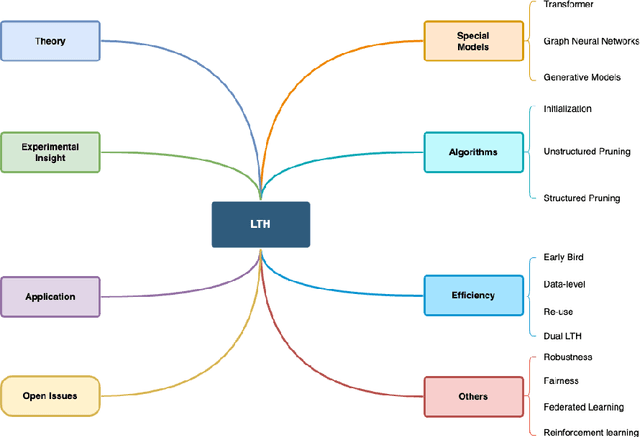
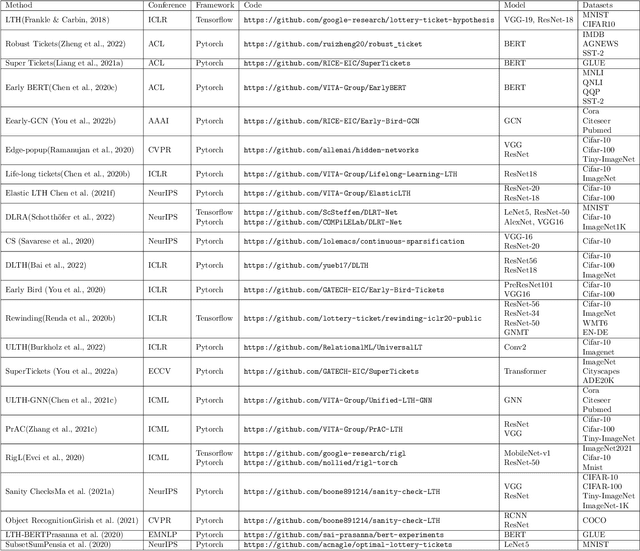
The Lottery Ticket Hypothesis (LTH) states that a dense neural network model contains a highly sparse subnetwork (i.e., winning tickets) that can achieve even better performance than the original model when trained in isolation. While LTH has been proved both empirically and theoretically in many works, there still are some open issues, such as efficiency and scalability, to be addressed. Also, the lack of open-source frameworks and consensual experimental setting poses a challenge to future research on LTH. We, for the first time, examine previous research and studies on LTH from different perspectives. We also discuss issues in existing works and list potential directions for further exploration. This survey aims to provide an in-depth look at the state of LTH and develop a duly maintained platform to conduct experiments and compare with the most updated baselines.