 Add to Chrome
 Add to Firefox
 Add to Edge
Empirical Characterization of Rationale Stability Under Controlled Perturbations for Explainable Pattern Recognition
Apr 06, 2026
Reliable pattern recognition systems should exhibit consistent behavior across similar inputs, and their explanations should remain stable. However, most Explainable AI evaluations remain instance centric and do not explicitly quantify whether attribution patterns are consistent across samples that share the same class or represent small variations of the same input. In this work, we propose a novel metric aimed at assessing the consistency of model explanations, ensuring that models consistently reflect the intended objectives and consistency under label-preserving perturbations. We implement this metric using a pre-trained BERT model on the SST-2 sentiment analysis dataset, with additional robustness tests on RoBERTa, DistilBERT, and IMDB, applying SHAP to compute feature importance for various test samples. The proposed metric quantifies the cosine similarity of SHAP values for inputs with the same label, aiming to detect inconsistent behaviors, such as biased reliance on certain features or failure to maintain consistent reasoning for similar predictions. Through a series of experiments, we evaluate the ability of this metric to identify misaligned predictions and inconsistencies in model explanations. These experiments are compared against standard fidelity metrics to assess whether the new metric can effectively identify when a model's behavior deviates from its intended objectives. The proposed framework provides a deeper understanding of model behavior by enabling more robust verification of rationale stability, which is critical for building trustworthy AI systems. By quantifying whether models rely on consistent attribution patterns for similar inputs, the proposed approach supports more robust evaluation of model behavior in practical pattern recognition pipelines. Our code is publicly available at https://github.com/anmspro/ESS-XAI-Stability.

A Survey of Lottery Ticket Hypothesis
Mar 12, 2024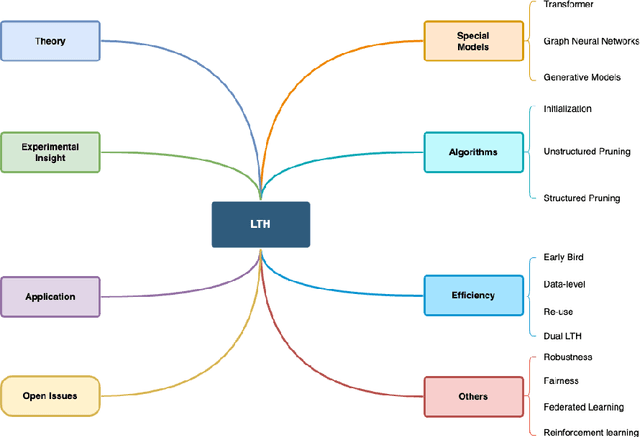
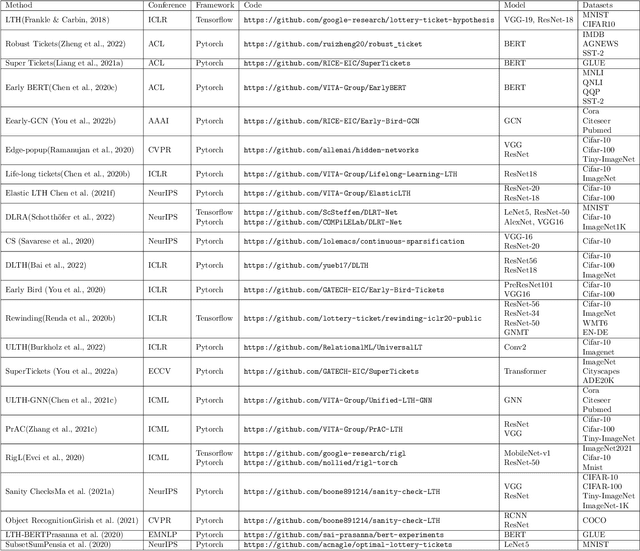
The Lottery Ticket Hypothesis (LTH) states that a dense neural network model contains a highly sparse subnetwork (i.e., winning tickets) that can achieve even better performance than the original model when trained in isolation. While LTH has been proved both empirically and theoretically in many works, there still are some open issues, such as efficiency and scalability, to be addressed. Also, the lack of open-source frameworks and consensual experimental setting poses a challenge to future research on LTH. We, for the first time, examine previous research and studies on LTH from different perspectives. We also discuss issues in existing works and list potential directions for further exploration. This survey aims to provide an in-depth look at the state of LTH and develop a duly maintained platform to conduct experiments and compare with the most updated baselines.