 Add to Chrome
 Add to Firefox
 Add to Edge
Fine-Grained Post-Training Quantization for Large Vision Language Models with Quantization-Aware Integrated Gradients
Mar 18, 2026
Large Vision Language Models (LVLMs) have achieved remarkable success in a range of downstream tasks that require multimodal interaction, but their capabilities come with substantial computational and memory overhead, which hinders practical deployment. Among numerous acceleration techniques, post-training quantization is a popular and effective strategy for reducing memory cost and accelerating inference. However, existing LVLM quantization methods typically measure token sensitivity at the modality level, which fails to capture the complex cross-token interactions and falls short in quantitatively measuring the quantization error at the token level. As tokens interact within the model, the distinction between modalities gradually diminishes, suggesting the need for fine-grained calibration. Inspired by axiomatic attribution in mechanistic interpretability, we introduce a fine-grained quantization strategy on Quantization-aware Integrated Gradients (QIG), which leverages integrated gradients to quantitatively evaluate token sensitivity and push the granularity from modality level to token level, reflecting both inter-modality and intra-modality dynamics. Extensive experiments on multiple LVLMs under both W4A8 and W3A16 settings show that our method improves accuracy across models and benchmarks with negligible latency overhead. For example, under 3-bit weight-only quantization, our method improves the average accuracy of LLaVA-onevision-7B by 1.60%, reducing the gap to its full-precision counterpart to only 1.33%. The code is available at https://github.com/ucas-xiang/QIG.

HiDe-LLaVA: Hierarchical Decoupling for Continual Instruction Tuning of Multimodal Large Language Model
Mar 17, 2025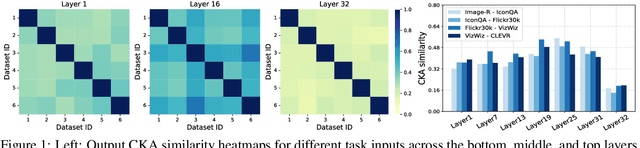
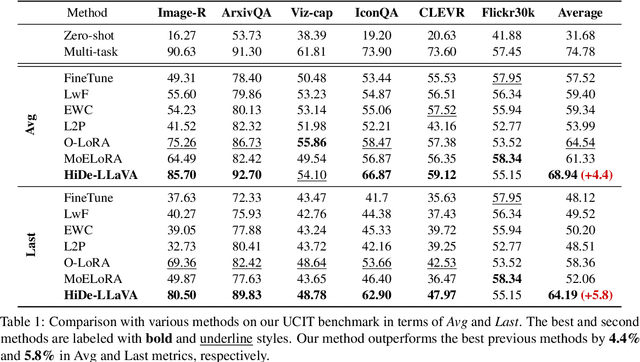
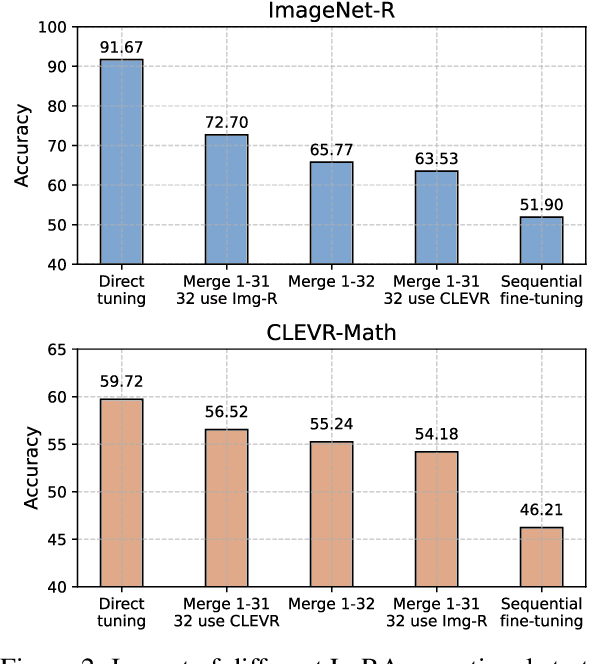
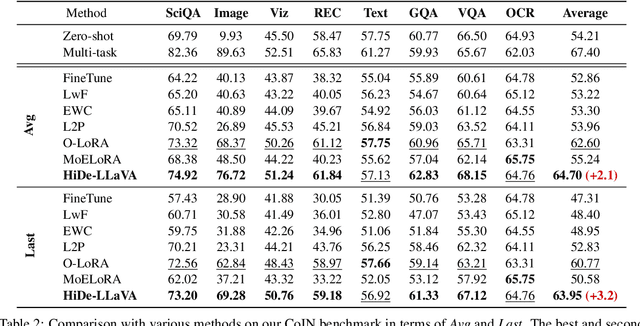
Instruction tuning is widely used to improve a pre-trained Multimodal Large Language Model (MLLM) by training it on curated task-specific datasets, enabling better comprehension of human instructions. However, it is infeasible to collect all possible instruction datasets simultaneously in real-world scenarios. Thus, enabling MLLM with continual instruction tuning is essential for maintaining their adaptability. However, existing methods often trade off memory efficiency for performance gains, significantly compromising overall efficiency. In this paper, we propose a task-specific expansion and task-general fusion framework based on the variations in Centered Kernel Alignment (CKA) similarity across different model layers when trained on diverse datasets. Furthermore, we analyze the information leakage present in the existing benchmark and propose a new and more challenging benchmark to rationally evaluate the performance of different methods. Comprehensive experiments showcase a significant performance improvement of our method compared to existing state-of-the-art methods. Our code will be public available.
ITCMA: A Generative Agent Based on a Computational Consciousness Structure
Mar 29, 2024
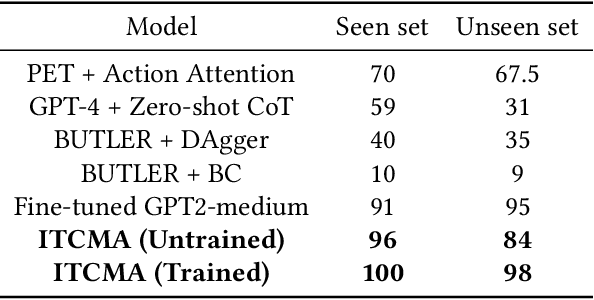

Large Language Models (LLMs) still face challenges in tasks requiring understanding implicit instructions and applying common-sense knowledge. In such scenarios, LLMs may require multiple attempts to achieve human-level performance, potentially leading to inaccurate responses or inferences in practical environments, affecting their long-term consistency and behavior. This paper introduces the Internal Time-Consciousness Machine (ITCM), a computational consciousness structure. We further propose the ITCM-based Agent (ITCMA), which supports behavior generation and reasoning in open-world settings. ITCMA enhances LLMs' ability to understand implicit instructions and apply common-sense knowledge by considering agents' interaction and reasoning with the environment. Evaluations in the Alfworld environment show that trained ITCMA outperforms the state-of-the-art (SOTA) by 9% on the seen set. Even untrained ITCMA achieves a 96% task completion rate on the seen set, 5% higher than SOTA, indicating its superiority over traditional intelligent agents in utility and generalization. In real-world tasks with quadruped robots, the untrained ITCMA achieves an 85% task completion rate, which is close to its performance in the unseen set, demonstrating its comparable utility in real-world settings.