 Add to Chrome
 Add to Firefox
 Add to Edge
ActionMap: Robot Policy Learning via Voxel Action Heatmap
Jun 05, 2026
Vision-language-action (VLA) models have advanced rapidly across backbones, training recipes, and data scale, yet the action decoder, which converts the backbone's hidden state into a continuous control signal, has barely changed and remains a single-point predictor across the majority of current VLAs. Whether implemented via autoregressive token bins, L1 regression, or flow-matching denoising, the resulting decoder treats the action space as unstructured, leaving the geometric proximity of neighboring actions unexploited during training. To advance this, we introduce ActionMap, a voxel heatmap action head that drops into an existing VLA in place of its native action decoder. For each new action, the head predicts a voxel heatmap over the action space, where each voxel directly stores the probability of the corresponding action. Across LIBERO simulation and real-world Franka manipulation, our heatmap head surpasses two architecturally distinct backbones at matched training steps (e.g., +8.2% over OpenVLA-OFT's L1 regression head on the LIBERO four-suite average), converges at comparable or faster rates on both backbones, and remains markedly more data-efficient at low training data. The cross-backbone consistency indicates that action representation is a real lever for VLA performance, distinct from further backbone or recipe scaling. Project Page: https://github.com/showlab/ActionMap.

OmniHumanoid: Streaming Cross-Embodiment Video Generation with Paired-Free Adaptation
May 12, 2026Cross-embodiment video generation aims to transfer motions across different humanoid embodiments, such as human-to-robot and robot-to-robot, enabling scalable data generation for embodied intelligence. A major challenge in this setting is that motion dynamics are partly transferable across embodiments, whereas appearance and morphology remain embodiment-specific. Existing approaches often entangle these factors, and many require paired data for every target embodiment, which limits scalability to new robots. We present OmniHumanoid, a framework that factorizes transferable motion learning and embodiment-specific adaptation. Our method learns a shared motion transfer model from motion-aligned paired videos spanning multiple embodiments, while adapting to a new embodiment using only unpaired videos through lightweight embodiment-specific adapters. To reduce interference between motion transfer and embodiment adaptation, we further introduce a branch-isolated attention design that separates motion conditioning from embodiment-specific modulation. In addition, we construct a synthetic cross-embodiment dataset with motion-aligned paired videos rendered across diverse humanoid assets, scenes, and viewpoints. Experiments on both synthetic and real-world benchmarks show that OmniHumanoid achieves strong motion fidelity and embodiment consistency, while enabling scalable adaptation to unseen humanoid embodiments without retraining the shared motion model.
UENR-600K: A Large-Scale Physically Grounded Dataset for Nighttime Video Deraining
Apr 06, 2026Nighttime video deraining is uniquely challenging because raindrops interact with artificial lighting. Unlike daytime white rain, nighttime rain takes on various colors and appears locally illuminated. Existing small-scale synthetic datasets rely on 2D rain overlays and fail to capture these physical properties, causing models to generalize poorly to real-world night rain. Meanwhile, capturing real paired nighttime videos remains impractical because rain effects cannot be isolated from other degradations like sensor noise. To bridge this gap, we introduce UENR-600K, a large-scale, physically grounded dataset containing 600,000 1080p frame pairs. We utilize Unreal Engine to simulate rain as 3D particles within virtual environments. This approach guarantees photorealism and physically real raindrops, capturing correct details like color refractions, scene occlusions, rain curtains. Leveraging this high-quality data, we establish a new state-of-the-art baseline by adapting the Wan 2.2 video generation model. Our baseline treat deraining as a video-to-video generation task, exploiting strong generative priors to almost entirely bridge the sim-to-real gap. Extensive benchmarking demonstrates that models trained on our dataset generalize significantly better to real-world videos. Project page: https://showlab.github.io/UENR-600K/.
AOI: Turning Failed Trajectories into Training Signals for Autonomous Cloud Diagnosis
Mar 05, 2026Large language model (LLM) agents offer a promising data-driven approach to automating Site Reliability Engineering (SRE), yet their enterprise deployment is constrained by three challenges: restricted access to proprietary data, unsafe action execution under permission-governed environments, and the inability of closed systems to improve from failures. We present AOI (Autonomous Operations Intelligence), a trainable multi-agent framework formulating automated operations as a structured trajectory learning problem under security constraints. Our approach integrates three key components. First, a trainable diagnostic system applies Group Relative Policy Optimization (GRPO) to distill expert-level knowledge into locally deployed open-source models, enabling preference-based learning without exposing sensitive data. Second, a read-write separated execution architecture decomposes operational trajectories into observation, reasoning, and action phases, allowing safe learning while preventing unauthorized state mutation. Third, a Failure Trajectory Closed-Loop Evolver mines unsuccessful trajectories and converts them into corrective supervision signals, enabling continual data augmentation. Evaluated on the AIOpsLab benchmark, our contributions yield cumulative gains. (1) The AOI runtime alone achieves 66.3% best@5 success on all 86 tasks, outperforming the prior state-of-the-art (41.9%) by 24.4 points. (2) Adding Observer GRPO training, a locally deployed 14B model reaches 42.9% avg@1 on 63 held-out tasks with unseen fault types, surpassing Claude Sonnet 4.5. (3) The Evolver converts 37 failed trajectories into diagnostic guidance, improving end-to-end avg@5 by 4.8 points while reducing variance by 35%.
EVM-QuestBench: An Execution-Grounded Benchmark for Natural-Language Transaction Code Generation
Jan 10, 2026Large language models are increasingly applied to various development scenarios. However, in on-chain transaction scenarios, even a minor error can cause irreversible loss for users. Existing evaluations often overlook execution accuracy and safety. We introduce EVM-QuestBench, an execution-grounded benchmark for natural-language transaction-script generation on EVM-compatible chains. The benchmark employs dynamic evaluation: instructions are sampled from template pools, numeric parameters are drawn from predefined intervals, and validators verify outcomes against these instantiated values. EVM-QuestBench contains 107 tasks (62 atomic, 45 composite). Its modular architecture enables rapid task development. The runner executes scripts on a forked EVM chain with snapshot isolation; composite tasks apply step-efficiency decay. We evaluate 20 models and find large performance gaps, with split scores revealing persistent asymmetry between single-action precision and multi-step workflow completion. Code: https://anonymous.4open.science/r/bsc_quest_bench-A9CF/.
H2R-Grounder: A Paired-Data-Free Paradigm for Translating Human Interaction Videos into Physically Grounded Robot Videos
Dec 10, 2025
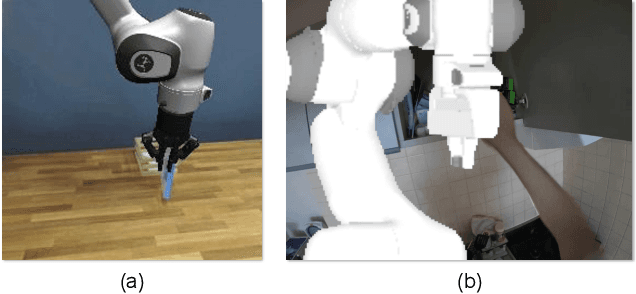

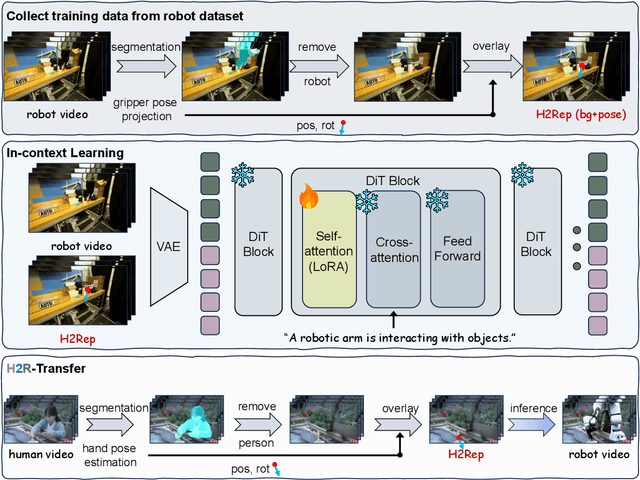
Robots that learn manipulation skills from everyday human videos could acquire broad capabilities without tedious robot data collection. We propose a video-to-video translation framework that converts ordinary human-object interaction videos into motion-consistent robot manipulation videos with realistic, physically grounded interactions. Our approach does not require any paired human-robot videos for training only a set of unpaired robot videos, making the system easy to scale. We introduce a transferable representation that bridges the embodiment gap: by inpainting the robot arm in training videos to obtain a clean background and overlaying a simple visual cue (a marker and arrow indicating the gripper's position and orientation), we can condition a generative model to insert the robot arm back into the scene. At test time, we apply the same process to human videos (inpainting the person and overlaying human pose cues) and generate high-quality robot videos that mimic the human's actions. We fine-tune a SOTA video diffusion model (Wan 2.2) in an in-context learning manner to ensure temporal coherence and leveraging of its rich prior knowledge. Empirical results demonstrate that our approach achieves significantly more realistic and grounded robot motions compared to baselines, pointing to a promising direction for scaling up robot learning from unlabeled human videos. Project page: https://showlab.github.io/H2R-Grounder/
Exploring Diffusion with Test-Time Training on Efficient Image Restoration
Jun 17, 2025Image restoration faces challenges including ineffective feature fusion, computational bottlenecks and inefficient diffusion processes. To address these, we propose DiffRWKVIR, a novel framework unifying Test-Time Training (TTT) with efficient diffusion. Our approach introduces three key innovations: (1) Omni-Scale 2D State Evolution extends RWKV's location-dependent parameterization to hierarchical multi-directional 2D scanning, enabling global contextual awareness with linear complexity O(L); (2) Chunk-Optimized Flash Processing accelerates intra-chunk parallelism by 3.2x via contiguous chunk processing (O(LCd) complexity), reducing sequential dependencies and computational overhead; (3) Prior-Guided Efficient Diffusion extracts a compact Image Prior Representation (IPR) in only 5-20 steps, proving 45% faster training/inference than DiffIR while solving computational inefficiency in denoising. Evaluated across super-resolution and inpainting benchmarks (Set5, Set14, BSD100, Urban100, Places365), DiffRWKVIR outperforms SwinIR, HAT, and MambaIR/v2 in PSNR, SSIM, LPIPS, and efficiency metrics. Our method establishes a new paradigm for adaptive, high-efficiency image restoration with optimized hardware utilization.
macOSWorld: A Multilingual Interactive Benchmark for GUI Agents
Jun 05, 2025

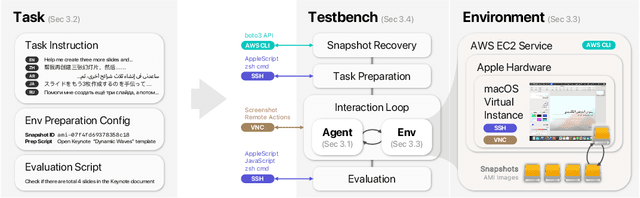

Graphical User Interface (GUI) agents show promising capabilities for automating computer-use tasks and facilitating accessibility, but existing interactive benchmarks are mostly English-only, covering web-use or Windows, Linux, and Android environments, but not macOS. macOS is a major OS with distinctive GUI patterns and exclusive applications. To bridge the gaps, we present macOSWorld, the first comprehensive benchmark for evaluating GUI agents on macOS. macOSWorld features 202 multilingual interactive tasks across 30 applications (28 macOS-exclusive), with task instructions and OS interfaces offered in 5 languages (English, Chinese, Arabic, Japanese, and Russian). As GUI agents are shown to be vulnerable to deception attacks, macOSWorld also includes a dedicated safety benchmarking subset. Our evaluation on six GUI agents reveals a dramatic gap: proprietary computer-use agents lead at above 30% success rate, while open-source lightweight research models lag at below 2%, highlighting the need for macOS domain adaptation. Multilingual benchmarks also expose common weaknesses, especially in Arabic, with a 27.5% average degradation compared to English. Results from safety benchmarking also highlight that deception attacks are more general and demand immediate attention. macOSWorld is available at https://github.com/showlab/macosworld.
In-Context Defense in Computer Agents: An Empirical Study
Mar 12, 2025Computer agents powered by vision-language models (VLMs) have significantly advanced human-computer interaction, enabling users to perform complex tasks through natural language instructions. However, these agents are vulnerable to context deception attacks, an emerging threat where adversaries embed misleading content into the agent's operational environment, such as a pop-up window containing deceptive instructions. Existing defenses, such as instructing agents to ignore deceptive elements, have proven largely ineffective. As the first systematic study on protecting computer agents, we introduce textbf{in-context defense}, leveraging in-context learning and chain-of-thought (CoT) reasoning to counter such attacks. Our approach involves augmenting the agent's context with a small set of carefully curated exemplars containing both malicious environments and corresponding defensive responses. These exemplars guide the agent to first perform explicit defensive reasoning before action planning, reducing susceptibility to deceptive attacks. Experiments demonstrate the effectiveness of our method, reducing attack success rates by 91.2% on pop-up window attacks, 74.6% on average on environment injection attacks, while achieving 100% successful defenses against distracting advertisements. Our findings highlight that (1) defensive reasoning must precede action planning for optimal performance, and (2) a minimal number of exemplars (fewer than three) is sufficient to induce an agent's defensive behavior.
Partial Distribution Alignment via Adaptive Optimal Transport
Mar 07, 2025To remedy the drawbacks of full-mass or fixed-mass constraints in classical optimal transport, we propose adaptive optimal transport which is distinctive from the classical optimal transport in its ability of adaptive-mass preserving. It aims to answer the mathematical problem of how to transport the probability mass adaptively between probability distributions, which is a fundamental topic in various areas of artificial intelligence. Adaptive optimal transport is able to transfer mass adaptively in the light of the intrinsic structure of the problem itself. The theoretical results shed light on the adaptive mechanism of mass transportation. Furthermore, we instantiate the adaptive optimal transport in machine learning application to align source and target distributions partially and adaptively by respecting the ubiquity of noises, outliers, and distribution shifts in the data. The experiment results on the domain adaptation benchmarks show that the proposed method significantly outperforms the state-of-the-art algorithms.