 Add to Chrome
 Add to Firefox
 Add to Edge
Thinking Beyond Labels: Vocabulary-Free Fine-Grained Recognition using Reasoning-Augmented LMMs
Dec 21, 2025
Vocabulary-free fine-grained image recognition aims to distinguish visually similar categories within a meta-class without a fixed, human-defined label set. Existing solutions for this problem are limited by either the usage of a large and rigid list of vocabularies or by the dependency on complex pipelines with fragile heuristics where errors propagate across stages. Meanwhile, the ability of recent large multi-modal models (LMMs) equipped with explicit or implicit reasoning to comprehend visual-language data, decompose problems, retrieve latent knowledge, and self-correct suggests a more principled and effective alternative. Building on these capabilities, we propose FiNDR (Fine-grained Name Discovery via Reasoning), the first reasoning-augmented LMM-based framework for vocabulary-free fine-grained recognition. The system operates in three automated steps: (i) a reasoning-enabled LMM generates descriptive candidate labels for each image; (ii) a vision-language model filters and ranks these candidates to form a coherent class set; and (iii) the verified names instantiate a lightweight multi-modal classifier used at inference time. Extensive experiments on popular fine-grained classification benchmarks demonstrate state-of-the-art performance under the vocabulary-free setting, with a significant relative margin of up to 18.8% over previous approaches. Remarkably, the proposed method surpasses zero-shot baselines that exploit pre-defined ground-truth names, challenging the assumption that human-curated vocabularies define an upper bound. Additionally, we show that carefully curated prompts enable open-source LMMs to match proprietary counterparts. These findings establish reasoning-augmented LMMs as an effective foundation for scalable, fully automated, open-world fine-grained visual recognition. The source code is available on github.com/demidovd98/FiNDR.

How Good is my Histopathology Vision-Language Foundation Model? A Holistic Benchmark
Mar 17, 2025
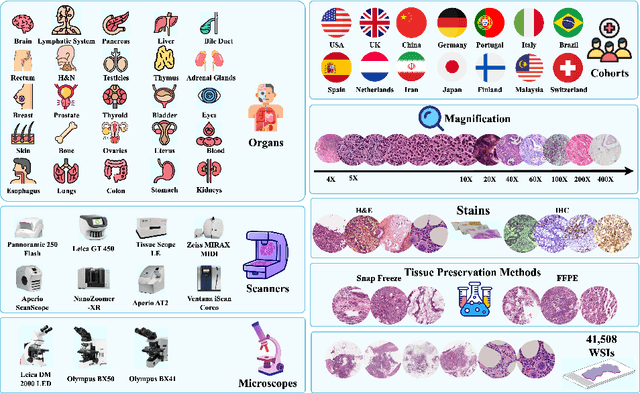
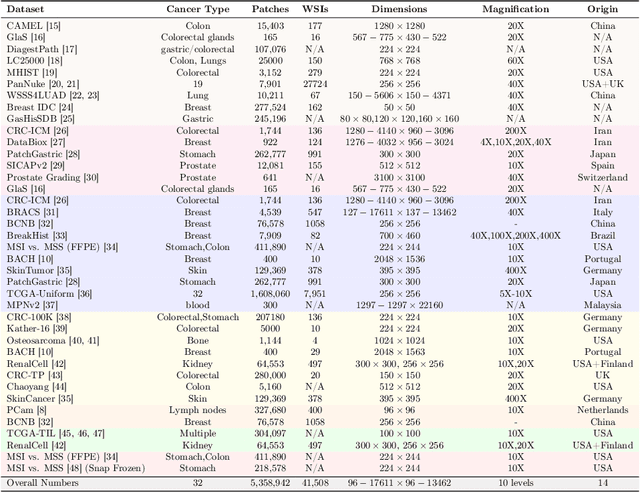
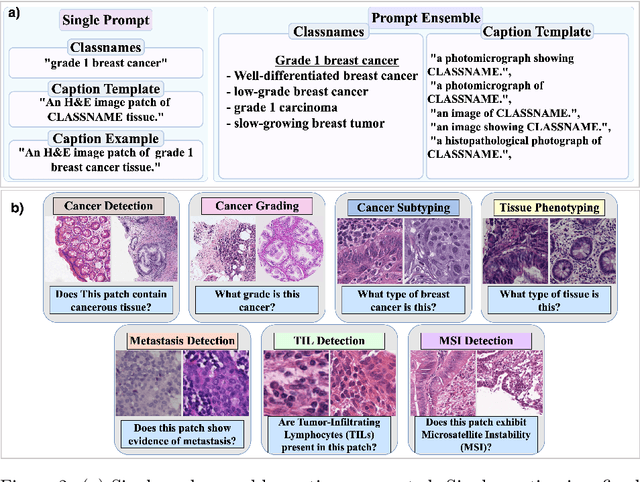
Recently, histopathology vision-language foundation models (VLMs) have gained popularity due to their enhanced performance and generalizability across different downstream tasks. However, most existing histopathology benchmarks are either unimodal or limited in terms of diversity of clinical tasks, organs, and acquisition instruments, as well as their partial availability to the public due to patient data privacy. As a consequence, there is a lack of comprehensive evaluation of existing histopathology VLMs on a unified benchmark setting that better reflects a wide range of clinical scenarios. To address this gap, we introduce HistoVL, a fully open-source comprehensive benchmark comprising images acquired using up to 11 various acquisition tools that are paired with specifically crafted captions by incorporating class names and diverse pathology descriptions. Our Histo-VL includes 26 organs, 31 cancer types, and a wide variety of tissue obtained from 14 heterogeneous patient cohorts, totaling more than 5 million patches obtained from over 41K WSIs viewed under various magnification levels. We systematically evaluate existing histopathology VLMs on Histo-VL to simulate diverse tasks performed by experts in real-world clinical scenarios. Our analysis reveals interesting findings, including large sensitivity of most existing histopathology VLMs to textual changes with a drop in balanced accuracy of up to 25% in tasks such as Metastasis detection, low robustness to adversarial attacks, as well as improper calibration of models evident through high ECE values and low model prediction confidence, all of which can affect their clinical implementation.
A Coarse-to-Fine Pseudo-Labeling Framework for Unsupervised Video Anomaly Detection
Oct 26, 2023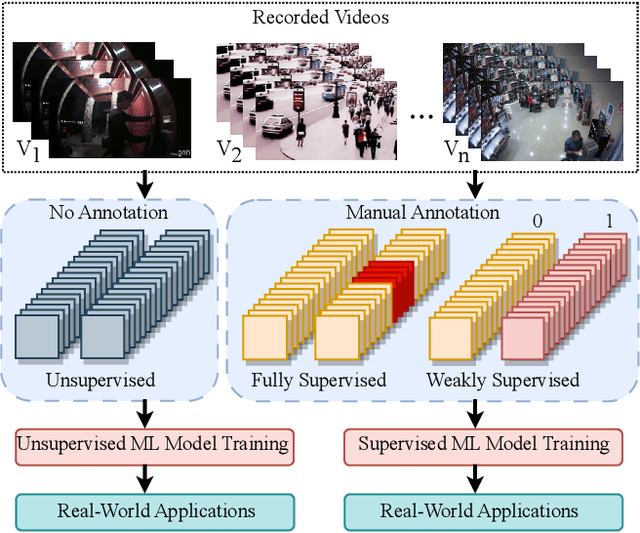
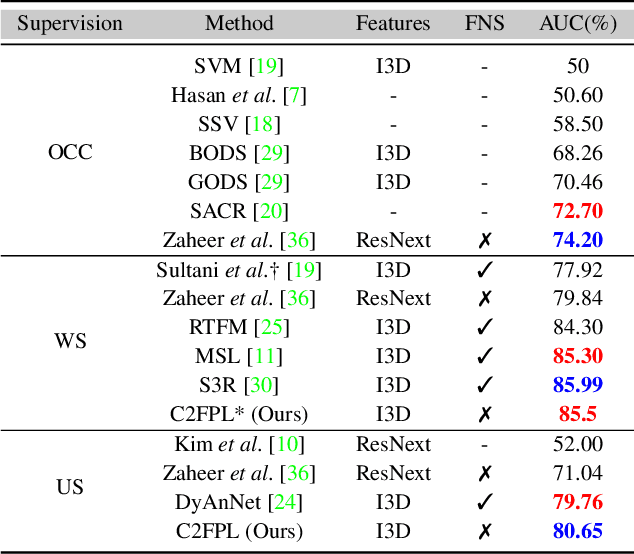
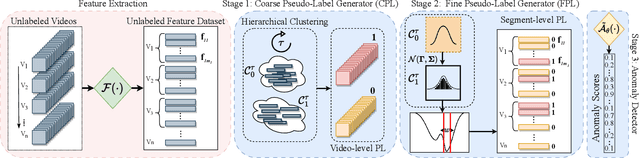
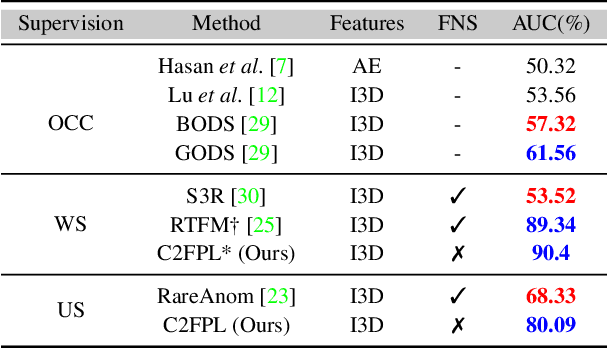
Detection of anomalous events in videos is an important problem in applications such as surveillance. Video anomaly detection (VAD) is well-studied in the one-class classification (OCC) and weakly supervised (WS) settings. However, fully unsupervised (US) video anomaly detection methods, which learn a complete system without any annotation or human supervision, have not been explored in depth. This is because the lack of any ground truth annotations significantly increases the magnitude of the VAD challenge. To address this challenge, we propose a simple-but-effective two-stage pseudo-label generation framework that produces segment-level (normal/anomaly) pseudo-labels, which can be further used to train a segment-level anomaly detector in a supervised manner. The proposed coarse-to-fine pseudo-label (C2FPL) generator employs carefully-designed hierarchical divisive clustering and statistical hypothesis testing to identify anomalous video segments from a set of completely unlabeled videos. The trained anomaly detector can be directly applied on segments of an unseen test video to obtain segment-level, and subsequently, frame-level anomaly predictions. Extensive studies on two large-scale public-domain datasets, UCF-Crime and XD-Violence, demonstrate that the proposed unsupervised approach achieves superior performance compared to all existing OCC and US methods , while yielding comparable performance to the state-of-the-art WS methods.