 Add to Chrome
 Add to Firefox
 Add to Edge
Plan2Map: A Multimodal Benchmark for Document-Grounded Geospatial Boundary Reconstruction from Planning Records
Jun 01, 2026
Planning records define restrictions over geographic areas, but their source documents often provide only indirect spatial evidence rather than machine-readable boundaries. We introduce Plan2Map, a 208-case multimodal benchmark for document-grounded geospatial boundary reconstruction from UK planning records. Given only a source planning document, systems must reconstruct a valid geospatial boundary from notice text, schedules, map plates, map labels, and boundary annotations; the reference GeoJSON is held out for scoring. We propose GeoPlanAgent, a document-grounded, geospatial-tool-in-the-loop system that decomposes the task into evidence extraction, localisation, map registration, boundary segmentation, projection, and verification. On Plan2Map, GeoPlanAgent achieves 0.736 mean IoU and 0.904 median IoU, with 67.8\% of predictions at or above 0.8 IoU, substantially outperforming direct VLM-to-GeoJSON baselines. Diagnostic analysis shows that direct VLM prediction remains unreliable, while remaining errors are concentrated in localisation and map registration, and supervised boundary segmentation substantially improves pixel-level mask quality. Plan2Map provides a concrete testbed for multimodal geospatial reconstruction from public planning records. Project page: https://odeb1.github.io/Plan2Map_Project_Page/.

Benchmarking at the Edge of Comprehension
Feb 15, 2026As frontier Large Language Models (LLMs) increasingly saturate new benchmarks shortly after they are published, benchmarking itself is at a juncture: if frontier models keep improving, it will become increasingly hard for humans to generate discriminative tasks, provide accurate ground-truth answers, or evaluate complex solutions. If benchmarking becomes infeasible, our ability to measure any progress in AI is at stake. We refer to this scenario as the post-comprehension regime. In this work, we propose Critique-Resilient Benchmarking, an adversarial framework designed to compare models even when full human understanding is infeasible. Our technique relies on the notion of critique-resilient correctness: an answer is deemed correct if no adversary has convincingly proved otherwise. Unlike standard benchmarking, humans serve as bounded verifiers and focus on localized claims, which preserves evaluation integrity beyond full comprehension of the task. Using an itemized bipartite Bradley-Terry model, we jointly rank LLMs by their ability to solve challenging tasks and to generate difficult yet solvable questions. We showcase the effectiveness of our method in the mathematical domain across eight frontier LLMs, showing that the resulting scores are stable and correlate with external capability measures. Our framework reformulates benchmarking as an adversarial generation-evaluation game in which humans serve as final adjudicators.
Articulate3D: Zero-Shot Text-Driven 3D Object Posing
Aug 26, 2025We propose a training-free method, Articulate3D, to pose a 3D asset through language control. Despite advances in vision and language models, this task remains surprisingly challenging. To achieve this goal, we decompose the problem into two steps. We modify a powerful image-generator to create target images conditioned on the input image and a text instruction. We then align the mesh to the target images through a multi-view pose optimisation step. In detail, we introduce a self-attention rewiring mechanism (RSActrl) that decouples the source structure from pose within an image generative model, allowing it to maintain a consistent structure across varying poses. We observed that differentiable rendering is an unreliable signal for articulation optimisation; instead, we use keypoints to establish correspondences between input and target images. The effectiveness of Articulate3D is demonstrated across a diverse range of 3D objects and free-form text prompts, successfully manipulating poses while maintaining the original identity of the mesh. Quantitative evaluations and a comparative user study, in which our method was preferred over 85\% of the time, confirm its superiority over existing approaches. Project page:https://odeb1.github.io/articulate3d_page_deb/
New keypoint-based approach for recognising British Sign Language (BSL) from sequences
Dec 12, 2024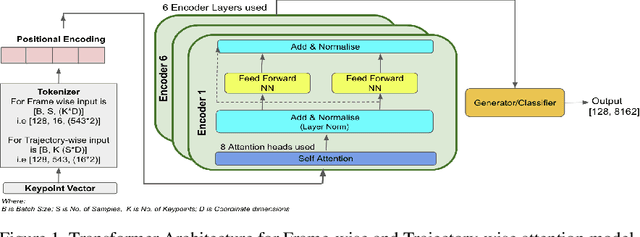
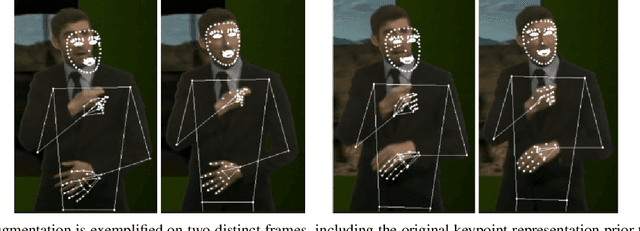
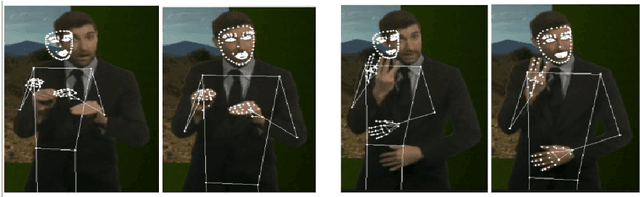
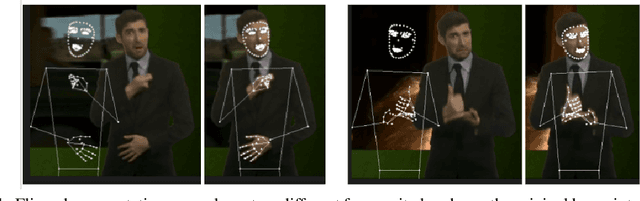
In this paper, we present a novel keypoint-based classification model designed to recognise British Sign Language (BSL) words within continuous signing sequences. Our model's performance is assessed using the BOBSL dataset, revealing that the keypoint-based approach surpasses its RGB-based counterpart in computational efficiency and memory usage. Furthermore, it offers expedited training times and demands fewer computational resources. To the best of our knowledge, this is the inaugural application of a keypoint-based model for BSL word classification, rendering direct comparisons with existing works unavailable.
Towards Multi-Modal Animal Pose Estimation: An In-Depth Analysis
Oct 12, 2024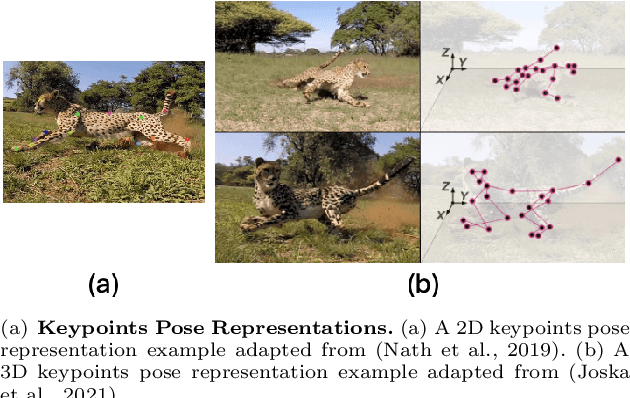
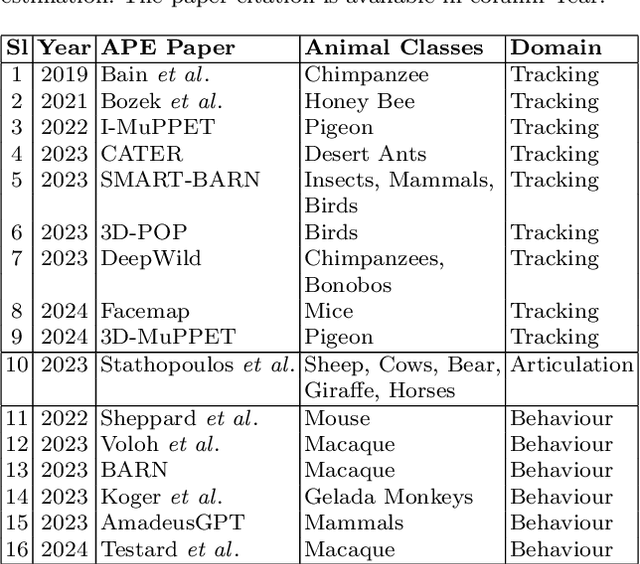
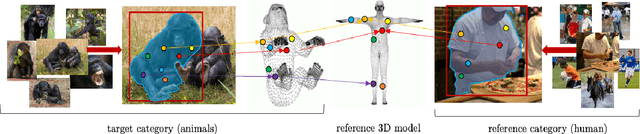
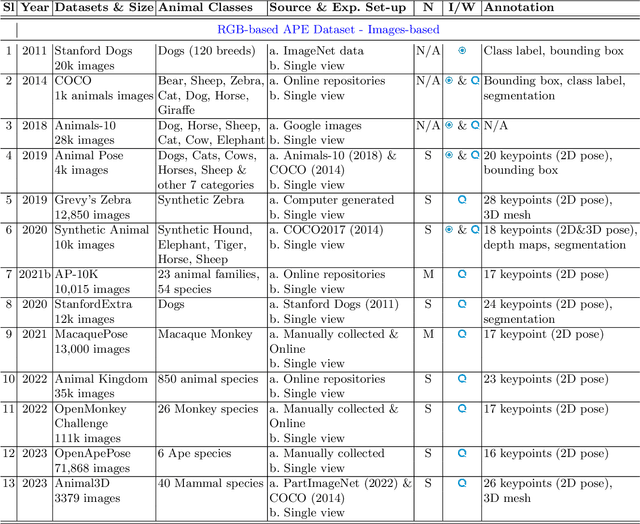
Animal pose estimation (APE) aims to locate the animal body parts using a diverse array of sensor and modality inputs, which is crucial for research across neuroscience, biomechanics, and veterinary medicine. By evaluating 178 papers since 2013, APE methods are categorised by sensor and modality types, learning paradigms, experimental setup, and application domains, presenting detailed analyses of current trends, challenges, and future directions in single- and multi-modality APE systems. The analysis also highlights the transition between human and animal pose estimation. Additionally, 2D and 3D APE datasets and evaluation metrics based on different sensors and modalities are provided. A regularly updated project page is provided here: https://github.com/ChennyDeng/MM-APE.