 Add to Chrome
 Add to Firefox
 Add to Edge
Exploring Language-Agnosticity in Function Vectors: A Case Study in Machine Translation
Apr 21, 2026
Function vectors (FVs) are vector representations of tasks extracted from model activations during in-context learning. While prior work has shown that multilingual model representations can be language-agnostic, it remains unclear whether the same holds for function vectors. We study whether FVs exhibit language-agnosticity, using machine translation as a case study. Across three decoder-only multilingual LLMs, we find that translation FVs extracted from a single English$\rightarrow$Target direction transfer to other target languages, consistently improving the rank of correct translation tokens across multiple unseen languages. Ablation results show that removing the FV degrades translation across languages with limited impact on unrelated tasks. We further show that base-model FVs transfer to instruction-tuned variants and partially generalize from word-level to sentence-level translation.

Why Don't You Know? Evaluating the Impact of Uncertainty Sources on Uncertainty Quantification in LLMs
Apr 12, 2026As Large Language Models (LLMs) are increasingly deployed in real-world applications, reliable uncertainty quantification (UQ) becomes critical for safe and effective use. Most existing UQ approaches for language models aim to produce a single confidence score -- for example, estimating the probability that a model's answer is correct. However, uncertainty in natural language tasks arises from multiple distinct sources, including model knowledge gaps, output variability, and input ambiguity, which have different implications for system behavior and user interaction. In this work, we study how the source of uncertainty impacts the behavior and effectiveness of existing UQ methods. To enable controlled analysis, we introduce a new dataset that explicitly categorizes uncertainty sources, allowing systematic evaluation of UQ performance under each condition. Our experiments reveal that while many UQ methods perform well when uncertainty stems solely from model knowledge limitations, their performance degrades or becomes misleading when other sources are introduced. These findings highlight the need for uncertainty-aware methods that explicitly account for the source of uncertainty in large language models.
Llama-3.1-Sherkala-8B-Chat: An Open Large Language Model for Kazakh
Mar 03, 2025Llama-3.1-Sherkala-8B-Chat, or Sherkala-Chat (8B) for short, is a state-of-the-art instruction-tuned open generative large language model (LLM) designed for Kazakh. Sherkala-Chat (8B) aims to enhance the inclusivity of LLM advancements for Kazakh speakers. Adapted from the LLaMA-3.1-8B model, Sherkala-Chat (8B) is trained on 45.3B tokens across Kazakh, English, Russian, and Turkish. With 8 billion parameters, it demonstrates strong knowledge and reasoning abilities in Kazakh, significantly outperforming existing open Kazakh and multilingual models of similar scale while achieving competitive performance in English. We release Sherkala-Chat (8B) as an open-weight instruction-tuned model and provide a detailed overview of its training, fine-tuning, safety alignment, and evaluation, aiming to advance research and support diverse real-world applications.
Qorgau: Evaluating LLM Safety in Kazakh-Russian Bilingual Contexts
Feb 19, 2025Large language models (LLMs) are known to have the potential to generate harmful content, posing risks to users. While significant progress has been made in developing taxonomies for LLM risks and safety evaluation prompts, most studies have focused on monolingual contexts, primarily in English. However, language- and region-specific risks in bilingual contexts are often overlooked, and core findings can diverge from those in monolingual settings. In this paper, we introduce Qorgau, a novel dataset specifically designed for safety evaluation in Kazakh and Russian, reflecting the unique bilingual context in Kazakhstan, where both Kazakh (a low-resource language) and Russian (a high-resource language) are spoken. Experiments with both multilingual and language-specific LLMs reveal notable differences in safety performance, emphasizing the need for tailored, region-specific datasets to ensure the responsible and safe deployment of LLMs in countries like Kazakhstan. Warning: this paper contains example data that may be offensive, harmful, or biased.
Instruction Tuning on Public Government and Cultural Data for Low-Resource Language: a Case Study in Kazakh
Feb 19, 2025Instruction tuning in low-resource languages remains underexplored due to limited text data, particularly in government and cultural domains. To address this, we introduce and open-source a large-scale (10,600 samples) instruction-following (IFT) dataset, covering key institutional and cultural knowledge relevant to Kazakhstan. Our dataset enhances LLMs' understanding of procedural, legal, and structural governance topics. We employ LLM-assisted data generation, comparing open-weight and closed-weight models for dataset construction, and select GPT-4o as the backbone. Each entity of our dataset undergoes full manual verification to ensure high quality. We also show that fine-tuning Qwen, Falcon, and Gemma on our dataset leads to consistent performance improvements in both multiple-choice and generative tasks, demonstrating the potential of LLM-assisted instruction tuning for low-resource languages.
KazMMLU: Evaluating Language Models on Kazakh, Russian, and Regional Knowledge of Kazakhstan
Feb 18, 2025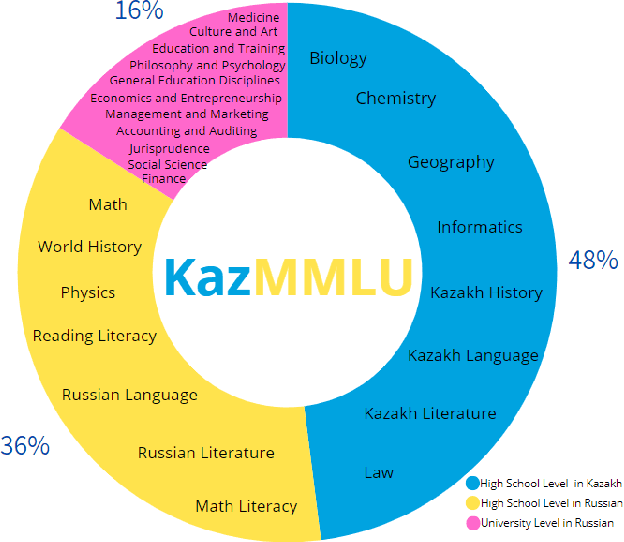
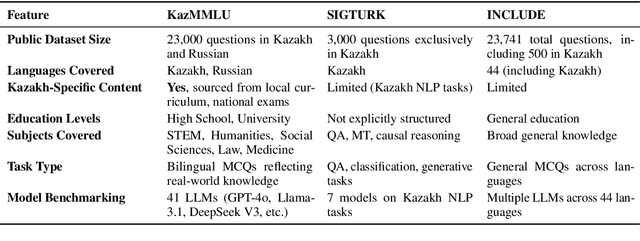
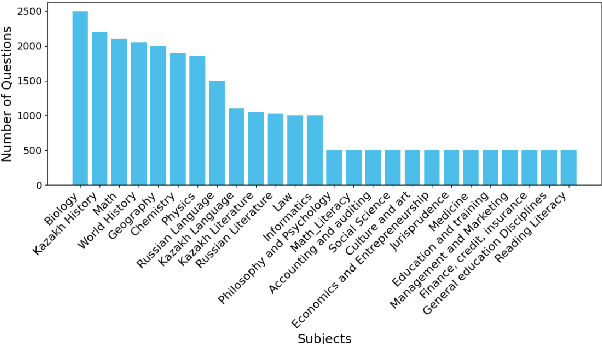
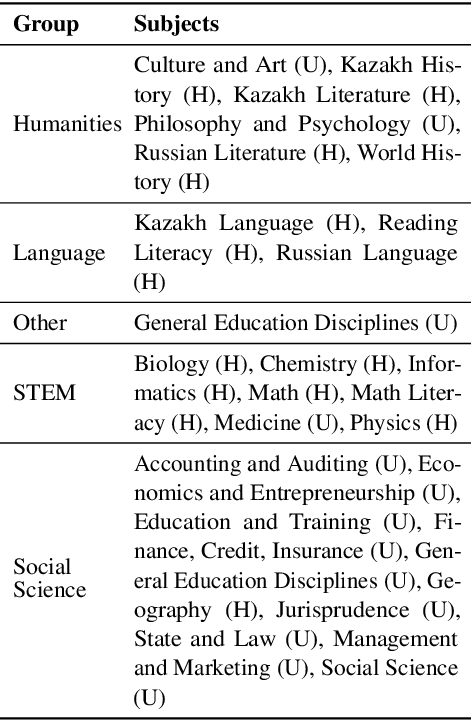
Despite having a population of twenty million, Kazakhstan's culture and language remain underrepresented in the field of natural language processing. Although large language models (LLMs) continue to advance worldwide, progress in Kazakh language has been limited, as seen in the scarcity of dedicated models and benchmark evaluations. To address this gap, we introduce KazMMLU, the first MMLU-style dataset specifically designed for Kazakh language. KazMMLU comprises 23,000 questions that cover various educational levels, including STEM, humanities, and social sciences, sourced from authentic educational materials and manually validated by native speakers and educators. The dataset includes 10,969 Kazakh questions and 12,031 Russian questions, reflecting Kazakhstan's bilingual education system and rich local context. Our evaluation of several state-of-the-art multilingual models (Llama-3.1, Qwen-2.5, GPT-4, and DeepSeek V3) demonstrates substantial room for improvement, as even the best-performing models struggle to achieve competitive performance in Kazakh and Russian. These findings underscore significant performance gaps compared to high-resource languages. We hope that our dataset will enable further research and development of Kazakh-centric LLMs. Data and code will be made available upon acceptance.
Is Human-Like Text Liked by Humans? Multilingual Human Detection and Preference Against AI
Feb 17, 2025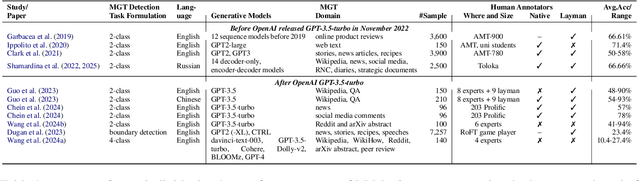
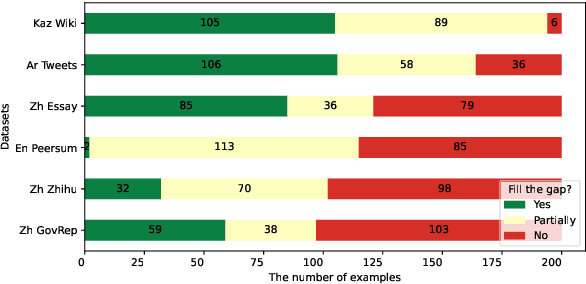
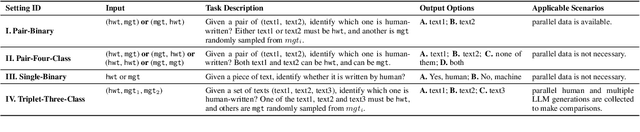
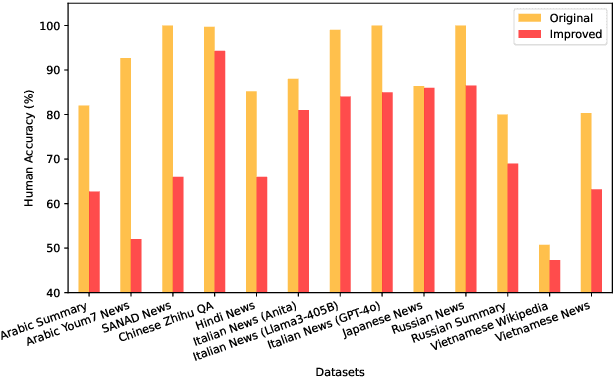
Prior studies have shown that distinguishing text generated by large language models (LLMs) from human-written one is highly challenging, and often no better than random guessing. To verify the generalizability of this finding across languages and domains, we perform an extensive case study to identify the upper bound of human detection accuracy. Across 16 datasets covering 9 languages and 9 domains, 19 annotators achieved an average detection accuracy of 87.6%, thus challenging previous conclusions. We find that major gaps between human and machine text lie in concreteness, cultural nuances, and diversity. Prompting by explicitly explaining the distinctions in the prompts can partially bridge the gaps in over 50% of the cases. However, we also find that humans do not always prefer human-written text, particularly when they cannot clearly identify its source.
GenAI Content Detection Task 1: English and Multilingual Machine-Generated Text Detection: AI vs. Human
Jan 19, 2025We present the GenAI Content Detection Task~1 -- a shared task on binary machine generated text detection, conducted as a part of the GenAI workshop at COLING 2025. The task consists of two subtasks: Monolingual (English) and Multilingual. The shared task attracted many participants: 36 teams made official submissions to the Monolingual subtask during the test phase and 26 teams -- to the Multilingual. We provide a comprehensive overview of the data, a summary of the results -- including system rankings and performance scores -- detailed descriptions of the participating systems, and an in-depth analysis of submissions. https://github.com/mbzuai-nlp/COLING-2025-Workshop-on-MGT-Detection-Task1