 Add to Chrome
 Add to Firefox
 Add to Edge
Property-driven Causal Abstractions for Markov Decision Processes
Jul 29, 2026
Markov Decision Processes (MDPs) are widely used as decision-making models, commonly specified over factored state spaces through state variables and their valuations. The exponential blowup in the number of states renders many reasoning tasks in MDPs challenging. Abstractions are promising techniques to reduce MDPs and thus mitigate scalability issues. In this work, we introduce a notion of causality on factored MDPs and a novel property-driven causal abstraction technique that retains many characteristics of the original MDP model. For this, we rely on causal relations over state variable predicates and identify those states that share the same reasons for fulfilling or violating a given abstraction property. We theoretically and empirically compare various causal MDP abstractions using different model types such as MDPs, interval MDPs, or stochastic games. Our evaluation demonstrates the potential of our approach: For several standard benchmarks, we obtain small abstractions that allow us to compute near-optimal policies for the original MDP. Furthermore, our causal abstractions often generalize to related large-scale MDP models.

dtControl2+$\varepsilon$: Trading Optimality for Explainability in MDPs via Decision Trees
Jul 28, 2026Over the past decade, decision trees have been used to represent controllers (a.k.a. policies) in an explainable way, with dtControl2 as a current state-of-the-art tool. However, for systems that are large or have many corner cases, even such representations tend to be too complex and not human-comprehensible. Unfortunately, reducing the size of the decision tree is not straightforward, as missing just a single crucial case might result in an incorrect controller. We tackle this issue in the setting of Markov decision processes, extending dtControl2 by "$\varepsilon$" functionality: Given an allowed imprecision $\varepsilon \geq 0$, we construct a smaller decision tree, distilling the essence of the controller, while still guaranteeing its $\varepsilon$-optimality. This enables us to provide tunably simpler explanations, omitting a controllable amount of detail. Our tool constructs decision trees that are orders of magnitude smaller than the state of the art.
Confidence Sequences for Online Statistical Model Checking of Markov Decision Processes
Jun 24, 2026Markov decision processes (MDPs) are a classic model of decision making under uncertainty, exhibiting both non-deterministic choice as well as probabilistic uncertainty. Traditionally, exact knowledge of the underlying probabilities is assumed. However, this often is unrealistic, e.g.\ when modelling cyber-physical systems or biological processes. Here, statistical methods provide a way towards obtaining meaningful guarantees. The classical approach is to gather samples in the MDP, use these to draw statistical conclusions about the transition probabilities, and from there obtain bounds on the true value; then, if these bounds are too broad, repeat. However, existing implementations of this approach are either subtly incorrect or sub-optimal, and quite often both. We present several \emph{confidence sequences}, which are specifically designed for such \enquote{online} settings, implement all of them in an efficient tool, and show their practical applicability. In particular, we show that they outperform classical \enquote{union-bound} style approaches, and overall our implementation requires 50x less samples on average than previous state of the art.
Missingness-MDPs: Bridging the Theory of Missing Data and POMDPs
May 12, 2026We introduce missingness-MDPs (miss-MDPs), a novel subclass of partially observable Markov decision processes (POMDPs) that incorporates the theory of missing data. A miss-MDP is a POMDP whose observation function is a missingness function, specifying the probability that individual state features are missing (i.e., unobserved) at a time step. The literature distinguishes three canonical missingness types: missing (1) completely at random (MCAR), (2) at random (MAR), and (3) not at random (MNAR). Our planning problem is to compute near-optimal policies for a miss-MDP with an unknown missingness function, given a dataset of action-observation trajectories. Achieving such optimality guarantees for policies requires learning the missingness function from data, which is infeasible for general POMDPs. To overcome this challenge, we exploit the structural properties of different missingness types to derive probably approximately correct (PAC) algorithms for learning the missingness function. These algorithms yield an approximate but fully specified miss-MDP that we solve using off-the-shelf planning methods. We prove that, with high probability, the resulting policies are epsilon-optimal in the true miss-MDP. Empirical results confirm the theory and demonstrate superior performance of our approach over two model-free POMDP methods.
Perception-Based Beliefs for POMDPs with Visual Observations
Feb 05, 2026Partially observable Markov decision processes (POMDPs) are a principled planning model for sequential decision-making under uncertainty. Yet, real-world problems with high-dimensional observations, such as camera images, remain intractable for traditional belief- and filtering-based solvers. To tackle this problem, we introduce the Perception-based Beliefs for POMDPs framework (PBP), which complements such solvers with a perception model. This model takes the form of an image classifier which maps visual observations to probability distributions over states. PBP incorporates these distributions directly into belief updates, so the underlying solver does not need to reason explicitly over high-dimensional observation spaces. We show that the belief update of PBP coincides with the standard belief update if the image classifier is exact. Moreover, to handle classifier imprecision, we incorporate uncertainty quantification and introduce two methods to adjust the belief update accordingly. We implement PBP using two traditional POMDP solvers and empirically show that (1) it outperforms existing end-to-end deep RL methods and (2) uncertainty quantification improves robustness of PBP against visual corruption.
Solving Robust Markov Decision Processes: Generic, Reliable, Efficient
Dec 13, 2024Markov decision processes (MDP) are a well-established model for sequential decision-making in the presence of probabilities. In robust MDP (RMDP), every action is associated with an uncertainty set of probability distributions, modelling that transition probabilities are not known precisely. Based on the known theoretical connection to stochastic games, we provide a framework for solving RMDPs that is generic, reliable, and efficient. It is *generic* both with respect to the model, allowing for a wide range of uncertainty sets, including but not limited to intervals, $L^1$- or $L^2$-balls, and polytopes; and with respect to the objective, including long-run average reward, undiscounted total reward, and stochastic shortest path. It is *reliable*, as our approach not only converges in the limit, but provides precision guarantees at any time during the computation. It is *efficient* because -- in contrast to state-of-the-art approaches -- it avoids explicitly constructing the underlying stochastic game. Consequently, our prototype implementation outperforms existing tools by several orders of magnitude and can solve RMDPs with a million states in under a minute.
1-2-3-Go! Policy Synthesis for Parameterized Markov Decision Processes via Decision-Tree Learning and Generalization
Oct 23, 2024Despite the advances in probabilistic model checking, the scalability of the verification methods remains limited. In particular, the state space often becomes extremely large when instantiating parameterized Markov decision processes (MDPs) even with moderate values. Synthesizing policies for such \emph{huge} MDPs is beyond the reach of available tools. We propose a learning-based approach to obtain a reasonable policy for such huge MDPs. The idea is to generalize optimal policies obtained by model-checking small instances to larger ones using decision-tree learning. Consequently, our method bypasses the need for explicit state-space exploration of large models, providing a practical solution to the state-space explosion problem. We demonstrate the efficacy of our approach by performing extensive experimentation on the relevant models from the quantitative verification benchmark set. The experimental results indicate that our policies perform well, even when the size of the model is orders of magnitude beyond the reach of state-of-the-art analysis tools.
Playing Games with your PET: Extending the Partial Exploration Tool to Stochastic Games
May 06, 2024
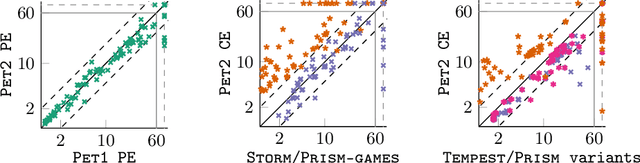
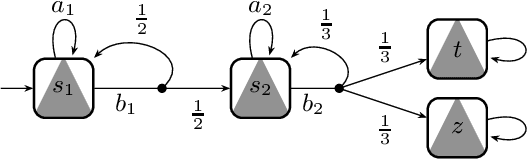
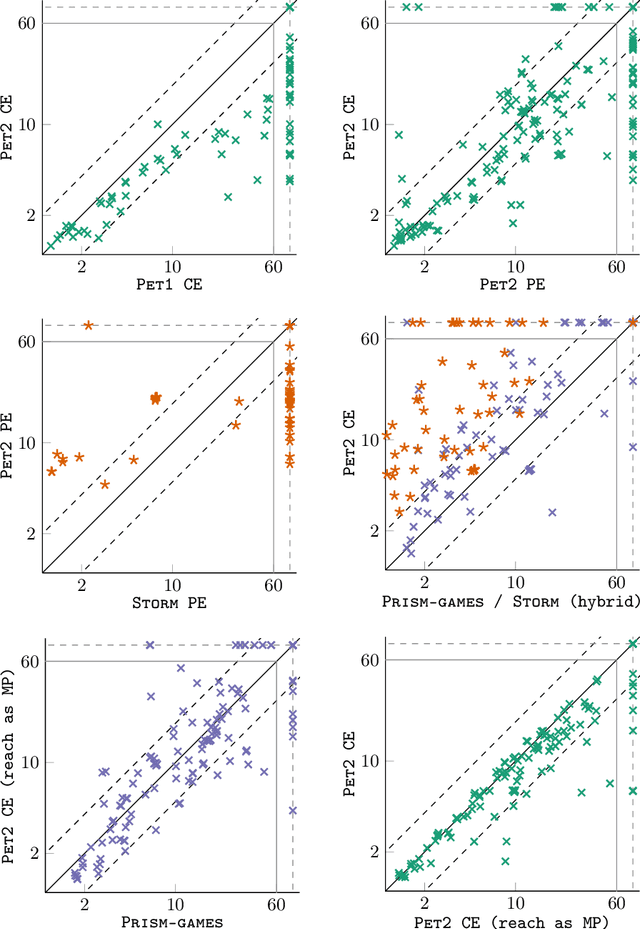
We present version 2.0 of the Partial Exploration Tool (PET), a tool for verification of probabilistic systems. We extend the previous version by adding support for stochastic games, based on a recent unified framework for sound value iteration algorithms. Thereby, PET2 is the first tool implementing a sound and efficient approach for solving stochastic games with objectives of the type reachability/safety and mean payoff. We complement this approach by developing and implementing a partial-exploration based variant for all three objectives. Our experimental evaluation shows that PET2 offers the most efficient partial-exploration based algorithm and is the most viable tool on SGs, even outperforming unsound tools.
What Are the Odds? Improving the foundations of Statistical Model Checking
Apr 08, 2024


Markov decision processes (MDPs) are a fundamental model for decision making under uncertainty. They exhibit non-deterministic choice as well as probabilistic uncertainty. Traditionally, verification algorithms assume exact knowledge of the probabilities that govern the behaviour of an MDP. As this assumption is often unrealistic in practice, statistical model checking (SMC) was developed in the past two decades. It allows to analyse MDPs with unknown transition probabilities and provide probably approximately correct (PAC) guarantees on the result. Model-based SMC algorithms sample the MDP and build a model of it by estimating all transition probabilities, essentially for every transition answering the question: ``What are the odds?'' However, so far the statistical methods employed by the state of the art SMC algorithms are quite naive. Our contribution are several fundamental improvements to those methods: On the one hand, we survey statistics literature for better concentration inequalities; on the other hand, we propose specialised approaches that exploit our knowledge of the MDP. Our improvements are generally applicable to many kinds of problem statements because they are largely independent of the setting. Moreover, our experimental evaluation shows that they lead to significant gains, reducing the number of samples that the SMC algorithm has to collect by up to two orders of magnitude.
Stopping Criteria for Value Iteration on Stochastic Games with Quantitative Objectives
Apr 19, 2023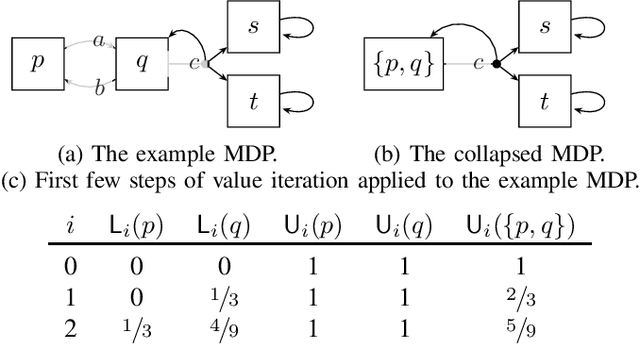

A classic solution technique for Markov decision processes (MDP) and stochastic games (SG) is value iteration (VI). Due to its good practical performance, this approximative approach is typically preferred over exact techniques, even though no practical bounds on the imprecision of the result could be given until recently. As a consequence, even the most used model checkers could return arbitrarily wrong results. Over the past decade, different works derived stopping criteria, indicating when the precision reaches the desired level, for various settings, in particular MDP with reachability, total reward, and mean payoff, and SG with reachability. In this paper, we provide the first stopping criteria for VI on SG with total reward and mean payoff, yielding the first anytime algorithms in these settings. To this end, we provide the solution in two flavours: First through a reduction to the MDP case and second directly on SG. The former is simpler and automatically utilizes any advances on MDP. The latter allows for more local computations, heading towards better practical efficiency. Our solution unifies the previously mentioned approaches for MDP and SG and their underlying ideas. To achieve this, we isolate objective-specific subroutines as well as identify objective-independent concepts. These structural concepts, while surprisingly simple, form the very essence of the unified solution.