 Add to Chrome
 Add to Firefox
 Add to Edge
Response Magnitude as a Dominant Signal for Held-Out CRISPRi Perturbation Effect Prediction
Jul 31, 2026
Predicting the magnitude of a CRISPRi perturbation's transcriptomic effect on held-out target genes is an important open problem in single-cell biology. Recent work has documented that simple baselines often match or exceed deep perturbation predictors on related protocols. We study this phenomenon on the Virtual Cell Challenge (VCC) benchmark under a strict held-out target-gene split, identify the specific low-dimensional signal that drives the gap, and characterize how it transfers across cell types. The target is the log Anderson-Darling distance from non-targeting controls, which is strongly predictable from four deterministic scalar functions of the 2,000-dimensional input. A deep MLP encoder with direct access to the full input collapses toward the marginal training mean, and standard remedies do not close the gap. A linear regression on the four magnitude scalars alone exceeds the strongest x-only classical model, while a Random Forest on the input plus the four scalars substantially outperforms our deep proof-of-concept encoder. Two pre-specified controls attribute the magnitude gain to per-row alignment rather than added dimensionality. Under zero-shot transfer to two external CRISPRi screens evaluated against a target-gene endpoint rebuilt from single-cell data, magnitude-only predictors transfer positively whereas expression-only predictors are negative or unresolved. Exposing magnitude to the deep encoder improves transfer over its expression-only counterpart, yet the encoder does not outperform a four-scalar linear regression on the same features. We also find that the Anderson-Darling column distributed with these screens measures transcriptome-wide response breadth rather than target-gene effect strength, so evaluating transfer against it scores a different outcome.

BRIDGE: Bottleneck-Aware Regulator-Set Inference and Diagnosis for Cooperative Gene Regulatory Recovery
Jul 21, 2026Cooperative gene regulation often depends on groups of regulators acting jointly, but most gene regulatory network (GRN) inference methods output pairwise regulator-target rankings. We introduce Bottleneck-Aware Regulator-Set Inference and Diagnosis (BRIDGE), a framework for complete regulator-set recovery, and Targeted Recovery Attribution for Cooperative Evaluation (TRACE), a diagnostic suite that attributes failures to retrieval, set-level scoring, decoding, and evaluation bottlenecks. TRACE includes a leak-free mechanism-mismatch cooperativity stress test in which cooperative targets are generated by random nonlinear mechanisms rather than product interactions. This design avoids feature-mechanism circularity: Residual higher-order set scoring (Residual HOS2) operates on raw expression vectors without handcrafted product-correlation features. Across 30 matched seed-cooperativity settings, Residual HOS2 improves Jaccard similarity from 0.382 to 0.460, recall from 0.522 to 0.597, and exact recovery from 0.053 to 0.113 over a decomposable pairwise set scorer (PairS2), although exact recovery remains low. On SERGIO DS3, oracle retrieval and TRACE show that candidate coverage is necessary but insufficient because set-level misranking remains the dominant source of exact-recovery failure. PairS2 proposal followed by Residual HOS2 reranking reduces HOS2-scored candidate sets by 94-97% while largely preserving exact-recovery behavior. These results distinguish edge ranking, candidate retrieval, set-level scoring, and exact cooperative regulator-set recovery as separate objectives.
Adaptive Multi-Expert Graph Transformer for Interpretable EEG-Based Diagnostics
Jul 20, 2026Electroencephalographic (EEG) abnormalities arise from dynamic changes in neural synchrony across spatial and temporal scales, yet many computational approaches reduce these dynamics to static features. We present a Spatial Multi-Expert Graph Transformer that models each EEG recording as a sequence of dynamic functional connectivity graphs. Time-resolved connectivity is estimated using the weighted Phase Lag Index (wPLI), and hierarchical graph encoding aggregates information from electrode to regional and global levels. A multi-expert transformer architecture enables subtype-aware reasoning, with a gating mechanism adaptively fusing expert outputs for global abnormality prediction. Experiments on the TUAB dataset show competitive abnormal EEG detection performance and demonstrate the potential of dynamic graph modeling with adaptive expert fusion for interpretable, subtype-aware spatial--temporal analysis.
Learning Stable Predictors from Weak Supervision under Distribution Shift
Apr 05, 2026Learning from weak or proxy supervision is common when ground-truth labels are unavailable, yet robustness under distribution shift remains poorly understood, especially when the supervision mechanism itself changes. We formalize this as supervision drift, defined as changes in P(y | x, c) across contexts, and study it in CRISPR-Cas13d experiments where guide efficacy is inferred indirectly from RNA-seq responses. Using data from two human cell lines and multiple time points, we build a controlled non-IID benchmark with explicit domain and temporal shifts while keeping the weak-label construction fixed. Models achieve strong in-domain performance (ridge R^2 = 0.356, Spearman rho = 0.442) and partial cross-cell-line transfer (rho ~ 0.40). However, temporal transfer fails across all models, with negative R^2 and near-zero correlation (e.g., XGBoost R^2 = -0.155, rho = 0.056). Additional analyses confirm this pattern. Feature-label relationships remain stable across cell lines but change sharply over time, indicating that failures arise from supervision drift rather than model limitations. These findings highlight feature stability as a simple diagnostic for detecting non-transferability before deployment.
Hybrid Diffusion Model for Breast Ultrasound Image Augmentation
Mar 27, 2026We propose a hybrid diffusion-based augmentation framework to overcome the critical challenge of ultrasound data augmentation in breast ultrasound (BUS) datasets. Unlike conventional diffusion-based augmentations, our approach improves visual fidelity and preserves ultrasound texture by combining text-to-image generation with image-to-image (img2img) refinement, as well as fine-tuning with low-rank adaptation (LoRA) and textual inversion (TI). Our method generated realistic, class-consistent images on an open-source Kaggle breast ultrasound image dataset (BUSI). Compared to the Stable Diffusion v1.5 baseline, incorporating TI and img2img refinement reduced the Frechet Inception Distance (FID) from 45.97 to 33.29, demonstrating a substantial gain in fidelity while maintaining comparable downstream classification performance. Overall, the proposed framework effectively mitigates the low-fidelity limitations of synthetic ultrasound images and enhances the quality of augmentation for robust diagnostic modeling.
Validating Interpretability in siRNA Efficacy Prediction: A Perturbation-Based, Dataset-Aware Protocol
Feb 09, 2026Saliency maps are increasingly used as \emph{design guidance} in siRNA efficacy prediction, yet attribution methods are rarely validated before motivating sequence edits. We introduce a \textbf{pre-synthesis gate}: a protocol for \emph{counterfactual sensitivity faithfulness} that tests whether mutating high-saliency positions changes model output more than composition-matched controls. Cross-dataset transfer reveals two failure modes that would otherwise go undetected: \emph{faithful-but-wrong} (saliency valid, predictions fail) and \emph{inverted saliency} (top-saliency edits less impactful than random). Strikingly, models trained on mRNA-level assays collapse on a luciferase reporter dataset, demonstrating that protocol shifts can silently invalidate deployment. Across four benchmarks, 19/20 fold instances pass; the single failure shows inverted saliency. A biology-informed regularizer (BioPrior) strengthens saliency faithfulness with modest, dataset-dependent predictive trade-offs. Our results establish saliency validation as essential pre-deployment practice for explanation-guided therapeutic design. Code is available at https://github.com/shadi97kh/BioPrior.
UAT-LITE: Inference-Time Uncertainty-Aware Attention for Pretrained Transformers
Feb 03, 2026Neural NLP models are often miscalibrated, assigning high confidence to incorrect predictions, which undermines selective prediction and high-stakes deployment. Post-hoc calibration methods adjust output probabilities but leave internal computation unchanged, while ensemble and Bayesian approaches improve uncertainty at substantial training or storage cost. We propose UAT-LITE, an inference-time framework that makes self-attention uncertainty-aware using approximate Bayesian inference via Monte Carlo dropout in pretrained transformer classifiers. Token-level epistemic uncertainty is estimated from stochastic forward passes and used to modulate self-attention during contextualization, without modifying pretrained weights or training objectives. We additionally introduce a layerwise variance decomposition to diagnose how predictive uncertainty accumulates across transformer depth. Across the SQuAD 2.0 answerability, MNLI, and SST-2, UAT-LITE reduces Expected Calibration Error by approximately 20% on average relative to a fine-tuned BERT-base baseline while preserving task accuracy, and improves selective prediction and robustness under distribution shift.
Explainable Detection of Implicit Influential Patterns in Conversations via Data Augmentation
Jun 17, 2025In the era of digitalization, as individuals increasingly rely on digital platforms for communication and news consumption, various actors employ linguistic strategies to influence public perception. While models have become proficient at detecting explicit patterns, which typically appear in texts as single remarks referred to as utterances, such as social media posts, malicious actors have shifted toward utilizing implicit influential verbal patterns embedded within conversations. These verbal patterns aim to mentally penetrate the victim's mind in order to influence them, enabling the actor to obtain the desired information through implicit means. This paper presents an improved approach for detecting such implicit influential patterns. Furthermore, the proposed model is capable of identifying the specific locations of these influential elements within a conversation. To achieve this, the existing dataset was augmented using the reasoning capabilities of state-of-the-art language models. Our designed framework resulted in a 6% improvement in the detection of implicit influential patterns in conversations. Moreover, this approach improved the multi-label classification tasks related to both the techniques used for influence and the vulnerability of victims by 33% and 43%, respectively.
Predicting Through Generation: Why Generation Is Better for Prediction
Feb 25, 2025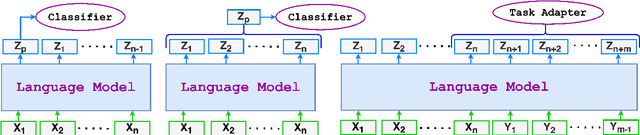
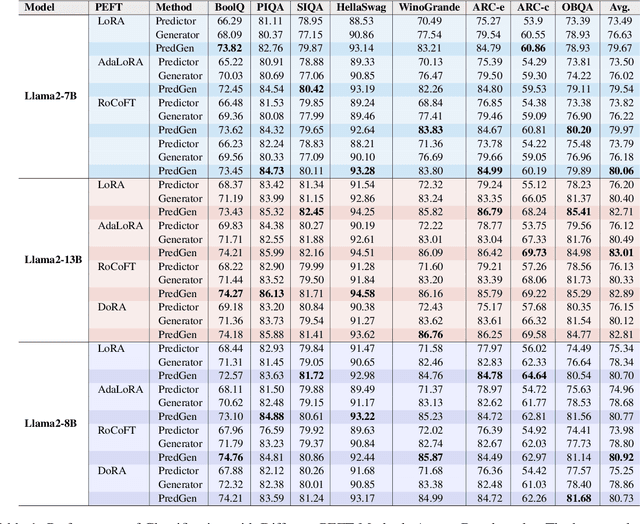
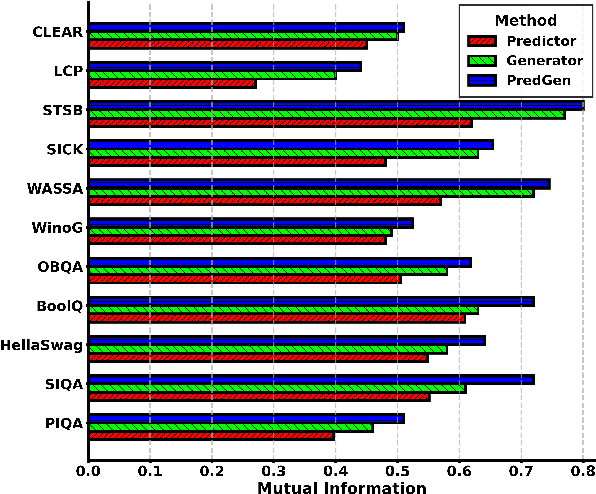
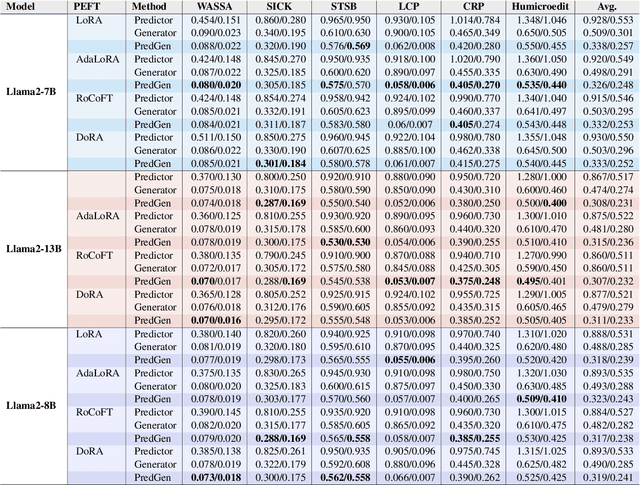
This paper argues that generating output tokens is more effective than using pooled representations for prediction tasks because token-level generation retains more mutual information. Since LLMs are trained on massive text corpora using next-token prediction, generation aligns naturally with their learned behavior. Using the Data Processing Inequality (DPI), we provide both theoretical and empirical evidence supporting this claim. However, autoregressive models face two key challenges when used for prediction: (1) exposure bias, where the model sees ground truth tokens during training but relies on its own predictions during inference, leading to errors, and (2) format mismatch, where discrete tokens do not always align with the tasks required output structure. To address these challenges, we introduce PredGen(Predicting Through Generating), an end to end framework that (i) uses scheduled sampling to reduce exposure bias, and (ii) introduces a task adapter to convert the generated tokens into structured outputs. Additionally, we introduce Writer-Director Alignment Loss (WDAL), which ensures consistency between token generation and final task predictions, improving both text coherence and numerical accuracy. We evaluate PredGen on multiple classification and regression benchmarks. Our results show that PredGen consistently outperforms standard baselines, demonstrating its effectiveness in structured prediction tasks.
BnTTS: Few-Shot Speaker Adaptation in Low-Resource Setting
Feb 09, 2025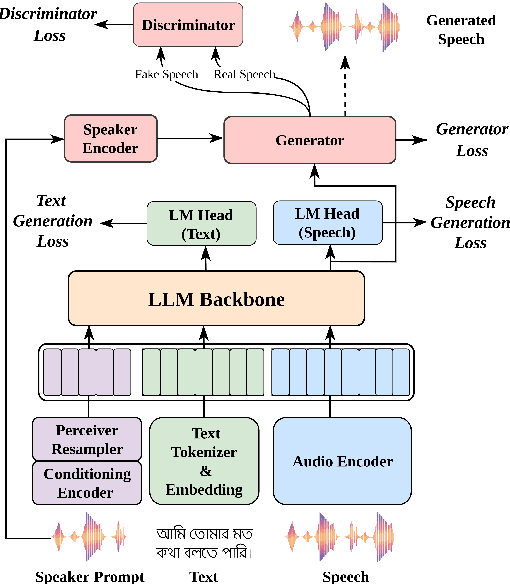
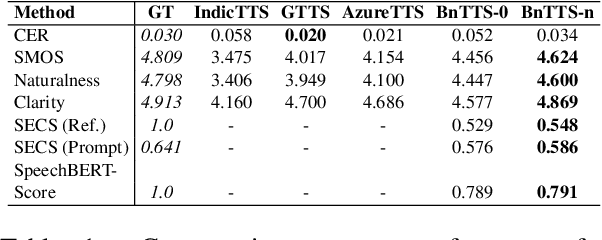
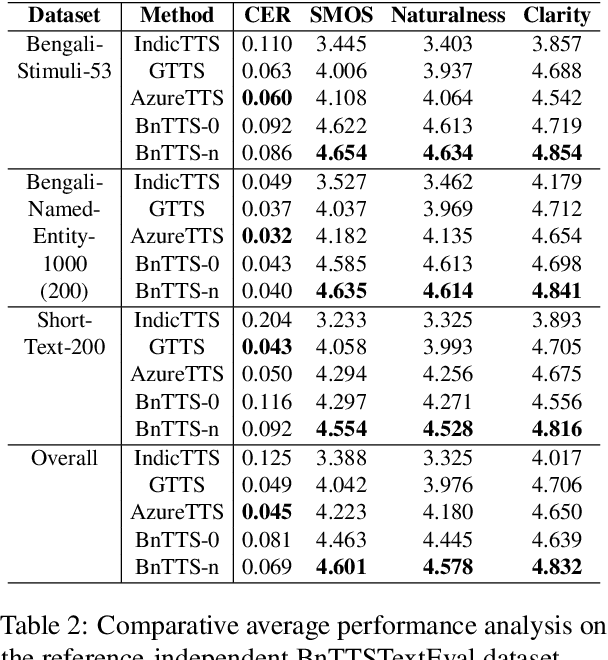
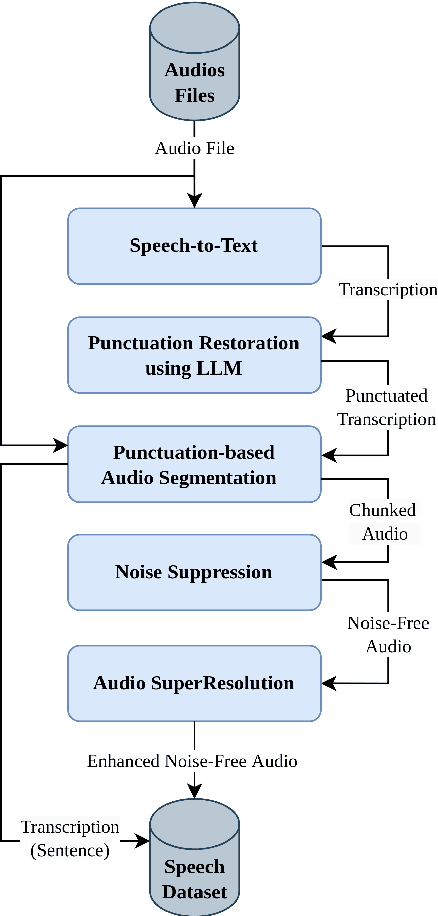
This paper introduces BnTTS (Bangla Text-To-Speech), the first framework for Bangla speaker adaptation-based TTS, designed to bridge the gap in Bangla speech synthesis using minimal training data. Building upon the XTTS architecture, our approach integrates Bangla into a multilingual TTS pipeline, with modifications to account for the phonetic and linguistic characteristics of the language. We pre-train BnTTS on 3.85k hours of Bangla speech dataset with corresponding text labels and evaluate performance in both zero-shot and few-shot settings on our proposed test dataset. Empirical evaluations in few-shot settings show that BnTTS significantly improves the naturalness, intelligibility, and speaker fidelity of synthesized Bangla speech. Compared to state-of-the-art Bangla TTS systems, BnTTS exhibits superior performance in Subjective Mean Opinion Score (SMOS), Naturalness, and Clarity metrics.