 Add to Chrome
 Add to Firefox
 Add to Edge
BRIDGE: Bottleneck-Aware Regulator-Set Inference and Diagnosis for Cooperative Gene Regulatory Recovery
Jul 21, 2026
Cooperative gene regulation often depends on groups of regulators acting jointly, but most gene regulatory network (GRN) inference methods output pairwise regulator-target rankings. We introduce Bottleneck-Aware Regulator-Set Inference and Diagnosis (BRIDGE), a framework for complete regulator-set recovery, and Targeted Recovery Attribution for Cooperative Evaluation (TRACE), a diagnostic suite that attributes failures to retrieval, set-level scoring, decoding, and evaluation bottlenecks. TRACE includes a leak-free mechanism-mismatch cooperativity stress test in which cooperative targets are generated by random nonlinear mechanisms rather than product interactions. This design avoids feature-mechanism circularity: Residual higher-order set scoring (Residual HOS2) operates on raw expression vectors without handcrafted product-correlation features. Across 30 matched seed-cooperativity settings, Residual HOS2 improves Jaccard similarity from 0.382 to 0.460, recall from 0.522 to 0.597, and exact recovery from 0.053 to 0.113 over a decomposable pairwise set scorer (PairS2), although exact recovery remains low. On SERGIO DS3, oracle retrieval and TRACE show that candidate coverage is necessary but insufficient because set-level misranking remains the dominant source of exact-recovery failure. PairS2 proposal followed by Residual HOS2 reranking reduces HOS2-scored candidate sets by 94-97% while largely preserving exact-recovery behavior. These results distinguish edge ranking, candidate retrieval, set-level scoring, and exact cooperative regulator-set recovery as separate objectives.

MotifRole-Diff: Risk-Optimal Role-Aware Corruption for Masked Molecular Graph Diffusion
Jul 20, 2026Masked discrete diffusion for molecular graph generation typically applies a uniform corruption schedule to all tokens in a lossless graph-to-sequence representation, implicitly treating structurally heterogeneous molecular components as equally difficult and equally important to reconstruct. However, different molecular graph token roles exhibit substantial variation in denoising difficulty and their influence on the decoded molecule, motivating role-specific corruption strategies. We introduce MotifRole-Diff, a role-aware corruption process that allocates masking rates according to empirically measured denoising difficulty and graph-level perturbation impact while preserving the model architecture, clean sequence space, and lossless molecular-graph decoder. We formulate schedule selection as the risk-optimal allocation of a fixed masking budget across token roles. Our theorem characterizes optimality for the modeled role-weighted residual risk, while downstream generation performance is evaluated empirically. Under matched architecture, training budget, and sampling compute, MotifRole-Diff improves validity on QM9 from 0.905 to 0.944 while reducing FCD from 1.701 to 1.609, and on MOSES improves validity from 0.920 to 0.938 while reducing FCD from 2.125 to 1.850. Role-wise diagnostics further show improved reconstruction across molecular graph token categories. Together, these matched-compute results indicate that structurally informed corruption is a more effective masking strategy than uniform schedules for serialized molecular graph diffusion.
Adaptive Multi-Expert Graph Transformer for Interpretable EEG-Based Diagnostics
Jul 20, 2026Electroencephalographic (EEG) abnormalities arise from dynamic changes in neural synchrony across spatial and temporal scales, yet many computational approaches reduce these dynamics to static features. We present a Spatial Multi-Expert Graph Transformer that models each EEG recording as a sequence of dynamic functional connectivity graphs. Time-resolved connectivity is estimated using the weighted Phase Lag Index (wPLI), and hierarchical graph encoding aggregates information from electrode to regional and global levels. A multi-expert transformer architecture enables subtype-aware reasoning, with a gating mechanism adaptively fusing expert outputs for global abnormality prediction. Experiments on the TUAB dataset show competitive abnormal EEG detection performance and demonstrate the potential of dynamic graph modeling with adaptive expert fusion for interpretable, subtype-aware spatial--temporal analysis.
Smarter Saboteurs, Better Fixers: Scaling & Security in Linear Multi-Agent Workflows
Jun 10, 2026As LLM-based multi-agent systems (MAS) are deployed in the wild, the resilience of their collaboration structures against adversarial compromise becomes a critical safety concern. Attackers may leverage prompt-injection or jailbreaking to sabotage individual agents within MAS workflows, but the interaction between model scaling and system-level resilience remains poorly understood. This paper investigates how model scale affects the security of linear multi-agent workflows. Our experiments across scales of two open-weight model families on the HumanEval benchmark reveal a compliance-correction symmetry: larger models are far more likely to faithfully execute malicious instructions, with the control-to-malicious performance drop reaching 53.7pp at 27B in uncorrected pipelines. However, appending a lightweight terminal Fixer stage collapses this to 0.6pp and restores statistical parity with control-level performance, demonstrating that strictly linear collaboration structures can be viable and resilient to adversaries at this scale, and suggesting that the brittleness previously attributed to linear topology may stem from a lack of correction.
ConRetroBert: EMA Stabilized Dual Encoders for Template-Based Single-Step Retrosynthesis
May 12, 2026Template based single step retrosynthesis predicts reactants by selecting and applying an explicit reaction template, making each prediction traceable to a chemical transformation rule. This is useful for synthesis planning, but template based methods are often viewed as less competitive than template free models because template prediction is commonly formulated as global classification over a long tailed rule library. We argue that this weakness is not inherent to templates, but to the learning formulation. We present ConRetroBert, a dual encoder framework that reframes template based retrosynthesis as dense product template retrieval followed by candidate set listwise ranking. Stage 1 uses contrastive pretraining to learn a shared embedding space between products and reaction templates. Stage 2 refines template ranking over mined hard negative candidate sets with a multi positive listwise objective. To enable template side adaptation without destabilizing hard negative mining, ConRetroBert uses a slow moving exponential moving average template encoder for retrieval bank construction while updating the live template encoder through the ranking loss. On the local USPTO-50k benchmark, Stage 2 candidate set ranking improves top-1 reaction accuracy from 50.5% to 61.3%, while EMA stabilized template adaptation further improves it to 62.4%. Fine tuning from a leakage controlled USPTO-Full checkpoint reaches 75.4% top-1 accuracy on USPTO-50k. We also show that retrieval based template prediction is strong in the long tail of rare templates, and that many correct reactant predictions arise from alternative explicit templates rather than only the recorded positive label. Code and data are available at https://github.com/JahidBasher/ConRetroBert.
Learning Stable Predictors from Weak Supervision under Distribution Shift
Apr 05, 2026Learning from weak or proxy supervision is common when ground-truth labels are unavailable, yet robustness under distribution shift remains poorly understood, especially when the supervision mechanism itself changes. We formalize this as supervision drift, defined as changes in P(y | x, c) across contexts, and study it in CRISPR-Cas13d experiments where guide efficacy is inferred indirectly from RNA-seq responses. Using data from two human cell lines and multiple time points, we build a controlled non-IID benchmark with explicit domain and temporal shifts while keeping the weak-label construction fixed. Models achieve strong in-domain performance (ridge R^2 = 0.356, Spearman rho = 0.442) and partial cross-cell-line transfer (rho ~ 0.40). However, temporal transfer fails across all models, with negative R^2 and near-zero correlation (e.g., XGBoost R^2 = -0.155, rho = 0.056). Additional analyses confirm this pattern. Feature-label relationships remain stable across cell lines but change sharply over time, indicating that failures arise from supervision drift rather than model limitations. These findings highlight feature stability as a simple diagnostic for detecting non-transferability before deployment.
UAT-LITE: Inference-Time Uncertainty-Aware Attention for Pretrained Transformers
Feb 03, 2026Neural NLP models are often miscalibrated, assigning high confidence to incorrect predictions, which undermines selective prediction and high-stakes deployment. Post-hoc calibration methods adjust output probabilities but leave internal computation unchanged, while ensemble and Bayesian approaches improve uncertainty at substantial training or storage cost. We propose UAT-LITE, an inference-time framework that makes self-attention uncertainty-aware using approximate Bayesian inference via Monte Carlo dropout in pretrained transformer classifiers. Token-level epistemic uncertainty is estimated from stochastic forward passes and used to modulate self-attention during contextualization, without modifying pretrained weights or training objectives. We additionally introduce a layerwise variance decomposition to diagnose how predictive uncertainty accumulates across transformer depth. Across the SQuAD 2.0 answerability, MNLI, and SST-2, UAT-LITE reduces Expected Calibration Error by approximately 20% on average relative to a fine-tuned BERT-base baseline while preserving task accuracy, and improves selective prediction and robustness under distribution shift.
Explainable Detection of Implicit Influential Patterns in Conversations via Data Augmentation
Jun 17, 2025In the era of digitalization, as individuals increasingly rely on digital platforms for communication and news consumption, various actors employ linguistic strategies to influence public perception. While models have become proficient at detecting explicit patterns, which typically appear in texts as single remarks referred to as utterances, such as social media posts, malicious actors have shifted toward utilizing implicit influential verbal patterns embedded within conversations. These verbal patterns aim to mentally penetrate the victim's mind in order to influence them, enabling the actor to obtain the desired information through implicit means. This paper presents an improved approach for detecting such implicit influential patterns. Furthermore, the proposed model is capable of identifying the specific locations of these influential elements within a conversation. To achieve this, the existing dataset was augmented using the reasoning capabilities of state-of-the-art language models. Our designed framework resulted in a 6% improvement in the detection of implicit influential patterns in conversations. Moreover, this approach improved the multi-label classification tasks related to both the techniques used for influence and the vulnerability of victims by 33% and 43%, respectively.
Predicting Through Generation: Why Generation Is Better for Prediction
Feb 25, 2025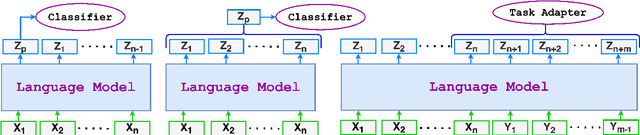
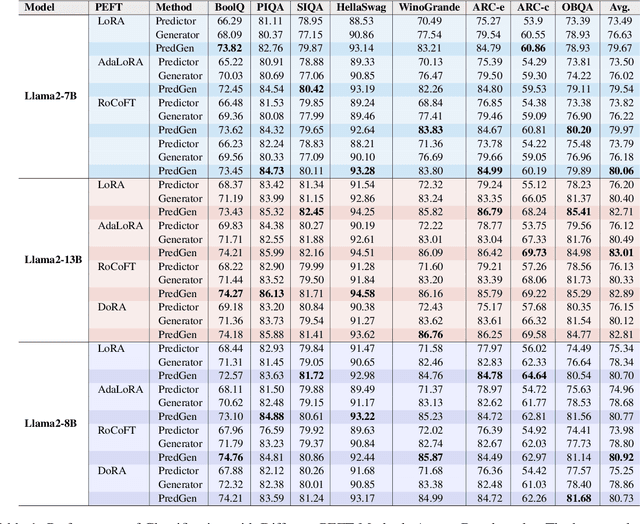
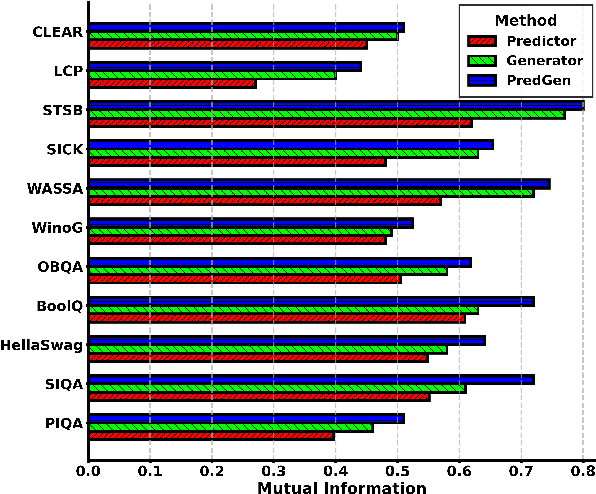
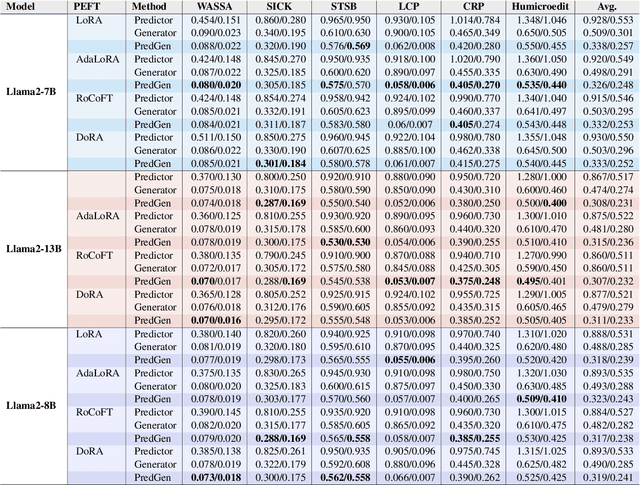
This paper argues that generating output tokens is more effective than using pooled representations for prediction tasks because token-level generation retains more mutual information. Since LLMs are trained on massive text corpora using next-token prediction, generation aligns naturally with their learned behavior. Using the Data Processing Inequality (DPI), we provide both theoretical and empirical evidence supporting this claim. However, autoregressive models face two key challenges when used for prediction: (1) exposure bias, where the model sees ground truth tokens during training but relies on its own predictions during inference, leading to errors, and (2) format mismatch, where discrete tokens do not always align with the tasks required output structure. To address these challenges, we introduce PredGen(Predicting Through Generating), an end to end framework that (i) uses scheduled sampling to reduce exposure bias, and (ii) introduces a task adapter to convert the generated tokens into structured outputs. Additionally, we introduce Writer-Director Alignment Loss (WDAL), which ensures consistency between token generation and final task predictions, improving both text coherence and numerical accuracy. We evaluate PredGen on multiple classification and regression benchmarks. Our results show that PredGen consistently outperforms standard baselines, demonstrating its effectiveness in structured prediction tasks.
Fair Bilevel Neural Network (FairBiNN): On Balancing fairness and accuracy via Stackelberg Equilibrium
Oct 21, 2024
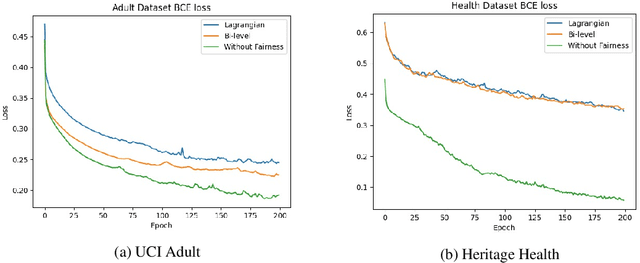
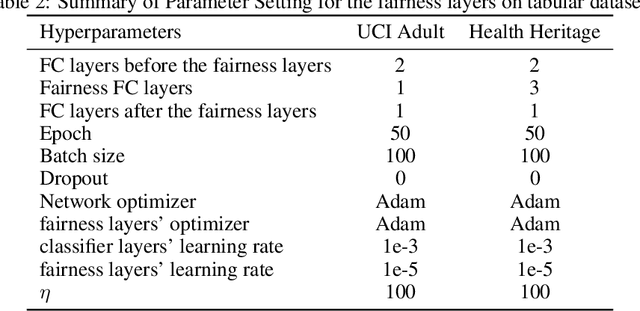

The persistent challenge of bias in machine learning models necessitates robust solutions to ensure parity and equal treatment across diverse groups, particularly in classification tasks. Current methods for mitigating bias often result in information loss and an inadequate balance between accuracy and fairness. To address this, we propose a novel methodology grounded in bilevel optimization principles. Our deep learning-based approach concurrently optimizes for both accuracy and fairness objectives, and under certain assumptions, achieving proven Pareto optimal solutions while mitigating bias in the trained model. Theoretical analysis indicates that the upper bound on the loss incurred by this method is less than or equal to the loss of the Lagrangian approach, which involves adding a regularization term to the loss function. We demonstrate the efficacy of our model primarily on tabular datasets such as UCI Adult and Heritage Health. When benchmarked against state-of-the-art fairness methods, our model exhibits superior performance, advancing fairness-aware machine learning solutions and bridging the accuracy-fairness gap. The implementation of FairBiNN is available on https://github.com/yazdanimehdi/FairBiNN.