 Add to Chrome
 Add to Firefox
 Add to Edge
Nemotron 3 Ultra: Open, Efficient Mixture-of-Experts Hybrid Mamba-Transformer Model for Agentic Reasoning
Jun 12, 2026
We introduce Nemotron 3 Ultra, a 550 billion total and 55 billion active parameter Mixture-of-Experts Hybrid Mamba-Attention language model. We pre-trained Nemotron 3 Ultra on 20 trillion text tokens, then extended the context length to 1M tokens, and post-trained using Supervised Fine Tuning (SFT), Reinforcement Learning (RL), and Multi-teacher On-Policy Distillation (MOPD). Nemotron 3 Ultra is our most capable model yet, employing multiple key technologies - LatentMoE, Multi Token Prediction (MTP), NVFP4 pre-training, multi-environment RLVR, MOPD, and reasoning budget control. Nemotron 3 Ultra achieves up to ~6x higher inference throughput as compared to state-of-the-art publicly available LLMs while attaining on-par accuracy. The state-of-the-art accuracy, high inference throughput, and 1M token context length make Nemotron 3 Ultra ideal for long-running autonomous agentic tasks. We open-source the base, post-trained, and quantized checkpoints, along with the training data and recipe on HuggingFace.

Trace2Skill: Verifier-Guided Skill Evolution for Long-Context EDA Agents
May 20, 2026Complex Verilog Design Problems (CVDP) challenge hardware LLM agents because solving them requires localizing verifier-relevant RTL, testbenches, include paths, and build dependencies inside large repository snapshots, making precise edits, and recovering from sparse hidden-verifier failures. We present Trace2Skill, a test-time scaling framework that improves a hardware agent without RTL-specialized model fine-tuning. Rather than training a new model or only sampling more candidate solutions, Trace2Skill treats the agent's natural-language skill as an evolvable policy. It mines repeated rollout traces for success and failure modes, converts them into dense diagnostics and oracle lessons, and uses an oracle, mutator, and selector loop to produce task-specific skills that guide later search, editing, validation, and recovery. Because final pass/fail labels are often too coarse for hard failures, Trace2Skill also supports bounded runtime dense verifier feedback that returns sanitized functional observations while keeping hidden harnesses and reference solutions inaccessible to the agent. This feedback helps guide skill evolution and agent execution by connecting skill text, verifier evidence, and downstream behavior. Across hard CVDP tasks that defeat the seed CVDP agent, including tasks that also defeat frontier coding agents, Trace2Skill with dense verifier feedback substantially improves task pass rates and produces breakthrough passes on previously unsolved tasks, without requiring high-quality fine-tuning data, specialized RTL model training, or model weight updates. The same framework provides a general test-time scaling strategy that can extend beyond digital design to other verifiable EDA tasks.
Nemotron 3 Super: Open, Efficient Mixture-of-Experts Hybrid Mamba-Transformer Model for Agentic Reasoning
Apr 14, 2026We describe the pre-training, post-training, and quantization of Nemotron 3 Super, a 120 billion (active 12 billion) parameter hybrid Mamba-Attention Mixture-of-Experts model. Nemotron 3 Super is the first model in the Nemotron 3 family to 1) be pre-trained in NVFP4, 2) leverage LatentMoE, a new Mixture-of-Experts architecture that optimizes for both accuracy per FLOP and accuracy per parameter, and 3) include MTP layers for inference acceleration through native speculative decoding. We pre-trained Nemotron 3 Super on 25 trillion tokens followed by post-training using supervised fine tuning (SFT) and reinforcement learning (RL). The final model supports up to 1M context length and achieves comparable accuracy on common benchmarks, while also achieving up to 2.2x and 7.5x higher inference throughput compared to GPT-OSS-120B and Qwen3.5-122B, respectively. Nemotron 3 Super datasets, along with the base, post-trained, and quantized checkpoints, are open-sourced on HuggingFace.
ACE-RTL: When Agentic Context Evolution Meets RTL-Specialized LLMs
Feb 10, 2026Recent advances in large language models (LLMs) have sparked growing interest in applying them to hardware design automation, particularly for accurate RTL code generation. Prior efforts follow two largely independent paths: (i) training domain-adapted RTL models to internalize hardware semantics, (ii) developing agentic systems that leverage frontier generic LLMs guided by simulation feedback. However, these two paths exhibit complementary strengths and weaknesses. In this work, we present ACE-RTL that unifies both directions through Agentic Context Evolution (ACE). ACE-RTL integrates an RTL-specialized LLM, trained on a large-scale dataset of 1.7 million RTL samples, with a frontier reasoning LLM through three synergistic components: the generator, reflector, and coordinator. These components iteratively refine RTL code toward functional correctness. We further introduce a parallel scaling strategy that significantly reduces the number of iterations required to reach correct solutions. On the Comprehensive Verilog Design Problems (CVDP) benchmark, ACE-RTL achieves up to a 44.87% pass rate improvement over 14 competitive baselines while requiring only four iterations on average.
GRPO with State Mutations: Improving LLM-Based Hardware Test Plan Generation
Jan 12, 2026RTL design often relies heavily on ad-hoc testbench creation early in the design cycle. While large language models (LLMs) show promise for RTL code generation, their ability to reason about hardware specifications and generate targeted test plans remains largely unexplored. We present the first systematic study of LLM reasoning capabilities for RTL verification stimuli generation, establishing a two-stage framework that decomposes test plan generation from testbench execution. Our benchmark reveals that state-of-the-art models, including DeepSeek-R1 and Claude-4.0-Sonnet, achieve only 15.7-21.7% success rates on generating stimuli that pass golden RTL designs. To improve LLM generated stimuli, we develop a comprehensive training methodology combining supervised fine-tuning with a novel reinforcement learning approach, GRPO with State Mutation (GRPO-SMu), which enhances exploration by varying input mutations. Our approach leverages a tree-based branching mutation strategy to construct training data comprising equivalent and mutated trees, moving beyond linear mutation approaches to provide rich learning signals. Training on this curated dataset, our 7B parameter model achieves a 33.3% golden test pass rate and a 13.9% mutation detection rate, representing a 17.6% absolute improvement over baseline and outperforming much larger general-purpose models. These results demonstrate that specialized training methodologies can significantly enhance LLM reasoning capabilities for hardware verification tasks, establishing a foundation for automated sub-unit testing in semiconductor design workflows.
Revisiting VerilogEval: Newer LLMs, In-Context Learning, and Specification-to-RTL Tasks
Aug 20, 2024The application of large-language models (LLMs) to digital hardware code generation is an emerging field. Most LLMs are primarily trained on natural language and software code. Hardware code, such as Verilog, represents only a small portion of the training data and few hardware benchmarks exist. To address this gap, the open-source VerilogEval benchmark was released in 2023, providing a consistent evaluation framework for LLMs on code completion tasks. It was tested on state-of-the-art models at the time including GPT-4. However, VerilogEval and other Verilog generation benchmarks lack failure analysis and, in present form, are not conducive to exploring prompting techniques. Also, since VerilogEval's release, both commercial and open-source models have seen continued development. In this work, we evaluate new commercial and open-source models of varying sizes against an improved VerilogEval benchmark suite. We enhance VerilogEval's infrastructure and dataset by automatically classifying failures, introduce new prompts for supporting in-context learning (ICL) examples, and extend the supported tasks to specification-to-RTL translation. We find a measurable improvement in commercial state-of-the-art models, with GPT-4 Turbo achieving a 59% pass rate on spec-to-RTL tasks. We also study the performance of open-source and domain-specific models that have emerged, and demonstrate that models can benefit substantially from ICL. We find that recently-released Llama 3.1 405B achieves a pass rate of 58%, effectively matching that of GPT-4 Turbo, and that the much smaller domain-specific RTL-Coder 6.7B models achieve an impressive 37% pass rate. However, prompt engineering is key to achieving good pass rates, and varies widely with model and task. A benchmark infrastructure that allows for prompt engineering and failure analysis is key to continued model development and deployment.
ChipNeMo: Domain-Adapted LLMs for Chip Design
Nov 13, 2023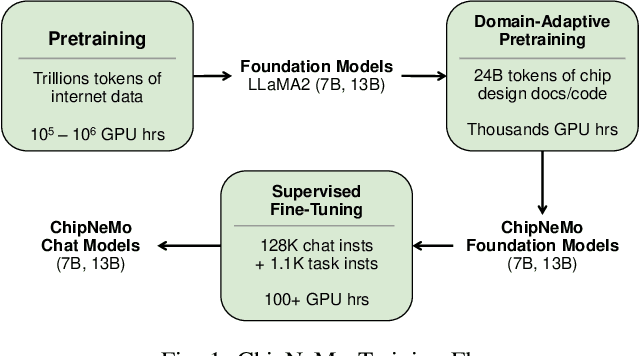


ChipNeMo aims to explore the applications of large language models (LLMs) for industrial chip design. Instead of directly deploying off-the-shelf commercial or open-source LLMs, we instead adopt the following domain adaptation techniques: custom tokenizers, domain-adaptive continued pretraining, supervised fine-tuning (SFT) with domain-specific instructions, and domain-adapted retrieval models. We evaluate these methods on three selected LLM applications for chip design: an engineering assistant chatbot, EDA script generation, and bug summarization and analysis. Our results show that these domain adaptation techniques enable significant LLM performance improvements over general-purpose base models across the three evaluated applications, enabling up to 5x model size reduction with similar or better performance on a range of design tasks. Our findings also indicate that there's still room for improvement between our current results and ideal outcomes. We believe that further investigation of domain-adapted LLM approaches will help close this gap in the future.
VerilogEval: Evaluating Large Language Models for Verilog Code Generation
Sep 14, 2023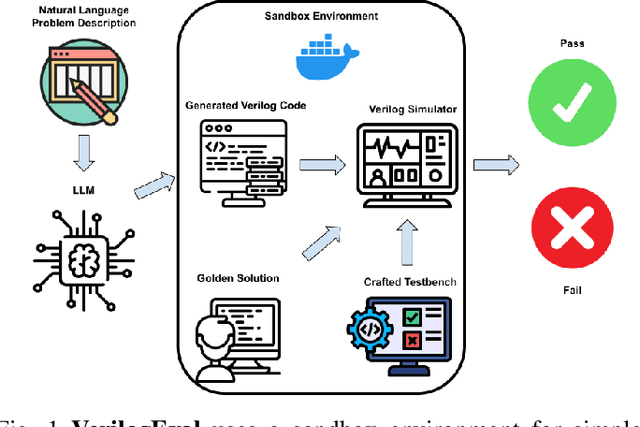
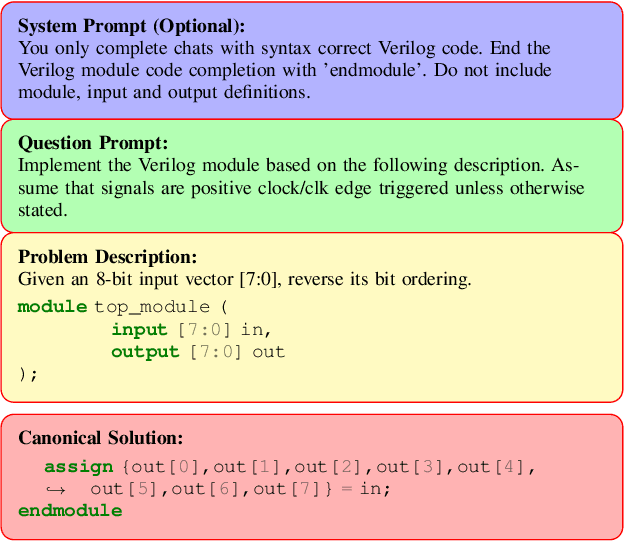
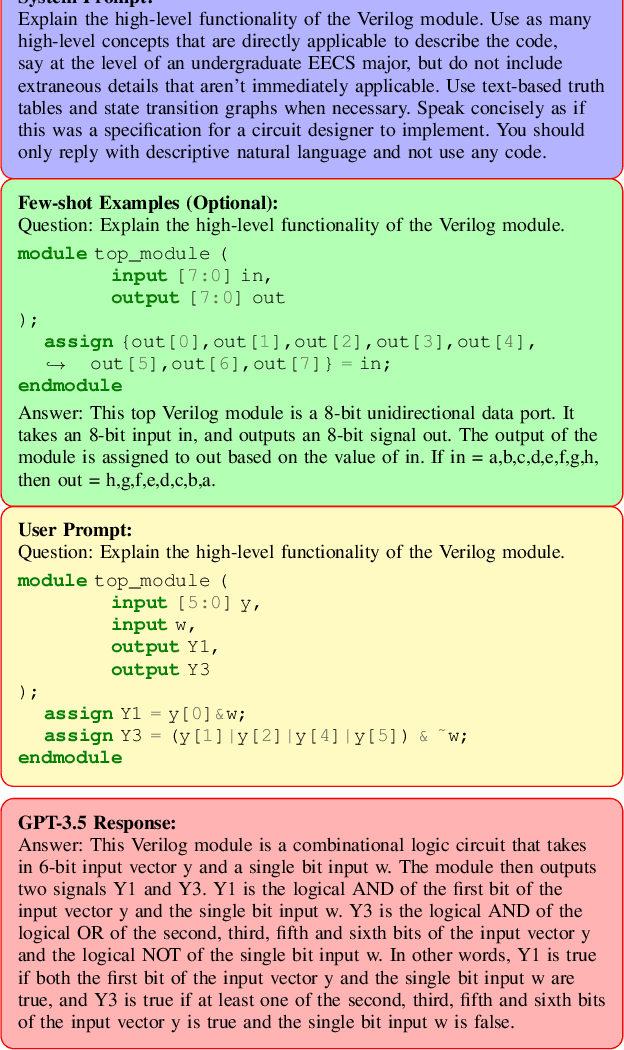
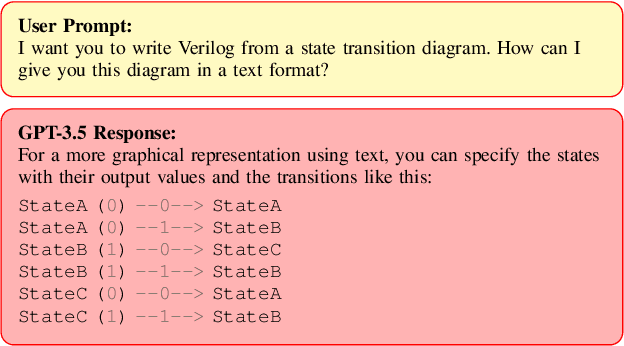
The increasing popularity of large language models (LLMs) has paved the way for their application in diverse domains. This paper proposes a benchmarking framework tailored specifically for evaluating LLM performance in the context of Verilog code generation for hardware design and verification. We present a comprehensive evaluation dataset consisting of 156 problems from the Verilog instructional website HDLBits. The evaluation set consists of a diverse set of Verilog code generation tasks, ranging from simple combinational circuits to complex finite state machines. The Verilog code completions can be automatically tested for functional correctness by comparing the transient simulation outputs of the generated design with a golden solution. We also demonstrate that the Verilog code generation capability of pretrained language models could be improved with supervised fine-tuning by bootstrapping with LLM generated synthetic problem-code pairs.