 Add to Chrome
 Add to Firefox
 Add to Edge
Matryoshka Language Model Suites
Aug 10, 2026
Training a language model suite classically requires training each model separately and serving them independently. We improve both training and inference efficiency by stacking sub-models of increasing size into a single nested architecture trained end-to-end. This Matryoshka training framework reduces the total parameter count of the suite, enables low-cost distillation from the largest to all smaller sub-models at every training step, and is well-suited for speculative decoding as the draft model is contained within the verifier. We validate our approach by training a Matryoshka suite comprising 500M, 1.5B, and 3B sub-models. Our suite is on par with independently trained baselines on benchmark performance and validation and out-of-domain perplexities, while using 36% less training compute and improving the throughput of speculative decoding by 14-26%. We also ablate key architectural choices, offering guidance for building strong Matryoshka LM suites.

Co-LMLM: Continuous-Query Limited Memory Language Models
Jul 08, 2026Limited memory language models (LMLMs) externalize factual knowledge during pretraining to a knowledge base (KB), rather than memorizing it in their weights. During generation, the model then fetches knowledge from the KB as needed. This recently introduced paradigm provides multiple advantages, including knowledge control capabilities that remain beyond conventional LLMs. We propose continuous-query LMLM (CO-LMLM), where the KB pairs continuous keys with textual knowledge values, a significant departure from prior reliance on relational KB and queries. CO-LMLM generates flexible vector queries at minimal cost, while still integrating human-readable and attributable retrieved knowledge into its generation. We pair this design with an annotation pipeline that tags free-form factual spans in arbitrary text, removing prior work's restriction to Wikipedia. Across pretraining on Wikipedia and FineWeb-Edu and at multiple model scales, CO-LMLM outperforms prior LMLMs and vanilla LLMs in both perplexity and factual precision. At 360M scale, this includes lower perplexity than models pretrained on 40x more data, and SimpleQA-verified performance that is in line with gpt-4o-mini and higher than Claude Sonnet 4.5.
The State-Prediction Separation Hypothesis
Jul 01, 2026Transformers use the same forward computation stream to both predict the next token and store useful state for future token predictions. We formulate the \emph{state-prediction separation hypothesis}: disentangling the two roles yields better language modeling performance. We design a Transformer variant that uses two computation streams to separate the two functions, and conduct pretraining experiments across various scales. Our experiments show that state-prediction separation consistently offers better data and compute efficiencies, improving validation loss and outperforming standard Transformers by 2--3 percentage points on average on downstream tasks. We also conduct extensive empirical analysis that rules out potential confounders and demonstrates the fundamental difference in the gradients our design entails.
Lost in Backpropagation: The LM Head is a Gradient Bottleneck
Mar 10, 2026The last layer of neural language models (LMs) projects output features of dimension $D$ to logits in dimension $V$, the size of the vocabulary, where usually $D \ll V$. This mismatch is known to raise risks of limited expressivity in neural LMs, creating a so-called softmax bottleneck. We show the softmax bottleneck is not only an expressivity bottleneck but also an optimization bottleneck. Backpropagating $V$-dimensional gradients through a rank-$D$ linear layer induces unavoidable compression, which alters the training feedback provided to the vast majority of the parameters. We present a theoretical analysis of this phenomenon and measure empirically that 95-99% of the gradient norm is suppressed by the output layer, resulting in vastly suboptimal update directions. We conduct controlled pretraining experiments showing that the gradient bottleneck makes trivial patterns unlearnable, and drastically affects the training dynamics of LLMs. We argue that this inherent flaw contributes to training inefficiencies at scale independently of the model architecture, and raises the need for new LM head designs.
Gaperon: A Peppered English-French Generative Language Model Suite
Oct 29, 2025We release Gaperon, a fully open suite of French-English-coding language models designed to advance transparency and reproducibility in large-scale model training. The Gaperon family includes 1.5B, 8B, and 24B parameter models trained on 2-4 trillion tokens, released with all elements of the training pipeline: French and English datasets filtered with a neural quality classifier, an efficient data curation and training framework, and hundreds of intermediate checkpoints. Through this work, we study how data filtering and contamination interact to shape both benchmark and generative performance. We find that filtering for linguistic quality enhances text fluency and coherence but yields subpar benchmark results, and that late deliberate contamination -- continuing training on data mixes that include test sets -- recovers competitive scores while only reasonably harming generation quality. We discuss how usual neural filtering can unintentionally amplify benchmark leakage. To support further research, we also introduce harmless data poisoning during pretraining, providing a realistic testbed for safety studies. By openly releasing all models, datasets, code, and checkpoints, Gaperon establishes a reproducible foundation for exploring the trade-offs between data curation, evaluation, safety, and openness in multilingual language model development.
Q-Filters: Leveraging QK Geometry for Efficient KV Cache Compression
Mar 04, 2025Autoregressive language models rely on a Key-Value (KV) Cache, which avoids re-computing past hidden states during generation, making it faster. As model sizes and context lengths grow, the KV Cache becomes a significant memory bottleneck, which calls for compression methods that limit its size during generation. In this paper, we discover surprising properties of Query (Q) and Key (K) vectors that allow us to efficiently approximate attention scores without computing the attention maps. We propose Q-Filters, a training-free KV Cache compression method that filters out less crucial Key-Value pairs based on a single context-agnostic projection. Contrarily to many alternatives, Q-Filters is compatible with FlashAttention, as it does not require direct access to attention weights. Experimental results in long-context settings demonstrate that Q-Filters is competitive with attention-based compression methods such as SnapKV in retrieval tasks while consistently outperforming efficient compression schemes such as Streaming-LLM in generation setups. Notably, Q-Filters achieves a 99% accuracy in the needle-in-a-haystack task with a x32 compression level while reducing the generation perplexity drop by up to 65% in text generation compared to Streaming-LLM.
Why do small language models underperform? Studying Language Model Saturation via the Softmax Bottleneck
Apr 11, 2024Recent advances in language modeling consist in pretraining highly parameterized neural networks on extremely large web-mined text corpora. Training and inference with such models can be costly in practice, which incentivizes the use of smaller counterparts. However, it has been observed that smaller models can suffer from saturation, characterized as a drop in performance at some advanced point in training followed by a plateau. In this paper, we find that such saturation can be explained by a mismatch between the hidden dimension of smaller models and the high rank of the target contextual probability distribution. This mismatch affects the performance of the linear prediction head used in such models through the well-known softmax bottleneck phenomenon. We measure the effect of the softmax bottleneck in various settings and find that models based on less than 1000 hidden dimensions tend to adopt degenerate latent representations in late pretraining, which leads to reduced evaluation performance.
On the Scaling Laws of Geographical Representation in Language Models
Mar 04, 2024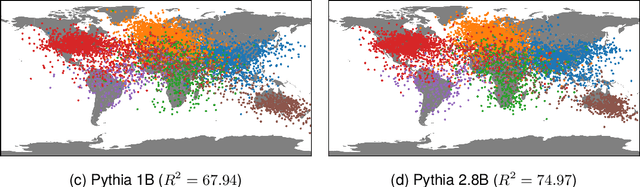
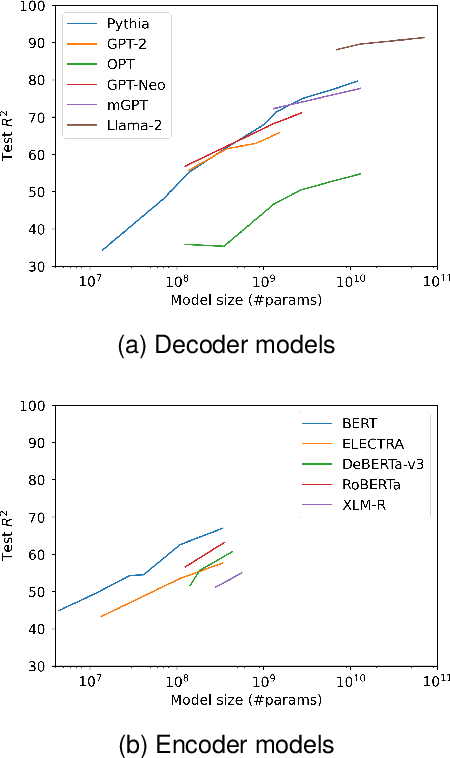
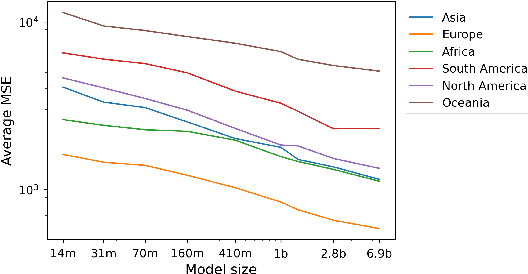
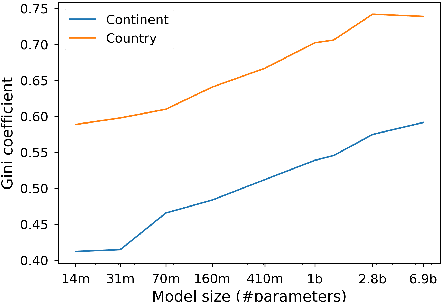
Language models have long been shown to embed geographical information in their hidden representations. This line of work has recently been revisited by extending this result to Large Language Models (LLMs). In this paper, we propose to fill the gap between well-established and recent literature by observing how geographical knowledge evolves when scaling language models. We show that geographical knowledge is observable even for tiny models, and that it scales consistently as we increase the model size. Notably, we observe that larger language models cannot mitigate the geographical bias that is inherent to the training data.
Anisotropy Is Inherent to Self-Attention in Transformers
Jan 24, 2024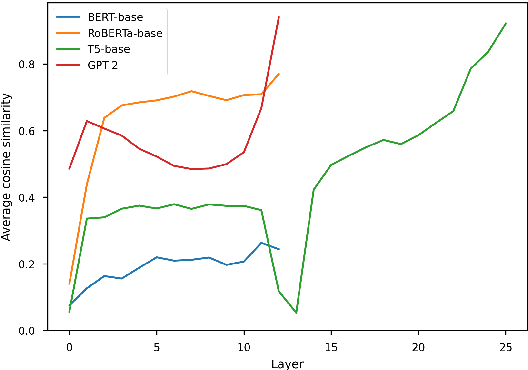
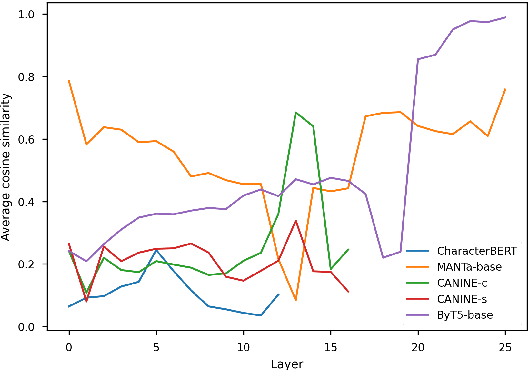
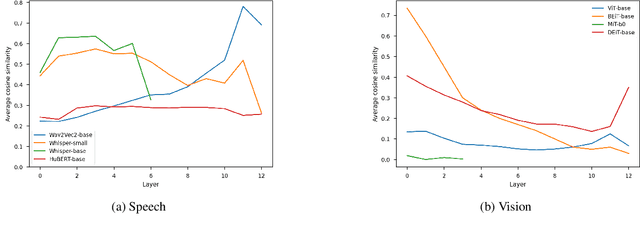
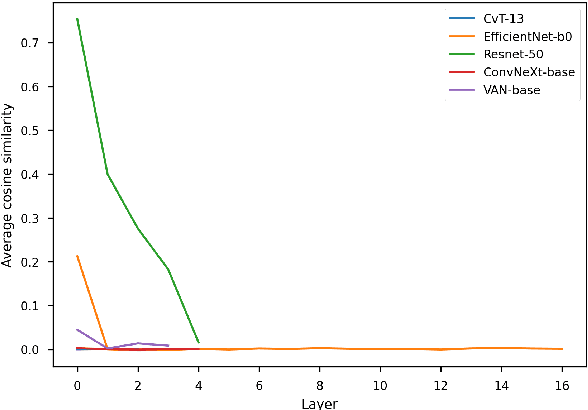
The representation degeneration problem is a phenomenon that is widely observed among self-supervised learning methods based on Transformers. In NLP, it takes the form of anisotropy, a singular property of hidden representations which makes them unexpectedly close to each other in terms of angular distance (cosine-similarity). Some recent works tend to show that anisotropy is a consequence of optimizing the cross-entropy loss on long-tailed distributions of tokens. We show in this paper that anisotropy can also be observed empirically in language models with specific objectives that should not suffer directly from the same consequences. We also show that the anisotropy problem extends to Transformers trained on other modalities. Our observations suggest that anisotropy is actually inherent to Transformers-based models.
Headless Language Models: Learning without Predicting with Contrastive Weight Tying
Sep 15, 2023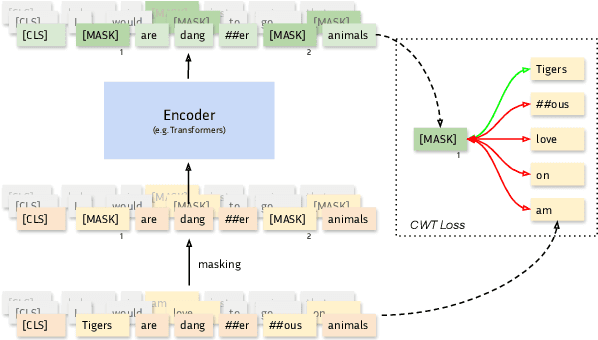

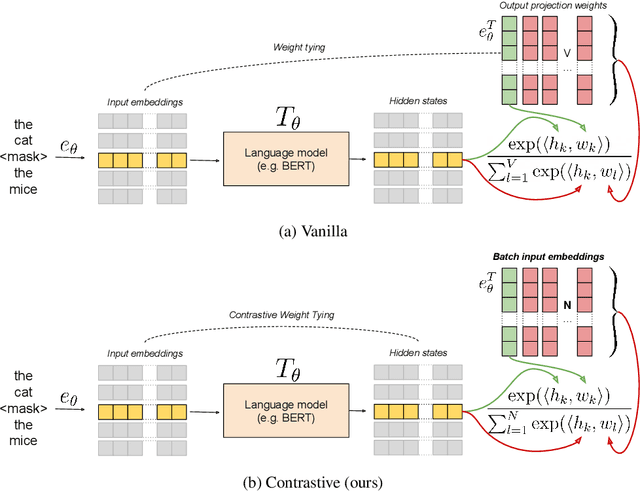
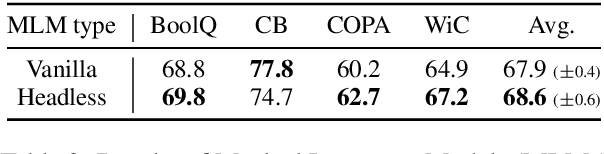
Self-supervised pre-training of language models usually consists in predicting probability distributions over extensive token vocabularies. In this study, we propose an innovative method that shifts away from probability prediction and instead focuses on reconstructing input embeddings in a contrastive fashion via Constrastive Weight Tying (CWT). We apply this approach to pretrain Headless Language Models in both monolingual and multilingual contexts. Our method offers practical advantages, substantially reducing training computational requirements by up to 20 times, while simultaneously enhancing downstream performance and data efficiency. We observe a significant +1.6 GLUE score increase and a notable +2.7 LAMBADA accuracy improvement compared to classical LMs within similar compute budgets.