 Add to Chrome
 Add to Firefox
 Add to Edge
Large-scale semantic mapping of learner agency and autonomy reveals what measurement and generative AI research overlook
Jun 09, 2026
Learner agency and autonomy are foundational to personal development, yet a pervasive "jingle-jangle" fallacy (i.e. identical terms denoting different constructs, distinct terms denoting identical ones) has substantially hindered cumulative knowledge. Treating meaning as a phenomenon constituted through use in linguistic practice, we extracted 8,954 definitions and 2,700 scale items from over 14,000 publications, to investigate how researchers actually used learner agency and autonomy with a semantic analysis pipeline. The definitional landscape of two constructs resolves into three dimensions: regulation and control of learning (task), intrinsic motivation and internal decision-making (person), and social-relational action (sociocultural), thereby empirically quantifying the jingle-jangle fallacy. Existing scales, however, systematically underrepresent the sociocultural dimension. Critically, current generative AI research in education concentrates on learning regulation and control, narrowing the behavioral repertoire that AI-mediated learning environments are designed to cultivate. Beyond conceptual clarification, this work carries direct implications for conceptualization, measurement, and practice towards supporting the multidimensional learner agency and autonomy.

Gaze to Insight: A Scalable AI Approach for Detecting Gaze Behaviours in Face-to-Face Collaborative Learning
Apr 09, 2026Previous studies have illustrated the potential of analysing gaze behaviours in collaborative learning to provide educationally meaningful information for students to reflect on their learning. Over the past decades, machine learning approaches have been developed to automatically detect gaze behaviours from video data. Yet, since these approaches often require large amounts of labelled data for training, human annotation remains necessary. Additionally, researchers have questioned the cross-configuration robustness of machine learning models developed, as training datasets often fail to encompass the full range of situations encountered in educational contexts. To address these challenges, this study proposes a scalable artificial intelligence approach that leverages pretrained and foundation models to automatically detect gaze behaviours in face-to-face collaborative learning contexts without requiring human-annotated data. The approach utilises pretrained YOLO11 for person tracking, YOLOE-26 with text-prompt capability for education-related object detection, and the Gaze-LLE model for gaze target prediction. The results indicate that the proposed approach achieves an F1-score of 0.829 in detecting students' gaze behaviours from video data, with strong performance for laptop-directed gaze and peer-directed gaze, yet weaker performance for other gaze targets. Furthermore, when compared to other supervised machine learning approaches, the proposed method demonstrates superior and more stable performance in complex contexts, highlighting its better cross-configuration robustness. The implications of this approach for supporting students' collaborative learning in real-world environments are also discussed.
Neural-Symbolic Knowledge Tracing: Injecting Educational Knowledge into Deep Learning for Responsible Learner Modelling
Apr 09, 2026The growing use of artificial intelligence (AI) in education, particularly large language models (LLMs), has increased interest in intelligent tutoring systems. However, LLMs often show limited adaptivity and struggle to model learners' evolving knowledge over time, highlighting the need for dedicated learner modelling approaches. Although deep knowledge tracing methods achieve strong predictive performance, their opacity and susceptibility to bias can limit alignment with pedagogical principles. To address this, we propose Responsible-DKT, a neural-symbolic deep knowledge tracing approach that integrates symbolic educational knowledge (e.g., mastery and non-mastery rules) into sequential neural models for responsible learner modelling. Experiments on a real-world dataset of students' math interactions show that Responsible-DKT outperforms both a neural-symbolic baseline and a fully data-driven PyTorch DKT model across training settings. The model achieves over 0.80 AUC with only 10% of training data and up to 0.90 AUC, improving performance by up to 13%. It also demonstrates improved temporal reliability, producing lower early- and mid-sequence prediction errors and the lowest prediction inconsistency rates across sequence lengths, indicating that prediction updates remain directionally aligned with observed student responses over time. Furthermore, the neural-symbolic approach offers intrinsic interpretability via a grounded computation graph that exposes the logic behind each prediction, enabling both local and global explanations. It also allows empirical evaluation of pedagogical assumptions, revealing that repeated incorrect responses (non-mastery) strongly influence prediction updates. These results indicate that neural-symbolic approaches enhance both performance and interpretability, mitigate data limitations, and support more responsible, human-centered AI in education.
Dialogue Act Patterns in GenAI-Mediated L2 Oral Practice: A Sequential Analysis of Learner-Chatbot Interactions
Apr 07, 2026While generative AI (GenAI) voice chatbots offer scalable opportunities for second language (L2) oral practice, the interactional processes related to learners' gains remain underexplored. This study investigates dialogue act (DA) patterns in interactions between Grade 9 Chinese English as a foreign language (EFL) learners and a GenAI voice chatbot over a 10-week intervention. Seventy sessions from 12 students were annotated by human coders using a pedagogy-informed coding scheme, yielding 6,957 coded DAs. DA distributions and sequential patterns were compared between high- and low-progress sessions. At the DA level, high-progress sessions showed more learner-initiated questions, whereas low-progress sessions exhibited higher rates of clarification-seeking, indicating greater comprehension difficulty. At the sequential level, high-progress sessions were characterised by more frequent prompting-based corrective feedback sequences, consistently positioned after learner responses, highlighting the role of feedback type and timing in effective interaction. Overall, these findings underscore the value of a dialogic lens in GenAI chatbot design, contribute a pedagogy-informed DA coding framework, and inform the design of adaptive GenAI chatbots for L2 education.
What Students Ask, How a Generative AI Assistant Responds: Exploring Higher Education Students' Dialogues on Learning Analytics Feedback
Jan 08, 2026Learning analytics dashboards (LADs) aim to support students' regulation of learning by translating complex data into feedback. Yet students, especially those with lower self-regulated learning (SRL) competence, often struggle to engage with and interpret analytics feedback. Conversational generative artificial intelligence (GenAI) assistants have shown potential to scaffold this process through real-time, personalised, dialogue-based support. Further advancing this potential, we explored authentic dialogues between students and GenAI assistant integrated into LAD during a 10-week semester. The analysis focused on questions students with different SRL levels posed, the relevance and quality of the assistant's answers, and how students perceived the assistant's role in their learning. Findings revealed distinct query patterns. While low SRL students sought clarification and reassurance, high SRL students queried technical aspects and requested personalised strategies. The assistant provided clear and reliable explanations but limited in personalisation, handling emotionally charged queries, and integrating multiple data points for tailored responses. Findings further extend that GenAI interventions can be especially valuable for low SRL students, offering scaffolding that supports engagement with feedback and narrows gaps with their higher SRL peers. At the same time, students' reflections underscored the importance of trust, need for greater adaptivity, context-awareness, and technical refinement in future systems.
Problems With Large Language Models for Learner Modelling: Why LLMs Alone Fall Short for Responsible Tutoring in K--12 Education
Dec 28, 2025The rapid rise of large language model (LLM)-based tutors in K--12 education has fostered a misconception that generative models can replace traditional learner modelling for adaptive instruction. This is especially problematic in K--12 settings, which the EU AI Act classifies as high-risk domain requiring responsible design. Motivated by these concerns, this study synthesises evidence on limitations of LLM-based tutors and empirically investigates one critical issue: the accuracy, reliability, and temporal coherence of assessing learners' evolving knowledge over time. We compare a deep knowledge tracing (DKT) model with a widely used LLM, evaluated zero-shot and fine-tuned, using a large open-access dataset. Results show that DKT achieves the highest discrimination performance (AUC = 0.83) on next-step correctness prediction and consistently outperforms the LLM across settings. Although fine-tuning improves the LLM's AUC by approximately 8\% over the zero-shot baseline, it remains 6\% below DKT and produces higher early-sequence errors, where incorrect predictions are most harmful for adaptive support. Temporal analyses further reveal that DKT maintains stable, directionally correct mastery updates, whereas LLM variants exhibit substantial temporal weaknesses, including inconsistent and wrong-direction updates. These limitations persist despite the fine-tuned LLM requiring nearly 198 hours of high-compute training, far exceeding the computational demands of DKT. Our qualitative analysis of multi-skill mastery estimation further shows that, even after fine-tuning, the LLM produced inconsistent mastery trajectories, while DKT maintained smooth and coherent updates. Overall, the findings suggest that LLMs alone are unlikely to match the effectiveness of established intelligent tutoring systems, and that responsible tutoring requires hybrid frameworks that incorporate learner modelling.
Examining Student Interactions with a Pedagogical AI-Assistant for Essay Writing and their Impact on Students Writing Quality
Dec 09, 2025The dynamic nature of interactions between students and GenAI, as well as their relationship to writing quality, remains underexplored. While most research has examined how general-purpose GenAI can support writing, fewer studies have investigated how students interact with pedagogically designed systems across different phases of the writing process. To address this gap, we evaluated a GenAI-driven essay-writing assistant (EWA) designed to support higher education students in argumentative writing. Drawing on 1,282 interaction logs from 32 undergraduates during a two-hour writing session, Sequential Pattern Mining and K-Means clustering were used to identify behavioral patterns. Two clusters emerged: Cluster 1 emphasized outline planning and essay structure, while Cluster 2 focused on content development. A Mann-Whitney U test revealed a moderate effect size (r = 0.36) in the essay Organization dimension, with Cluster 1 showing higher scores. Qualitative analysis indicated that students with better performance actively wrote and shared essay sections with EWA for feedback, rather than interacted passively by asking questions. These findings suggest implications for teaching and system design. Teachers can encourage active engagement, while future EWAs may integrate automatic labeling and monitoring to prompt students to move from questioning to writing, enabling fuller benefits from GenAI-supported learning.
Benchmarking Educational LLMs with Analytics: A Case Study on Gender Bias in Feedback
Nov 11, 2025As teachers increasingly turn to GenAI in their educational practice, we need robust methods to benchmark large language models (LLMs) for pedagogical purposes. This article presents an embedding-based benchmarking framework to detect bias in LLMs in the context of formative feedback. Using 600 authentic student essays from the AES 2.0 corpus, we constructed controlled counterfactuals along two dimensions: (i) implicit cues via lexicon-based swaps of gendered terms within essays, and (ii) explicit cues via gendered author background in the prompt. We investigated six representative LLMs (i.e. GPT-5 mini, GPT-4o mini, DeepSeek-R1, DeepSeek-R1-Qwen, Gemini 2.5 Pro, Llama-3-8B). We first quantified the response divergence with cosine and Euclidean distances over sentence embeddings, then assessed significance via permutation tests, and finally, visualised structure using dimensionality reduction. In all models, implicit manipulations reliably induced larger semantic shifts for male-female counterfactuals than for female-male. Only the GPT and Llama models showed sensitivity to explicit gender cues. These findings show that even state-of-the-art LLMs exhibit asymmetric semantic responses to gender substitutions, suggesting persistent gender biases in feedback they provide learners. Qualitative analyses further revealed consistent linguistic differences (e.g., more autonomy-supportive feedback under male cues vs. more controlling feedback under female cues). We discuss implications for fairness auditing of pedagogical GenAI, propose reporting standards for counterfactual evaluation in learning analytics, and outline practical guidance for prompt design and deployment to safeguard equitable feedback.
Evaluating Trust in AI, Human, and Co-produced Feedback Among Undergraduate Students
Apr 15, 2025As generative AI transforms educational feedback practices, understanding students' perceptions of different feedback providers becomes crucial for effective implementation. This study addresses a critical gap by comparing undergraduate students' trust in AI-generated, human-created, and human-AI co-produced feedback, informing how institutions can adapt feedback practices in this new era. Through a within-subject experiment with 91 participants, we investigated factors predicting students' ability to distinguish between feedback types, perception of feedback quality, and potential biases to AI involvement. Findings revealed that students generally preferred AI and co-produced feedback over human feedback in terms of perceived usefulness and objectivity. Only AI feedback suffered a decline in perceived genuineness when feedback sources were revealed, while co-produced feedback maintained its positive perception. Educational AI experience improved students' ability to identify AI feedback and increased their trust in all feedback types, while general AI experience decreased perceived usefulness and credibility. Male students consistently rated all feedback types as less valuable than their female and non-binary counterparts. These insights inform evidence-based guidelines for integrating AI into higher education feedback systems while addressing trust concerns and fostering AI literacy among students.
A Novel Approach to Scalable and Automatic Topic-Controlled Question Generation in Education
Jan 09, 2025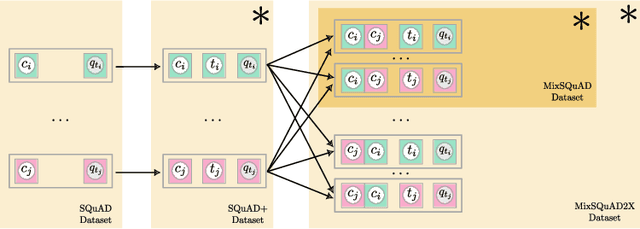
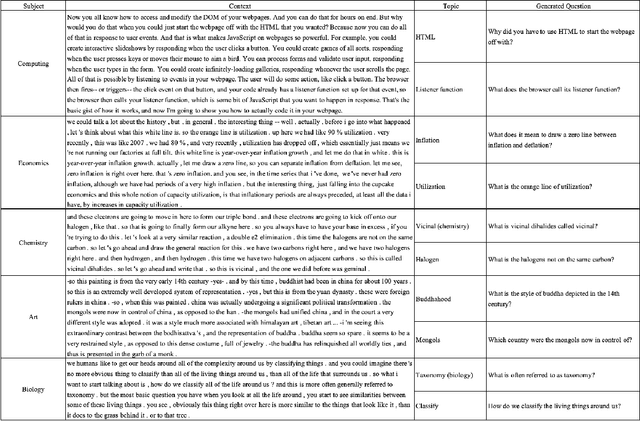
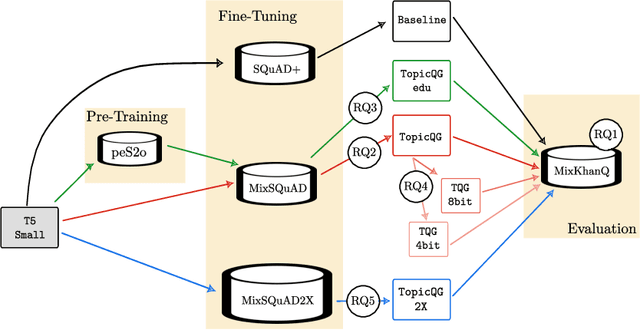

The development of Automatic Question Generation (QG) models has the potential to significantly improve educational practices by reducing the teacher workload associated with creating educational content. This paper introduces a novel approach to educational question generation that controls the topical focus of questions. The proposed Topic-Controlled Question Generation (T-CQG) method enhances the relevance and effectiveness of the generated content for educational purposes. Our approach uses fine-tuning on a pre-trained T5-small model, employing specially created datasets tailored to educational needs. The research further explores the impacts of pre-training strategies, quantisation, and data augmentation on the model's performance. We specifically address the challenge of generating semantically aligned questions with paragraph-level contexts, thereby improving the topic specificity of the generated questions. In addition, we introduce and explore novel evaluation methods to assess the topical relatedness of the generated questions. Our results, validated through rigorous offline and human-backed evaluations, demonstrate that the proposed models effectively generate high-quality, topic-focused questions. These models have the potential to reduce teacher workload and support personalised tutoring systems by serving as bespoke question generators. With its relatively small number of parameters, the proposals not only advance the capabilities of question generation models for handling specific educational topics but also offer a scalable solution that reduces infrastructure costs. This scalability makes them feasible for widespread use in education without reliance on proprietary large language models like ChatGPT.