 Add to Chrome
 Add to Firefox
 Add to Edge
VideoRun2D Demo: Markerless Body Tracking for Biomechanical Analysis of Running
Aug 19, 2026
Human pose estimation has advanced significantly due to the development of deep learning models, increased data availability, and improved computing resources. These developments have led to highly accurate body tracking systems with direct applications in sports analysis and performance evaluation. The VideoRun2D Demo performs a biomechanical analysis during sprints using different human pose estimators. The proposed framework was evaluated using human pose trackers and expert manual annotations. The tested framework uses 314 sprints from 44 professional runners, focusing on two key joint angles in sprint biomechanics: 1) hip flexion/extension and 2) knee flexion/extension. The framework also includes a post-processing module for outlier detection. The tested results demonstrate that the average root-mean-square errors range from 11.46° to 5.83° for the best trackers. When integrated with the post-processing modules, these errors can be reduced to 9.87° and 5.30°, respectively. The VideoRun2D Demo findings suggest that human pose-tracking approaches can be valuable resources for the biomechanical analysis of running.

AIriskEval-edu Demo: Auditing of Pedagogical Risks in Educational Explanations
Jul 28, 2026We present AIriskEval-edu Demo, a platform that audits the pedagogical quality of instructional explanations and provides explainable audit results. The platform evaluates an explanation against a rubric covering five dimensions of pedagogical risk: factual accuracy, depth and completeness, focus and relevance, student-level appropriateness, and ideological bias. For each dimension, it returns a binary decision and a confidence score. Detected risks also include a natural-language rationale and, except for Depth and Completeness, a localized evidence span. The platform integrates GPT-5.5 through an external API and a self-hosted Llama 3.1 8B evaluator that runs on consumer-grade GPUs. The local evaluator is fine-tuned on AIriskEval-edu, a dataset of K-12 instructional explanations with risk and explainability annotations. The platform operates in two modes: in AI mode, both evaluators assess stored explanations generated under six simulated teacher profiles, each representing a distinct pedagogical behavior and potential risk; in human mode, the local evaluator audits user-written explanations in real time. The local evaluator outperforms GPT-5.5 on most reported metrics, offering educational institutions a practical way to keep audited content within their own infrastructure.
AIriskEval-edu: New Dataset for Risk Assessment in AI-mediated K-12 Educational Explanations
Jul 02, 2026This work introduces AIriskEval-edu-db2, a new dataset designed to train and evaluate auditors based on LLMs for an explainable pedagogical risk assessment in instructional content for grades K-12. The dataset comprises 1,639 explanations from 170 curated ScienceQA questions, covering science, language arts, and social sciences. For each question, the dataset includes an explanation written by a human teacher alongside 11 explanations generated by LLM-simulated teacher profiles associated with distinct pedagogical risks. We propose a comprehensive risk rubric aligned with established educational standards that covers five complementary dimensions: factual precision, depth and completeness, focus and relevance, student-level appropriateness, and ideological bias. A key contribution is the addition of 785 explanations with structured explainability annotations, including risk localization and risk description. The annotations are produced through a semi-automatic process with expert teacher validation. Finally, we present validation experiments comparing state-of-the-art proprietary models with a lightweight local Llama 3.1 8B model in both the pedagogical risk detection and the explainability assessment. These experiments evaluate whether supervised fine-tuning on AIriskEval-edu-db2 enables a locally deployable model to approach or outperform stronger frontier models while preserving privacy in educational auditing and assessment tasks.
Overview of Risk Assessment and Management for Intelligent Systems under the AI Act and Beyond
Jul 02, 2026The society and emerging risk-based regulatory frameworks for AI underscore the need for rigorous risk assessment to ensure safe and reliable AI systems. In response to this imperative, this paper presents an overview of AI risk assessment (identification and analysis) and management methodologies. It begins by reviewing the worldwide regulatory landscape that drives the need for systematic AI risk assessment. Then we characterize the spectrum of AI-related risks identified in the literature, from technical failures to ethical and social impacts. Subsequently, it reviews key risk assessment methodologies proposed for AI systems, focusing on general frameworks. The paper highlights best practices and illuminates methodological gaps, highlighting areas for further research on AI risk assessment.
Leveraging Avatar Fingerprinting: A Multi-Generator Photorealistic Talking-Head Public Database and Benchmark
Mar 27, 2026Recent advances in photorealistic avatar generation have enabled highly realistic talking-head avatars, raising security concerns regarding identity impersonation in AI-mediated communication. To advance in this challenging problem, the task of avatar fingerprinting aims to determine whether two avatar videos are driven by the same human operator or not. However, current public databases in the literature are scarce and based solely on old-fashioned talking-head avatar generators, not representing realistic scenarios for the current task of avatar fingerprinting. To overcome this situation, the present article introduces AVAPrintDB, a new publicly available multi-generator talking-head avatar database for avatar fingerprinting. AVAPrintDB is constructed from two audiovisual corpora and three state-of-the-art avatar generators (GAGAvatar, LivePortrait, HunyuanPortrait), representing different synthesis paradigms, and includes both self- and cross-reenactments to simulate legitimate usage and impersonation scenarios. Building on this database, we also define a standardized and reproducible benchmark for avatar fingerprinting, considering public state-of-the-art avatar fingerprinting systems and exploring novel methods based on Foundation Models (DINOv2 and CLIP). Also, we conduct a comprehensive analysis under generator and dataset shift. Our results show that, while identity-related motion cues persist across synthetic avatars, current avatar fingerprinting systems remain highly sensitive to changes in the synthesis pipeline and source domain. The AVAPrintDB, benchmark protocols, and avatar fingerprinting systems are publicly available to facilitate reproducible research.
EduEVAL-DB: A Role-Based Dataset for Pedagogical Risk Evaluation in Educational Explanations
Feb 19, 2026This work introduces EduEVAL-DB, a dataset based on teacher roles designed to support the evaluation and training of automatic pedagogical evaluators and AI tutors for instructional explanations. The dataset comprises 854 explanations corresponding to 139 questions from a curated subset of the ScienceQA benchmark, spanning science, language, and social science across K-12 grade levels. For each question, one human-teacher explanation is provided and six are generated by LLM-simulated teacher roles. These roles are inspired by instructional styles and shortcomings observed in real educational practice and are instantiated via prompt engineering. We further propose a pedagogical risk rubric aligned with established educational standards, operationalizing five complementary risk dimensions: factual correctness, explanatory depth and completeness, focus and relevance, student-level appropriateness, and ideological bias. All explanations are annotated with binary risk labels through a semi-automatic process with expert teacher review. Finally, we present preliminary validation experiments to assess the suitability of EduEVAL-DB for evaluation. We benchmark a state-of-the-art education-oriented model (Gemini 2.5 Pro) against a lightweight local Llama 3.1 8B model and examine whether supervised fine-tuning on EduEVAL-DB supports pedagogical risk detection using models deployable on consumer hardware.
GenAI-LA: Generative AI and Learning Analytics Workshop (LAK 2026), April 27--May 1, 2026, Bergen, Norway
Feb 17, 2026This work introduces EduEVAL-DB, a dataset based on teacher roles designed to support the evaluation and training of automatic pedagogical evaluators and AI tutors for instructional explanations. The dataset comprises 854 explanations corresponding to 139 questions from a curated subset of the ScienceQA benchmark, spanning science, language, and social science across K-12 grade levels. For each question, one human-teacher explanation is provided and six are generated by LLM-simulated teacher roles. These roles are inspired by instructional styles and shortcomings observed in real educational practice and are instantiated via prompt engineering. We further propose a pedagogical risk rubric aligned with established educational standards, operationalizing five complementary risk dimensions: factual correctness, explanatory depth and completeness, focus and relevance, student-level appropriateness, and ideological bias. All explanations are annotated with binary risk labels through a semi-automatic process with expert teacher review. Finally, we present preliminary validation experiments to assess the suitability of EduEVAL-DB for evaluation. We benchmark a state-of-the-art education-oriented model (Gemini 2.5 Pro) against a lightweight local Llama 3.1 8B model and examine whether supervised fine-tuning on EduEVAL-DB supports pedagogical risk detection using models deployable on consumer hardware.
A Multimodal Dataset of Student Oral Presentations with Sensors and Evaluation Data
Jan 12, 2026Oral presentation skills are a critical component of higher education, yet comprehensive datasets capturing real-world student performance across multiple modalities remain scarce. To address this gap, we present SOPHIAS (Student Oral Presentation monitoring for Holistic Insights & Analytics using Sensors), a 12-hour multimodal dataset containing recordings of 50 oral presentations (10-15-minute presentation followed by 5-15-minute Q&A) delivered by 65 undergraduate and master's students at the Universidad Autonoma de Madrid. SOPHIAS integrates eight synchronized sensor streams from high-definition webcams, ambient and webcam audio, eye-tracking glasses, smartwatch physiological sensors, and clicker, keyboard, and mouse interactions. In addition, the dataset includes slides and rubric-based evaluations from teachers, peers, and self-assessments, along with timestamped contextual annotations. The dataset captures presentations conducted in real classroom settings, preserving authentic student behaviors, interactions, and physiological responses. SOPHIAS enables the exploration of relationships between multimodal behavioral and physiological signals and presentation performance, supports the study of peer assessment, and provides a benchmark for developing automated feedback and Multimodal Learning Analytics tools. The dataset is publicly available for research through GitHub and Science Data Bank.
MOSAIC-F: A Framework for Enhancing Students' Oral Presentation Skills through Personalized Feedback
Jun 10, 2025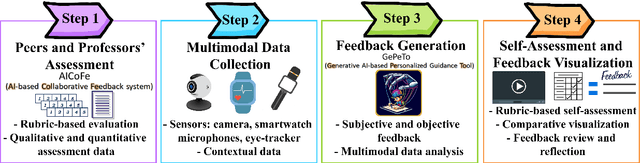
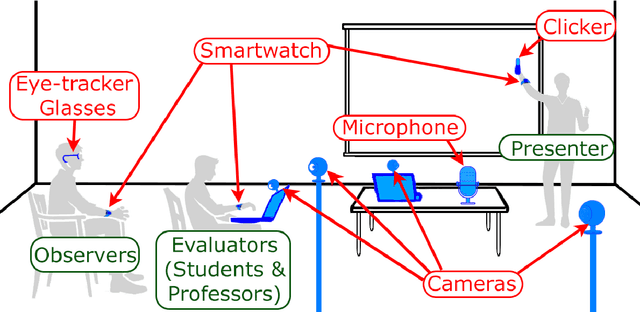
In this article, we present a novel multimodal feedback framework called MOSAIC-F, an acronym for a data-driven Framework that integrates Multimodal Learning Analytics (MMLA), Observations, Sensors, Artificial Intelligence (AI), and Collaborative assessments for generating personalized feedback on student learning activities. This framework consists of four key steps. First, peers and professors' assessments are conducted through standardized rubrics (that include both quantitative and qualitative evaluations). Second, multimodal data are collected during learning activities, including video recordings, audio capture, gaze tracking, physiological signals (heart rate, motion data), and behavioral interactions. Third, personalized feedback is generated using AI, synthesizing human-based evaluations and data-based multimodal insights such as posture, speech patterns, stress levels, and cognitive load, among others. Finally, students review their own performance through video recordings and engage in self-assessment and feedback visualization, comparing their own evaluations with peers and professors' assessments, class averages, and AI-generated recommendations. By combining human-based and data-based evaluation techniques, this framework enables more accurate, personalized and actionable feedback. We tested MOSAIC-F in the context of improving oral presentation skills.
M2LADS Demo: A System for Generating Multimodal Learning Analytics Dashboards
Feb 21, 2025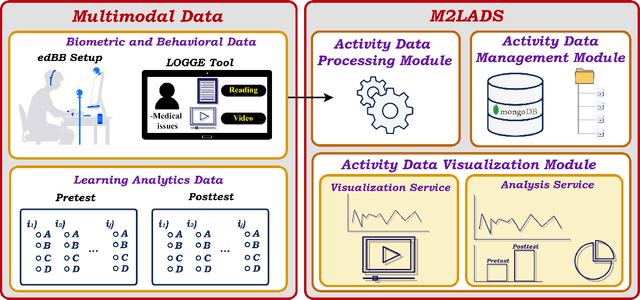
We present a demonstration of a web-based system called M2LADS ("System for Generating Multimodal Learning Analytics Dashboards"), designed to integrate, synchronize, visualize, and analyze multimodal data recorded during computer-based learning sessions with biosensors. This system presents a range of biometric and behavioral data on web-based dashboards, providing detailed insights into various physiological and activity-based metrics. The multimodal data visualized include electroencephalogram (EEG) data for assessing attention and brain activity, heart rate metrics, eye-tracking data to measure visual attention, webcam video recordings, and activity logs of the monitored tasks. M2LADS aims to assist data scientists in two key ways: (1) by providing a comprehensive view of participants' experiences, displaying all data categorized by the activities in which participants are engaged, and (2) by synchronizing all biosignals and videos, facilitating easier data relabeling if any activity information contains errors.