 Add to Chrome
 Add to Firefox
 Add to Edge
The Correct Answer Trap: Pedagogically-Grounded Detection and Feedback for Hidden Misconceptions
Jun 22, 2026
Automated feedback systems that rely on answer correctness will reinforce, rather than address, misconceptions when students reach the correct answer through flawed reasoning. We investigate automatic detection of these hidden misconceptions using 20,964 real student responses from the Eedi mathematics platform. Fine-tuned classifiers detect only 57% of these hidden misconceptions, and standard ML interventions do not improve on this. An open-weight reasoning model detects 84%, but at realistic prevalence, false alarms outnumber genuine detections roughly 8 to 1. We present a graduated assessment rubric that separates answer correctness from method validity, and propose a detect-verify-escalate pipeline that routes uncertain cases to diagnostic follow-up questions rather than directly to teachers. Two deployment modes adapt the pipeline: a teacher dashboard where the system filters a review queue, and an autonomous tutor where flags trigger low-cost formative follow-up.

Mix and Match: Context Pairing for Scalable Topic-Controlled Educational Summarisation
Apr 20, 2026Topic-controlled summarisation enables users to generate summaries focused on specific aspects of source documents. This paper investigates a data augmentation strategy for training small language models (sLMs) to perform topic-controlled summarisation. We propose a pairwise data augmentation method that combines contexts from different documents to create contrastive training examples, enabling models to learn the relationship between topics and summaries more effectively. Using the SciTLDR dataset enriched with Wikipedia-derived topics, we systematically evaluate how augmentation scale affects model performance. Results show consistent improvements in win rate and semantic alignment as the augmentation scale increases, while the amount of real training data remains fixed. Consequently, a T5-base model trained with our augmentation approach achieves competitive performance relative to larger models, despite using significantly fewer parameters and substantially fewer real training examples.
Gaze to Insight: A Scalable AI Approach for Detecting Gaze Behaviours in Face-to-Face Collaborative Learning
Apr 09, 2026Previous studies have illustrated the potential of analysing gaze behaviours in collaborative learning to provide educationally meaningful information for students to reflect on their learning. Over the past decades, machine learning approaches have been developed to automatically detect gaze behaviours from video data. Yet, since these approaches often require large amounts of labelled data for training, human annotation remains necessary. Additionally, researchers have questioned the cross-configuration robustness of machine learning models developed, as training datasets often fail to encompass the full range of situations encountered in educational contexts. To address these challenges, this study proposes a scalable artificial intelligence approach that leverages pretrained and foundation models to automatically detect gaze behaviours in face-to-face collaborative learning contexts without requiring human-annotated data. The approach utilises pretrained YOLO11 for person tracking, YOLOE-26 with text-prompt capability for education-related object detection, and the Gaze-LLE model for gaze target prediction. The results indicate that the proposed approach achieves an F1-score of 0.829 in detecting students' gaze behaviours from video data, with strong performance for laptop-directed gaze and peer-directed gaze, yet weaker performance for other gaze targets. Furthermore, when compared to other supervised machine learning approaches, the proposed method demonstrates superior and more stable performance in complex contexts, highlighting its better cross-configuration robustness. The implications of this approach for supporting students' collaborative learning in real-world environments are also discussed.
AgentDrift: Unsafe Recommendation Drift Under Tool Corruption Hidden by Ranking Metrics in LLM Agents
Mar 18, 2026Tool-augmented LLM agents increasingly serve as multi-turn advisors in high-stakes domains, yet their evaluation relies on ranking-quality metrics that measure what is recommended but not whether it is safe for the user. We introduce a paired-trajectory protocol that replays real financial dialogues under clean and contaminated tool-output conditions across seven LLMs (7B to frontier) and decomposes divergence into information-channel and memory-channel mechanisms. Across the seven models tested, we consistently observe the evaluation-blindness pattern: recommendation quality is largely preserved under contamination (utility preservation ratio approximately 1.0) while risk-inappropriate products appear in 65-93% of turns, a systematic safety failure poorly reflected by standard NDCG. Safety violations are predominantly information-channel-driven, emerge at the first contaminated turn, and persist without self-correction over 23-step trajectories; no agent across 1,563 contaminated turns explicitly questions tool-data reliability. Even narrative-only corruption (biased headlines, no numerical manipulation) induces significant drift while completely evading consistency monitors. A safety-penalized NDCG variant (sNDCG) reduces preservation ratios to 0.51-0.74, indicating that much of the evaluation gap becomes visible once safety is explicitly measured. These results motivate considering trajectory-level safety monitoring, beyond single-turn quality, for deployed multi-turn agents in high-stakes settings.
Examining Student Interactions with a Pedagogical AI-Assistant for Essay Writing and their Impact on Students Writing Quality
Dec 09, 2025The dynamic nature of interactions between students and GenAI, as well as their relationship to writing quality, remains underexplored. While most research has examined how general-purpose GenAI can support writing, fewer studies have investigated how students interact with pedagogically designed systems across different phases of the writing process. To address this gap, we evaluated a GenAI-driven essay-writing assistant (EWA) designed to support higher education students in argumentative writing. Drawing on 1,282 interaction logs from 32 undergraduates during a two-hour writing session, Sequential Pattern Mining and K-Means clustering were used to identify behavioral patterns. Two clusters emerged: Cluster 1 emphasized outline planning and essay structure, while Cluster 2 focused on content development. A Mann-Whitney U test revealed a moderate effect size (r = 0.36) in the essay Organization dimension, with Cluster 1 showing higher scores. Qualitative analysis indicated that students with better performance actively wrote and shared essay sections with EWA for feedback, rather than interacted passively by asking questions. These findings suggest implications for teaching and system design. Teachers can encourage active engagement, while future EWAs may integrate automatic labeling and monitoring to prompt students to move from questioning to writing, enabling fuller benefits from GenAI-supported learning.
A Novel Approach to Scalable and Automatic Topic-Controlled Question Generation in Education
Jan 09, 2025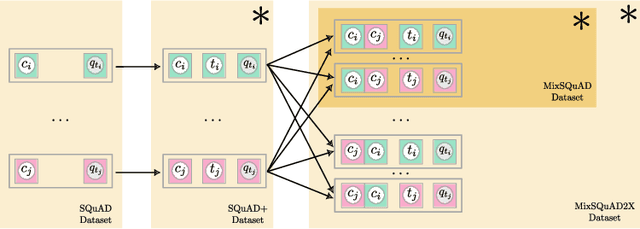
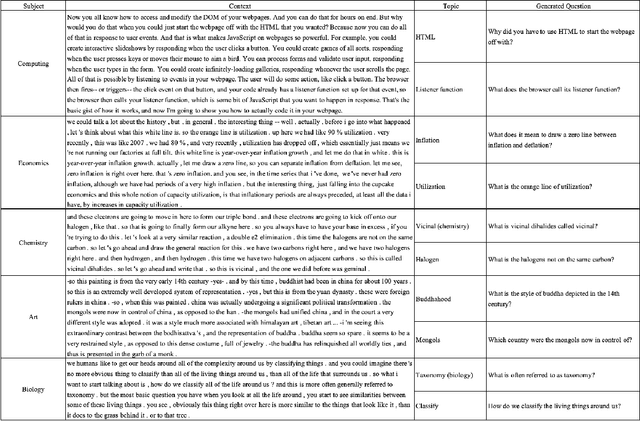
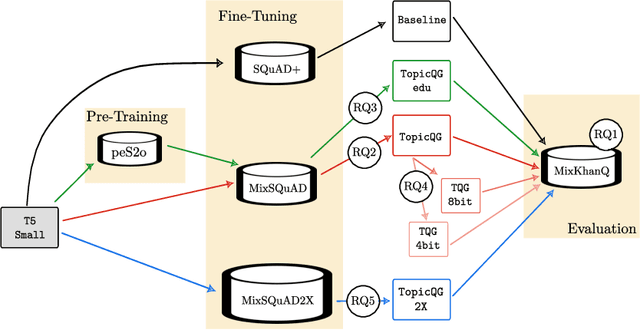

The development of Automatic Question Generation (QG) models has the potential to significantly improve educational practices by reducing the teacher workload associated with creating educational content. This paper introduces a novel approach to educational question generation that controls the topical focus of questions. The proposed Topic-Controlled Question Generation (T-CQG) method enhances the relevance and effectiveness of the generated content for educational purposes. Our approach uses fine-tuning on a pre-trained T5-small model, employing specially created datasets tailored to educational needs. The research further explores the impacts of pre-training strategies, quantisation, and data augmentation on the model's performance. We specifically address the challenge of generating semantically aligned questions with paragraph-level contexts, thereby improving the topic specificity of the generated questions. In addition, we introduce and explore novel evaluation methods to assess the topical relatedness of the generated questions. Our results, validated through rigorous offline and human-backed evaluations, demonstrate that the proposed models effectively generate high-quality, topic-focused questions. These models have the potential to reduce teacher workload and support personalised tutoring systems by serving as bespoke question generators. With its relatively small number of parameters, the proposals not only advance the capabilities of question generation models for handling specific educational topics but also offer a scalable solution that reduces infrastructure costs. This scalability makes them feasible for widespread use in education without reliance on proprietary large language models like ChatGPT.
Auditing Large Language Models for Enhanced Text-Based Stereotype Detection and Probing-Based Bias Evaluation
Apr 02, 2024


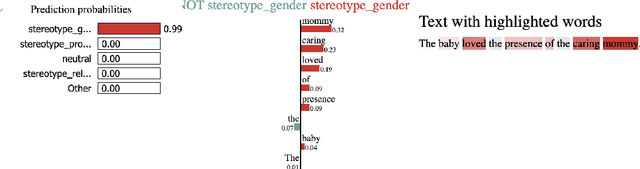
Recent advancements in Large Language Models (LLMs) have significantly increased their presence in human-facing Artificial Intelligence (AI) applications. However, LLMs could reproduce and even exacerbate stereotypical outputs from training data. This work introduces the Multi-Grain Stereotype (MGS) dataset, encompassing 51,867 instances across gender, race, profession, religion, and stereotypical text, collected by fusing multiple previously publicly available stereotype detection datasets. We explore different machine learning approaches aimed at establishing baselines for stereotype detection, and fine-tune several language models of various architectures and model sizes, presenting in this work a series of stereotypes classifier models for English text trained on MGS. To understand whether our stereotype detectors capture relevant features (aligning with human common sense) we utilise a variety of explanainable AI tools, including SHAP, LIME, and BertViz, and analyse a series of example cases discussing the results. Finally, we develop a series of stereotype elicitation prompts and evaluate the presence of stereotypes in text generation tasks with popular LLMs, using one of our best performing previously presented stereotypes detectors. Our experiments yielded several key findings: i) Training stereotype detectors in a multi-dimension setting yields better results than training multiple single-dimension classifiers.ii) The integrated MGS Dataset enhances both the in-dataset and cross-dataset generalisation ability of stereotype detectors compared to using the datasets separately. iii) There is a reduction in stereotypes in the content generated by GPT Family LLMs with newer versions.
A Toolbox for Modelling Engagement with Educational Videos
Dec 30, 2023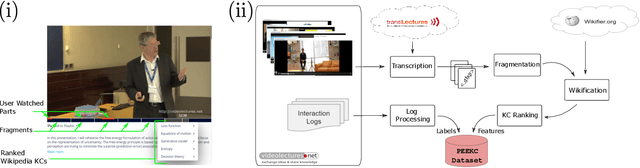
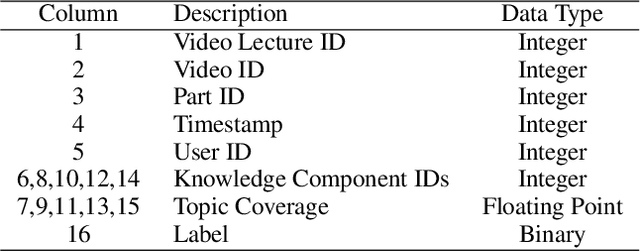
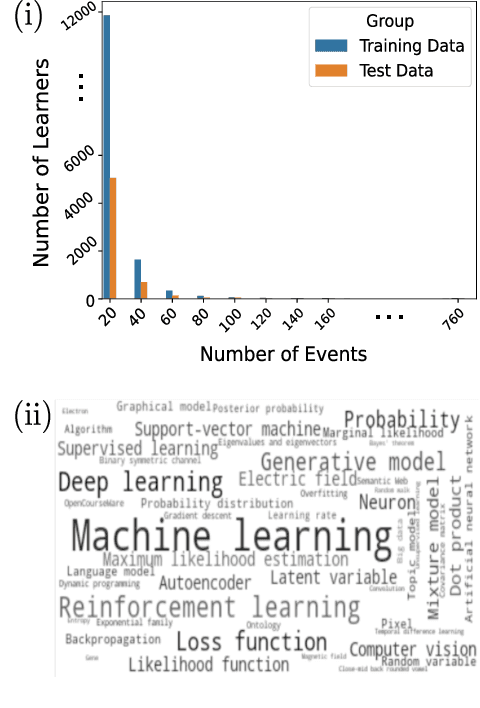
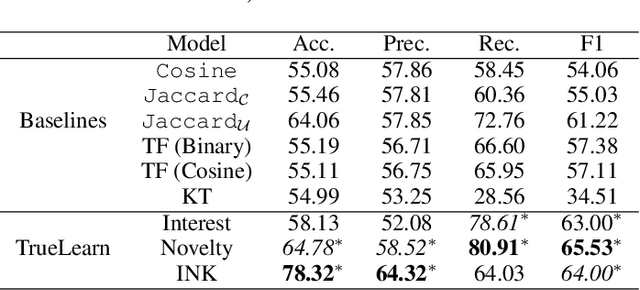
With the advancement and utility of Artificial Intelligence (AI), personalising education to a global population could be a cornerstone of new educational systems in the future. This work presents the PEEKC dataset and the TrueLearn Python library, which contains a dataset and a series of online learner state models that are essential to facilitate research on learner engagement modelling.TrueLearn family of models was designed following the "open learner" concept, using humanly-intuitive user representations. This family of scalable, online models also help end-users visualise the learner models, which may in the future facilitate user interaction with their models/recommenders. The extensive documentation and coding examples make the library highly accessible to both machine learning developers and educational data mining and learning analytics practitioners. The experiments show the utility of both the dataset and the library with predictive performance significantly exceeding comparative baseline models. The dataset contains a large amount of AI-related educational videos, which are of interest for building and validating AI-specific educational recommenders.
Towards Auditing Large Language Models: Improving Text-based Stereotype Detection
Nov 23, 2023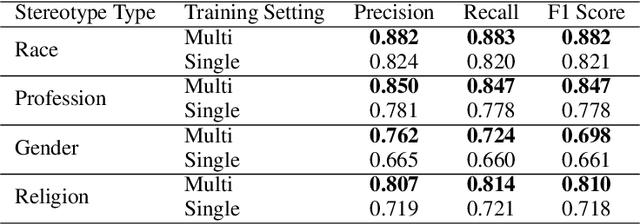
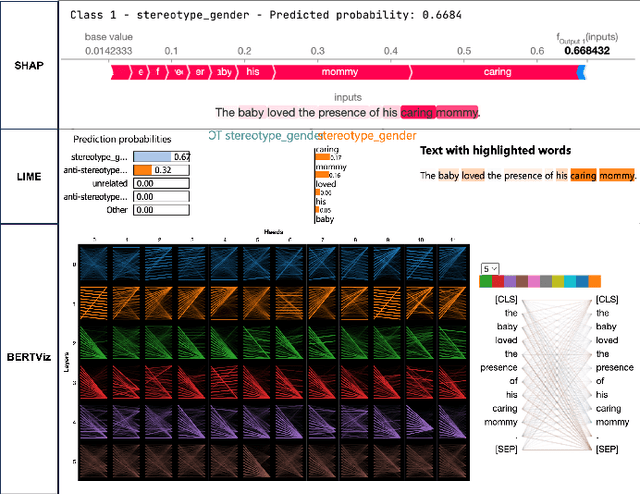
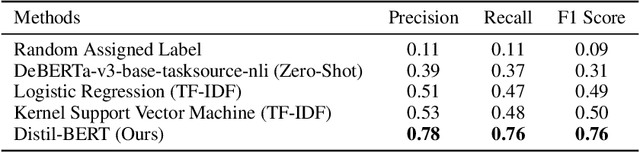
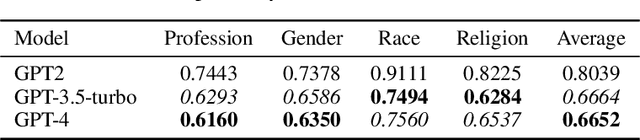
Large Language Models (LLM) have made significant advances in the recent past becoming more mainstream in Artificial Intelligence (AI) enabled human-facing applications. However, LLMs often generate stereotypical output inherited from historical data, amplifying societal biases and raising ethical concerns. This work introduces i) the Multi-Grain Stereotype Dataset, which includes 52,751 instances of gender, race, profession and religion stereotypic text and ii) a novel stereotype classifier for English text. We design several experiments to rigorously test the proposed model trained on the novel dataset. Our experiments show that training the model in a multi-class setting can outperform the one-vs-all binary counterpart. Consistent feature importance signals from different eXplainable AI tools demonstrate that the new model exploits relevant text features. We utilise the newly created model to assess the stereotypic behaviour of the popular GPT family of models and observe the reduction of bias over time. In summary, our work establishes a robust and practical framework for auditing and evaluating the stereotypic bias in LLM.
TrueLearn: A Python Library for Personalised Informational Recommendations with (Implicit) Feedback
Sep 20, 2023This work describes the TrueLearn Python library, which contains a family of online learning Bayesian models for building educational (or more generally, informational) recommendation systems. This family of models was designed following the "open learner" concept, using humanly-intuitive user representations. For the sake of interpretability and putting the user in control, the TrueLearn library also contains different representations to help end-users visualise the learner models, which may in the future facilitate user interaction with their own models. Together with the library, we include a previously publicly released implicit feedback educational dataset with evaluation metrics to measure the performance of the models. The extensive documentation and coding examples make the library highly accessible to both machine learning developers and educational data mining and learning analytic practitioners. The library and the support documentation with examples are available at https://truelearn.readthedocs.io/en/latest.