 Add to Chrome
 Add to Firefox
 Add to Edge
EduEVAL-DB: A Role-Based Dataset for Pedagogical Risk Evaluation in Educational Explanations
Feb 19, 2026
This work introduces EduEVAL-DB, a dataset based on teacher roles designed to support the evaluation and training of automatic pedagogical evaluators and AI tutors for instructional explanations. The dataset comprises 854 explanations corresponding to 139 questions from a curated subset of the ScienceQA benchmark, spanning science, language, and social science across K-12 grade levels. For each question, one human-teacher explanation is provided and six are generated by LLM-simulated teacher roles. These roles are inspired by instructional styles and shortcomings observed in real educational practice and are instantiated via prompt engineering. We further propose a pedagogical risk rubric aligned with established educational standards, operationalizing five complementary risk dimensions: factual correctness, explanatory depth and completeness, focus and relevance, student-level appropriateness, and ideological bias. All explanations are annotated with binary risk labels through a semi-automatic process with expert teacher review. Finally, we present preliminary validation experiments to assess the suitability of EduEVAL-DB for evaluation. We benchmark a state-of-the-art education-oriented model (Gemini 2.5 Pro) against a lightweight local Llama 3.1 8B model and examine whether supervised fine-tuning on EduEVAL-DB supports pedagogical risk detection using models deployable on consumer hardware.

GenAI-LA: Generative AI and Learning Analytics Workshop (LAK 2026), April 27--May 1, 2026, Bergen, Norway
Feb 17, 2026This work introduces EduEVAL-DB, a dataset based on teacher roles designed to support the evaluation and training of automatic pedagogical evaluators and AI tutors for instructional explanations. The dataset comprises 854 explanations corresponding to 139 questions from a curated subset of the ScienceQA benchmark, spanning science, language, and social science across K-12 grade levels. For each question, one human-teacher explanation is provided and six are generated by LLM-simulated teacher roles. These roles are inspired by instructional styles and shortcomings observed in real educational practice and are instantiated via prompt engineering. We further propose a pedagogical risk rubric aligned with established educational standards, operationalizing five complementary risk dimensions: factual correctness, explanatory depth and completeness, focus and relevance, student-level appropriateness, and ideological bias. All explanations are annotated with binary risk labels through a semi-automatic process with expert teacher review. Finally, we present preliminary validation experiments to assess the suitability of EduEVAL-DB for evaluation. We benchmark a state-of-the-art education-oriented model (Gemini 2.5 Pro) against a lightweight local Llama 3.1 8B model and examine whether supervised fine-tuning on EduEVAL-DB supports pedagogical risk detection using models deployable on consumer hardware.
Biometrics and Behavioral Modelling for Detecting Distractions in Online Learning
May 24, 2024

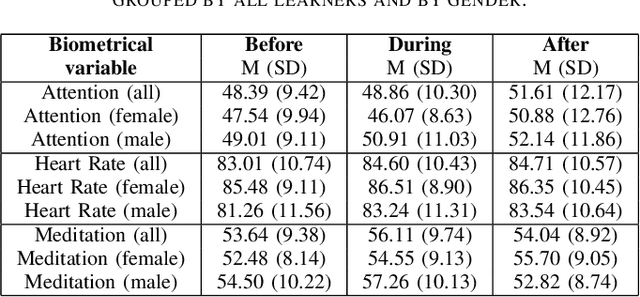
In this article, we explore computer vision approaches to detect abnormal head pose during e-learning sessions and we introduce a study on the effects of mobile phone usage during these sessions. We utilize behavioral data collected from 120 learners monitored while participating in a MOOC learning sessions. Our study focuses on the influence of phone-usage events on behavior and physiological responses, specifically attention, heart rate, and meditation, before, during, and after phone usage. Additionally, we propose an approach for estimating head pose events using images taken by the webcam during the MOOC learning sessions to detect phone-usage events. Our hypothesis suggests that head posture undergoes significant changes when learners interact with a mobile phone, contrasting with the typical behavior seen when learners face a computer during e-learning sessions. We propose an approach designed to detect deviations in head posture from the average observed during a learner's session, operating as a semi-supervised method. This system flags events indicating alterations in head posture for subsequent human review and selection of mobile phone usage occurrences with a sensitivity over 90%.